MCQ
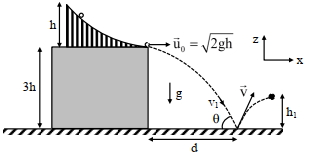
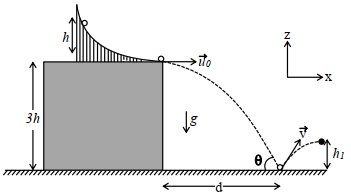
A slide with a frictionless curved surface, which becomes horizontal at its lower end,, is fixed on the terrace of a building of height $3 h$ from the ground, as shown in the figure. A spherical ball of mass $\mathrm{m}$ is released on the slide from rest at a height $h$ from the top of the terrace. The ball leaves the slide with a velocity $\vec{u}_0=u_0 \hat{x}$ and falls on the ground at a distance $d$ from the building making an angle $\theta$ with the horizontal. It bounces off with a velocity $\overrightarrow{\mathrm{v}}$ and reaches a maximum height $h_l$. The acceleration due to gravity is $g$ and the coefficient of restitution of the ground is $1 / \sqrt{3}$. Which of the following statement($s$) is(are) correct?

($AV$) $\vec{u}_0=\sqrt{2 g h} \hat{x}$ ($B$) $\vec{v}=\sqrt{2 g h}(\hat{x}-\hat{z})$  ($C$) $\theta=60^{\circ}$  ($D$) $d / h_1=2 \sqrt{3}$
  • $A,C,D$
  • B
    $A,C,B$
  • C
    $A,C$
  • D
    $A,D$

Answer

Correct option: A.
$A,C,D$
a
$\overrightarrow{\mathrm{v}}_1=\sqrt{2 g h} \hat{\mathrm{i}}-\sqrt{2 g 3 \mathrm{~h}} \hat{\mathrm{k}}$

$\overrightarrow{\mathrm{v}}=\sqrt{2 g h} \hat{\mathrm{i}}+\sqrt{2 g 3 \mathrm{~h}} \times \frac{1}{\sqrt{3}} \hat{\mathrm{k}}$

$=\sqrt{2 g h} \hat{\mathrm{i}}+\sqrt{2 g h} \hat{\mathrm{k}}$

$\tan \theta=\frac{\sqrt{2 g 3 \mathrm{~h}}}{\sqrt{2 g h}}=\sqrt{3} \quad \theta=60^{\circ}$

$\mathrm{h}_1=\frac{\mathrm{v}_{1 y}^2}{2 \mathrm{~g}}=\frac{2 g h}{2 \mathrm{~g}}=\mathrm{h}$

$\mathrm{d}=\mathrm{v}_x \mathrm{t}=\sqrt{2 g h} \times \sqrt{\frac{2 \times 3 \mathrm{~h}}{\mathrm{~g}}}$

$=\sqrt{2 g h} \sqrt{\frac{6 \mathrm{~h}}{\mathrm{~g}}}=2 \sqrt{3 \mathrm{~h}}$

$=\frac{\mathrm{d}}{\mathrm{h}_1}=2 \sqrt{3}$

Need a full question paper?

Generate a complete, print-ready paper with questions like this in minutes — across 16+ boards, with answer keys.

Start Generating Free

Similar questions

A light string passing over a smooth light pulley connects two blocks of masses ${m_1}$ and ${m_2}$ (vertically). If the acceleration of the system is $\left( {\frac{g}{8}} \right)$ then the ratio of the masses is
If it takes $5\,minutes$ to fill a $15\,litre$ bucket from a water tap of diameter $\frac{2}{{\sqrt \pi  }}cm$ then the Reynolds number for the flow is (density of water $= 10^3\,kg/m^3$ ) and viscosity of water $= 10^{-3}\,Pa.s$ ) close to
Two balls at same temperature collide. What is conserved
Given below are two statements:

Statement $I :$ In a diatomic molecule, the rotational energy at a given temperature obeys Maxwell's distribution.

Statement $II :$ In a diatomic molecule, the rotational energy at a given temperature equals the translational kinetic energy for each molecule.

In the light of the above statements, choose the correct answer from the options given below:

Which of the following graphs correctly represents the variation of $\beta = - (dV/dP)/V$ with $P$ for an ideal gas at constant temperature
A uniform sphere of weight $W$ and radius $5\, cm$ is being held by a string as shown in the figure. The tension in the string will be
Two equal masses $m$ and $m$ are hung from a balance whose scale pans differ in vertical height by $'h'$. The error in weighing in terms of density of the earth $\rho $ is
Equations $y = 2A \cos ^2 \omega \,t$ and $y = A (\sin \omega t + \cos \omega t )$ represent the motion of two particles.
Two liquids $A$ and $B$ are at $32°C$ and $24°C$. When mixed in equal masses the temperature of the mixture is found to be $28°C$. Their specific heats are in the ratio of
The density of a material is $CGS$ system of units is $4\,g/cm^3$. In a system of units in which unit of length is $10\,cm$ and unit of mass is $100\,g$, the value of density of material will be