d
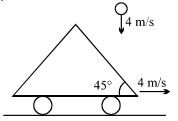
when the ball rebounds, it experiences the same amount of momentum in the opposite direction.
Hence,
change in momentum $=2 \times \rho$
Relative velocity ( ball),
$-v$ along $x-$ axis directed to the right
$-v$ along $y$ -axis directed up
After rebound,
$V$ along $x-$ axis directed to the left
$v$ along $y-$ axis directed down
Therefore,
velocity ( rebounded ball) $=\sqrt{(} 2 v)^{2}+v^{2}$
$v \sqrt{5}$
velocity ( rebounded ball ) $=4 \sqrt{5} \mathrm{m} / \mathrm{s}$
Hence, the velocity of the rebounded ball is $4 \sqrt{5} \mathrm{m} / \mathrm{s}$