Question
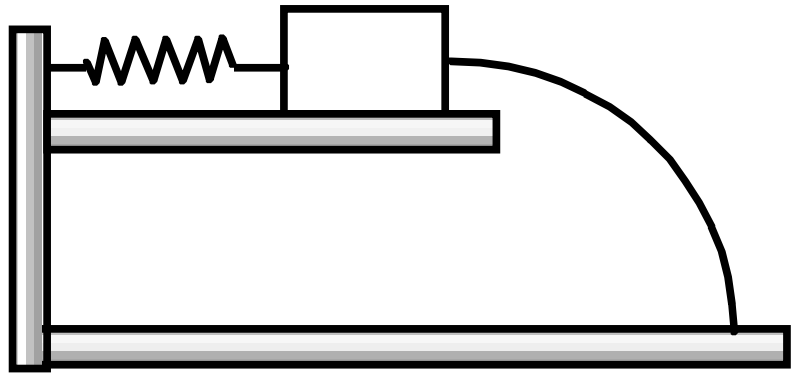
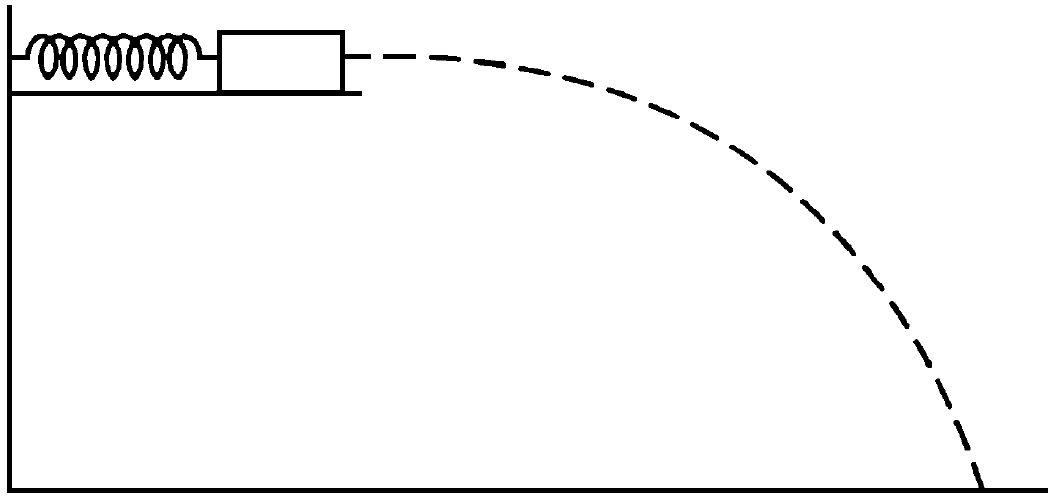
A small block of mass 100g is pressed against a horizontal spring fixed at one end to compress the spring through 5.0cm (figure). The spring constant is 100N/m. When released, the block moves horizontally till it leaves the spring. Where will it hit the ground 2m below the spring?

Answer


m = 100g = 0.1kg, x = 5cm = 0.05m, k = 100N/m

When the body leaves the spring, let the velocity be v,

$\frac{1}{2}\text{mv}^2=\frac{1}{2}\text{k}\text{x}^2$

$\Rightarrow\text{v}=\text{x}\sqrt{\frac{\text{k}}{\text{m}}}$

$\Rightarrow0.05\times\sqrt{\frac{100}{0.1}}=1.58\text{m}/\text{sec}$

For the projectile motion, $\theta=0^\circ,\text{Y}=-2$

Now, $\text{Y}=(\text{u}\sin\theta)\text{t}-\frac{1}{2}\text{gt}^2$

$\Rightarrow-2=\Big(\frac{-1}{2}\Big)\times9.8\times\text{t}^2$

$\Rightarrow\text{t}=0.63\text{sec}$

So, $\text{x}=(\text{u}\cos\theta)\text{t}$

$\Rightarrow1.58\times0.63=1\text{m}$
Need a full question paper?

Generate a complete, print-ready paper with questions like this in minutes — across 16+ boards, with answer keys.

Start Generating Free

Similar questions

The half-life of $^{14}_6\text{C}$ is 5700 years. What does it mean? Two radioactive nuclei X and Y initially contain an equal number of atoms. Their half-lives are 1 hour and 2 hours respectively. Calculate the ratio of their rates of disintegration after two hours.
Is the colour of 620nm light and 780nm light same? Is the colour of 620nm light and 621nm light same? How many colours are there in white light?
In accordance with the Bohr's model, find the quantum that characterises the earth's revolution around the sun in an orbit of radius $1.5 \times 10^{11} m$ with orbital speed $3 \times 10^4 m / s$. (Mass of earth $=6.0 \times 10^{24} kg$. )
  1. Draw a plot showing the variation of photoelectric current with collector potential for different frequencies but same intensity of incident radiation.
  2. Use Einstein’s photoelectric equation to explain the observations from this graph.
  3. What change will you observe if intensity of incident radiation is changed but the frequency remains the same?
Write a short note on $n$-type semi-conductors.
Write the two processes that take place in the formation of a p-n junction. Explain with the help of a diagram, the formation of depletion region and barrier potential in a p-n junction.
Figures 2.8 (a) and (b) show the field lines of a positive and negative point charge respectively.
Image
(a) Give the signs of the potential difference $V_{ P }-V_{ Q } ; V_{ B }-V_{ A }$.
(b) Give the sign of the potential energy difference of a small negative charge between the points $O$ and $P ; A$ and $B$.
(c) Give the sign of the work done by the field in moving a small positive charge from $Q$ to $P$.
(d) Give the sign of the work done by the external agency in moving a small negative charge from $B$ to $A$.
(e) Does the kinetic energy of a small negative charge increase or decrease in going from $B$ to $A$ ?
A circular coil of wire consisting of 100 turns, each of radius 8.0 cm carries a current of 0.40 A. What is the magnitude of the magnetic field B at the centre of the coil?
Determine the current drawn from a 12 V supply with internal resistance $0.5\ \Omega$ by the infinite network shown in Fig. Each resistor has $1\ \Omega$ resistance.

The speed of light in glass is 2.0 × 101m/s. Does it violate the second postulate of special relativity?