Question
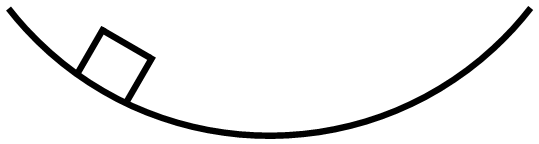
A small block oscillates back and forth on a smooth concave surface of radius R figure. Find the time period of small oscillation.
Answer

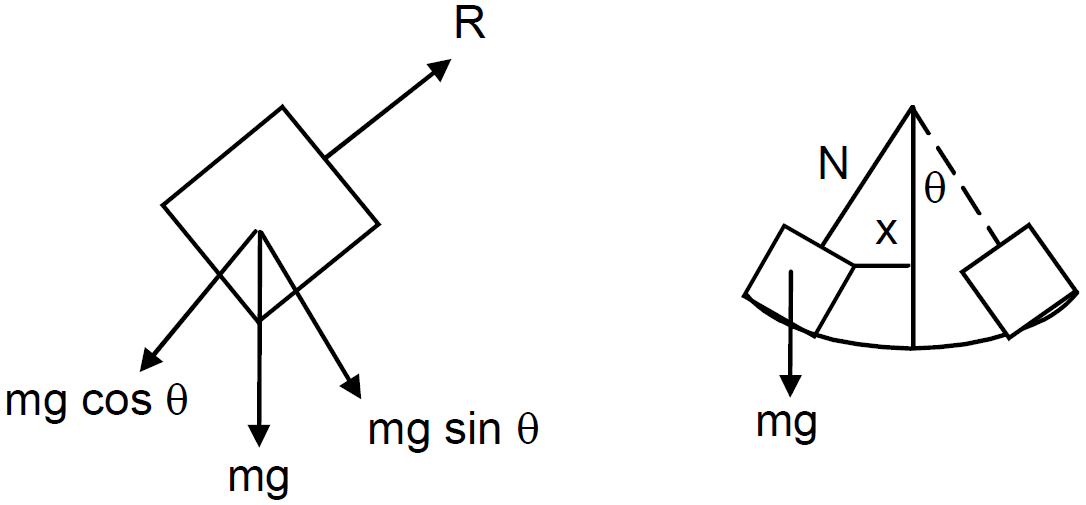
Given that, R = radius.

Let N = normal reaction.

Driving force $\text{F}=\text{mg}\sin\theta.$

Acceleration $=\text{a}=\text{g}\sin\theta$

As, $\sin\theta$ is very small, $\sin\theta\rightarrow\theta$

$\therefore$ Acceleration $\text{a}=\text{g}\theta$

Let ‘x’ be the displacement from the mean position of the body,

$\therefore\theta=\frac{\text{x}}{\text{R}}$

$\Rightarrow\text{a}=\text{g}\theta=\text{g}\Big(\frac{\text{x}}{\text{R}}\Big)\Rightarrow\Big(\frac{\text{a}}{\text{x}}\Big)=\Big(\frac{\text{g}}{\text{R}}\Big)$

So the body makes S.H.M.

$\therefore\text{T}=2\pi\sqrt{\frac{\text{Displacement}}{\text{Acceleration}}}=2\pi\sqrt{\frac{\text{x}}{\frac{\text{gx}}{\text{R}}}}=2\pi\sqrt{\frac{\text{R}}{\text{g}}}$
Need a full question paper?

Generate a complete, print-ready paper with questions like this in minutes — across 16+ boards, with answer keys.

Start Generating Free

Similar questions

A thin lens made of a material of refractive index $\mu_2$ has a medium of refractive index $\mu_1$ on one side and a medium of refractive index $\mu_3$ on the other side. The lens is biconvex and the two radii of curvature have equal magnitude R. A beam of light travelling parallel to the principal axis is incident on the lens. Where will the image be formed if the beam is incident from:
  1. The medium $\mu_1$
  2. From the medium $\mu_3?$
Use the formula $\text{v}=\sqrt{\frac{\gamma\text{P}}{\rho}}$ to explain why the speed of sound in air:
Increases with humidity.
A person normally weighing 50kg stands on a massless platform which oscillates up and down harmonically at a frequency of 2.0s–1 and an amplitude 5.0cm. A weighing machine on the platform gives the persons weight against time.
  1. Will there be any change in weight of the body, during the oscillation?
  2. If answer to part (a) is yes, what will be the maximum and minimum reading in the machine and at which position?
A gun kept on a straight horizontal road is used to hit a car travelling along the same road away from the gun with a uniform speed of 72km/ h. The car is at a distance of 500m from the gun when the gun is fired at an angle of 45° to the horizontal. Find,
  1. The distance of the car from the gun when the shell hits it.
  2. The speed of projection of the shell from the gun.
Given below are densities of some solids and liquids. Give rough estimates of the size of their atoms:
Substance
Atomic Mass(u)
Density (103kgm-3)
Carbon (diamond)
Gold
Nitrogen (liquid)
Lithium
Fluorine (liquid)
12.01
197.00
14.01
6.94
19.00
2.22
19.32
1.00
0.53
1.14
$\big[$Hint: Assume the atoms to be ‘tightly packed’ in a solid or liquid phase, and use the known value of Avogadro’s number. You should, however, not take the actual numbers you obtain for various atomic sizes too literally. Because of the crudeness of the tight packing approximation, the results only indicate that atomic sizes are in the range of a few $\mathring{\text{A}}\big].$
A block of mass 1kg is pushed up a surface inclined to horizontal at an angle of 30º by a force of 10N parallel to the inclined surface. The coefficient of friction between block and the incline is 0.1. If the block is pushed up by 10m along the incline, calulate.

  1. Work done against gravity.
  2. Work done against force of friction.
  3. Increase in potential energy.
  4. Increase in kinetic energy.
  5. Work done by applied force.
A train, standing at the outer signal of a railway station blows a whistle of frequency 400Hz in still air.
  1. What is the frequency of the whistle for a platform observer when the train (a) approaches the platform with a speed of 10m s–1, (b) recedes from the platform with a speed of 10m s–1?
  2. What is the speed of sound in each case? The speed of sound in still air can be taken as 340m s–1.
A constant current exists in an inductor-coil connected to a battery. The coil is short-circuited and the battery is removed. Show that the charge flown through the coil after the short-circuiting is the same as that which flows in one time constant before the short-circuiting.
Given the example of the motion in the following cases:
  1. Where magnitude and direction of the acceleration of the particle changes.
  2. Where the magnitude and direction of acceleration of body remains constant.
  3. Where magnitude of acceleration changes but its direction remains constants.
  4. Where the magnitude of acceleration remains constant but its direction changes.
Io, one of the satellites of Jupiter, has an orbital period of 1.769 days and the radius of the orbit is $4.22 \times 10^8 m$. Show that the mass of Jupiter is about one-thousandth that of the sun.