MCQ
A small object of uniform density rolls up a curved surface with an initial velocity v'. If reaches up to a maximum height of $\frac{3 v^2}{4 g}$ with respect to the initial position. The object is
  • A
    solid sphere
  • B
    ring
  • C
    disc
  • D
    hollow sphere

Answer

(c) disc
Explanation: Loss in (translational K.E. + rotational K.E.) = Gain in P.E.
$
\begin{aligned}
& \frac{1}{2} m v^2+\frac{1}{2} T \omega^2=m g h_{\max } \\
& \frac{1}{2} m v^2+\frac{1}{2} I\left(\frac{v}{R}\right)^2=m g \times \frac{3 v^2}{4 g}=\frac{3}{4} m v^2 \\
& \Rightarrow I=\frac{1}{2} m R^2
\end{aligned}
$

Need a full question paper?

Generate a complete, print-ready paper with questions like this in minutes — across 16+ boards, with answer keys.
Start Generating Free

Similar questions

A body is executing Simple Harmonic Motion. At a displacement $x$ its potential energy is ${E_1}$ and at a displacement y its potential energy is ${E_2}$. The potential energy $E$ at displacement $(x + y)$ is
A particle is moving in a circular path. The acceleration and momentum vectors at an instant of time are $\vec{a}=2 \hat{i}+3 \hat{j} m / s ^2$ and $\overrightarrow{ p }=6 \hat{ i } + 4 \hat{ j } kgm /$ $s$. Then the motion of the particle is
A particle is whirled in a vertical circle of radius $1.0\  m$ using a string with one end fixed. If the ratio of maximum and minimum tension in the string is $\frac{5}{3}$, the minimum velocity of the particle during circular motion is    ......... $ms^{-1}$
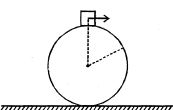
An object is at the top of a smooth sphere which is kept fixed. As object slides down  after being given a negligible side push, magnitude of acceleration of object during its motion till it reaches ground
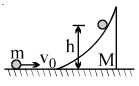
A particle of mass $m$ moving horizontally with $v_0$ strikes $a$ smooth wedge of mass $M$, as shown in figure. After collision, the ball starts moving up the inclined face of the wedge and rises to $a$ height $h$. The maximum height h attained by the particle is 
In some region, the gravitational field is zero. The gravitational potential in this region
The first law of thermodynamics is concerned with the conservation of
Equations ${y_1} = A\sin \omega t$ and ${y_2} = \frac{A}{2}\sin \omega t + \frac{A}{2}\cos \omega t$ represent $S.H.M.$ The ratio of the amplitudes of the two motions is
A body of mass $5 \times 10^{3} \,kg$ moving with speed $2\, m / s$ collides with a body of mass $15 \times 10^{3} \,kg$ in elastically and sticks to it. Then loss in $K. E.$ of the system will be (in $KJ$)
A satellite moves around the earth in a circular orbit of radius $r$ with speed $v$. If the mass of the satellite is $M$, its total energy is