MCQ
A small particle moves to position $5 \hat{i}-2 \hat{j}+\hat{k}$ from its initial position $2 \hat{i}+3 \hat{j}-4 \hat{k}$ under the action of force $5 \hat{i}+2 \hat{j}+7 \hat{k} N$. The value of work done will be $............J$.
  • A
    $38$
  • $40$
  • C
    $39$
  • D
    $41$

Answer

Correct option: B.
$40$
b
$W=\vec{F} \cdot\left(\vec{r}_f-\vec{r}_{ i }\right)$

$=(5 \hat{i}+2 \hat{j}+7 \hat{k}) \cdot((5 \hat{i}-2 \hat{j}+\hat{k})-(2 \hat{i}+3 \hat{j}-4 \hat{k}))$

$W=40\,J$

Need a full question paper?

Generate a complete, print-ready paper with questions like this in minutes — across 16+ boards, with answer keys.

Start Generating Free

Similar questions

Two particles of equal mass go around a circle of radius R under the action of their mutual gravitational attraction. The speed v of each particle is:
The displacement of a body is given to be proportional to the cube of time elapsed. The magnitude of the acceleration of the body is
A tuning fork vibrating with a sonometer having $20\,cm$ wire produces $5$ beats per sec. The beat frequency does not change if the length of the wire is changed to $21\,cm$. The frequency of the tuning fork must be ..... $Hz$
A man of weight $80\, kg$ is standing in an elevator which is moving with an acceleration of $6\,\,m/{s^2}$ in upward direction. The apparent weight of the man will be  ......... $N$ $(g = 10\,m/{s^2})$
In figure, two blocks $M$ and $m$ are tied together with an inextensible and light string. The mass $M$ is placed on a rough horizontal surface with coefficient of friction $\mu$ and the mass $m$ is hanging vertically against a smooth vertical wall. The pulley is frictionless. When the downward acceleration of the elevator becomes equal to $g$, then
The temperature to which a gas must be cooled before it can't be liquefied by pressure alone is called its:
A cart is moving with a velocity $20\,m/s$. Sand is being dropped into the cart at the rate of $50\, kg/min$. The force required to move the cart with constant velocity will be ............ $N$
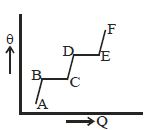
A solid cube having certain fixed melting and boiling points takes heat from some source.The variation  of temperature $\theta$ of the cube with the heat supplied $Q$ is shown in the adjoining graph. The portion $BC$ of the graph represents the conversion of
The conversion of $1 \;MW$ power in a new system having basic unit of mass, length and time as $10 \;kg , 1 \;dm$ and $1 \;minute$ respectively is:
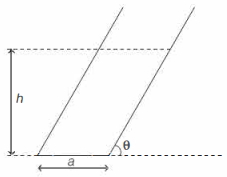
A hollow tilted cylindrical vessel of negligible mass rests on a horizontal plane as shown. The diameter of the base is $a$ and the side of the cylinder makes an angle $\theta$ with the horizontal.Water is then slowly poured into the cylinder. The cylinder topples over when the water reaches a certain height $h$, given by