MCQ
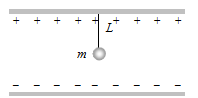
A small sphere carrying a charge $'q\ '$ is hanging in between two parallel plates by a string of length $L$. Time period of pendulum is $T_0$. When parallel plates are charged, the time period changes to $T$. The ratio $T / T_0$ is equal to
  • A
    $\left(\frac{g+\frac{q E}{m}}{g}\right)$
  • B
    $\left(\frac{g}{g+\frac{q E}{m}}\right)$
  • $\left(\frac{g}{g+\frac{q E}{m}}\right)$
  • D
    None of these

Answer

Correct option: C.
$\left(\frac{g}{g+\frac{q E}{m}}\right)$

Need a full question paper?

Generate a complete, print-ready paper with questions like this in minutes — across 16+ boards, with answer keys.

Start Generating Free

Similar questions

The only property possessed by ferromagnetic substance is(a) Hysteresis(b) Susceptibility(c) Directional property(d) Attracting magnetic substances
   
   
Two coherent monochromatic light beams of intensities I  and 4I are superposed. The maximum and minimum possible intensities in the resulting beam are(a) 5I and I(b) 5I and 3I(c) 9I and I(d) 9I and 3I
       
A bar magnet has a magnetic moment equal to $5 \times 10^{-5}\ \ce{weber \times m}$. It is suspended in a magnetic field which has a magnetic induction $(B)$ equal to $8 \pi \times 10^{-4}$ tesla. The magnet vibrates with a period of vibration equal to $15\sec.$ The moment of inertia of the magnet is
A coil develops heat of 800 cal/sec. When 20 volts is applied across its ends. The resistance of the coil is (1 cal = 4.2 joule)(a) 1.2 Ω(b) 1.4 Ω(c) 0.12 Ω(d) 0.14 Ω
       
An $X-$ray machine has an accelerating potential difference of $25,000$ volts. By calculation the shortest wavelength will be obtained as  $\left(\mathrm{h}=6.63 \times 10^{-34} \mathrm{~J}-\mathrm{sec} ; \mathrm{e}=1.6 \times 10^{-19}\right.$ coulomb $)$
Three point charges are placed at the corners of an equilateral triangle. Assuming only electrostatic forces are acting(a) The system can never be in equilibrium(b) The system will be in equilibrium if the charges rotate about the centre of the triangle(c) The system will be in equilibrium if the charges have different magnitudes and different signs(d) The system will be in equilibrium if the charges have the same magnitudes but different signs


For which of the following particles will it be most difficult to experimentally verify the de-Broglie relationship?
Which of the following is not the disadvantage of wire wound resistor?
If $\delta$ is the angle of dip at a place, then expression for $\tan \delta$ is :
An inductor has a resistance R and inductance L. It is connected to an AC source of emf Ev​ and angular frequency ω; then the current Iv​ in the circuit is: