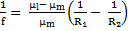
Question

A soap bubble is given a negative charge, then its radius

(a) Decreases

(b) Increases

(c) Remains unchanged

(d) Nothing can be predicted as information is insufficient

Answer

(b) Increases

Need a full question paper?

Generate a complete, print-ready paper with questions like this in minutes — across 16+ boards, with answer keys.

Start Generating Free

Similar questions

In  solution when electric current equal to 2.5 faraday is passed, the gm equivalent deposited on the cathode is

(a) 1

(b) 1.5

(c) 2  

(d) 2.5

Assertion  :  A double convex lens (m = 1.5) has focal length 10 cm. When the lens is immersed in water (m = 4/3) its focal length becomes 40 cm.

Reason      :  

(a) If both assertion and reason are true and the reason is the correct explanation of the assertion.

(b) If both assertion and reason are true but reason is not the correct explanation of the assertion.

(c) If assertion is true but reason is false.

(d) If the assertion and reason both are false.

Light of wavelength $\lambda$ falls on a metal having work function $\frac{\text{h}_\text{c}}{\lambda_0}.$ Photoelectric effect will take place only if:

  1. $\lambda\geq\lambda_0$

  2. $\lambda\geq2\lambda_0$

  3. $\lambda\leq\lambda_0$

  4. $\lambda<\frac{\lambda_ 0}{2}.$

Assertion  : In high latitude one sees colourful curtains of light hanging down from high altitudes.

Reason      :  The high energy charged particles from the sun are deflected to polar regions by the magnetic field of the earth.

(a) If both assertion and reason are true and the reason is the correct explanation of the assertion.

(b) If both assertion and reason are true but reason is not the correct explanation of the assertion.

(c) If assertion is true but reason is false.

(d) If the assertion and reason both are false.

What is the time taken (in seconds) to cross a glass of thickness 4 mm and μ = 3 by light

(a) 4  

(b) 2  

(c) 16  

(d) 8  

A semiconductor is doped with a donor impurity:
In the field of electromagnetism, the term 'EMI' stands for:
In the diagram, three point charges (labeled 1, 2 and 3) are shown, along with the electric field around them. Which charge(s) is/ are positive?
Two equal masses are attached to the two ends of a spring of spring constant k. The masses are pulled out symmetrically to stretch the spring by a length x over its natural length. The work done by the spring on each mass is:

  1. $\frac{1}{2}\text{kx}^2$

  2. $-\frac{1}{2}\text{kx}^2$

  3. $\frac{1}{4}\text{kx}^2$

  4. $-\frac{1}{4}\text{kx}^2$

Copper has face centered cubic (fcc) lattice with interatomic spacing equal to 2.54Å. The value of the lattice constant for this lattice is

(a) 1.27 Å

(b) 5.08 Å

(c) 2.54 Å   

(d) 3.59 Å