Question
A soft drink is available in two packs:
  1. A tin can with a rectangular base of length $5\ cm,$ breadth $4\ cm$ and height $15\ cm.$
  2. A plastic cylinder with circular base of diameter $7\ cm$ and height $10\ cm.$
Which container has greater capacity and by how much?

Answer

  1. For a tin of rectangular base,
Length $= 5\ cm$
Breadth $= 4\ cm$
Height $= 15\ cm$
$\therefore$ Volume of a tin can $=$ Length $\times$ Breadth $\times$ Height
$= (5 \times 4 \times 15)cm^3$
$= 300\ cm^3$
  1. For a cylinder with circular base,
Diameter $= 7$
$\Rightarrow$ Radius $=\text{r}=\frac{7}{2}\text{ cm}$
Height$ = h = 10\ cm$
$\therefore$ Volume of cylinder $=\pi\text{r}^2\text{h}$
$=\Big(\frac{22}{7}\times\frac{7}{2}\times\frac{7}{2}\times10\Big)\text{ cm}^3$
$=385\text{ cm}^3$
$\Rightarrow$ Volume of plastic cylinder is greater than volume of a tin can.
Difference in volume $= (385 - 300) = 85\ cm^3$
Thus, a plastic cylinder has more capacity that a tin can by $85\ cm^3.$

Need a full question paper?

Generate a complete, print-ready paper with questions like this in minutes — across 16+ boards, with answer keys.

Start Generating Free

Similar questions

Draw the graphs of linear equations y = x and y = -x on the same Cartesian plane.
What do you observe?
ABCD is a rectangle in which diagonal AC bisects $\angle\text{A}$ as well as $\angle\text{C}.$ Show that:
  1. ABCD is a square
  2. diagonal BD bisects $\angle\text{B}$ as well as $\angle\text{D}.$​​​​​​​
In a $\triangle\text{ABC},\angle\text{ABC}=\angle\text{ACB}$ and the bisectors of $\angle\text{ABC}$ and $\angle\text{ACB}$ intersect at O such that $\angle\text{BOC}=120^\circ.$ Show that $\angle\text{A}=\angle\text{B}=\angle\text{C}=60^\circ.$
A transversal intersects two parallel lines. Prove that the bisectors of any pair of corresponding angles so formed are parallel.
The radius of the base and the height of a cylinder are in the ratio $2 : 3.$ If its volume is $1617\ cm^3,$ find the total surface area of the cylinder.
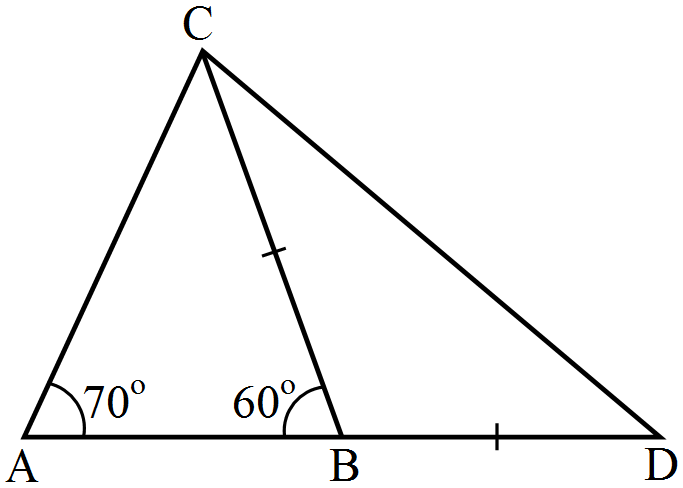
In $\triangle\text{ABC,}$ side AB is produced to D such that BD = BC. If $\angle\text{B}=60^{\circ},$ and $\angle\text{B}=60^{\circ},$ prove that:
  1. AD > CD and
  2. AD > AC.
Two parallel lines l and m are intersected by a transversal t. Show that the quadrilateral formed by the bisectors of interior angles is a rectangle.
If $\text{x}^4+\frac{1}{\text{x}^4}=119,$ find the valu of $\text{x}^3-\frac{1}{\text{x}^3}.$
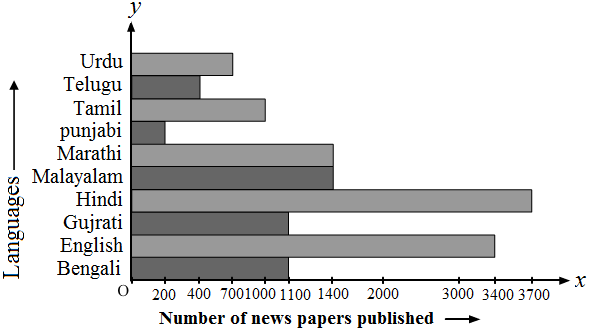
The bar graph shown in figure represents the circulation of newspapers in $10$ languages.
Study the bar graph and answer the following questions:
  1. What is the total number of newspapers published in Hindi, English, Urdu, Punjabi, and Bengali?
  2. What percent is the number of newspapers published in Hindi of the total number of newspapers?
  3. Find the excess of the number of newspapers published in English over those published in Urdu.
  4. Name two pairs of languages which publish the same number of newspapers.
  5. State the language in which the smallest number of newspapers are published.
  6. State the language in which the largest number of newspapers are published.
  7. State the language in which the number of newspapers published is between $2500$ and $3500.$
  8. State whether true or false:
  1. The number of newspapers published in Malayalam and Marathi together is less than those published in English.
  2. The number of newspapers published in Telugu is more than those published in Tamil.
Construct a histogram for the following frequency distribution:
Class interval
5-12 
13-20
21-28
29-36
37-44
45-52
Frequency
6
15
24
18
4
9