Question
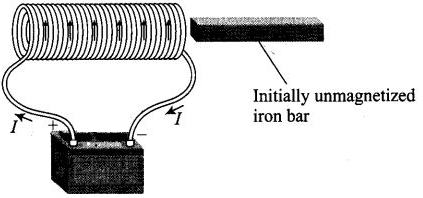
A solenoid is connected to a battery so that a steady current flows through it. If an iron core is inserted into the solenoid, will the current increase or decrease? Explain.
Answer

This problem is based on Lenz’s law and according to this law, the direction of induced emf or current in a circuit is such as to oppose the cause that produces it.

When the iron core is inserted in the current carrying solenoid, the magnetic field increases due to the magnetisation of iron core and hence the flux increases.
So, the emf induced in the coil must oppose this increase in flux, so the current induced in the coil in such a direction that it will oppose the increasing magnetic field which can be done by making decrease in current. So, the current will decrease.

Need a full question paper?

Generate a complete, print-ready paper with questions like this in minutes — across 16+ boards, with answer keys.
Start Generating Free

Similar questions

A proton goes undeflected in a crossed electric and magnetic field (the fields are perpendicular to each other) at a speed of $2.0 \times 10^5ms^{-1}.$ The velocity is perpendicular to both the fields. When the electric field is switched off, the proton moves along a circle of radius 4.0cm. Find the magnitudes of the electric and magnetic fields. Take the mass of the proton $= 1.6 \times 10^{-27}kg$
An electric kettle used to prepare tea, takes 2 minutes to boil 4 cups of water (1 cup contains 200cc of water) if the room temperature is 25C.
  1. If the cost of power consumption is Rs. 1.00 per unit (1 unit - 1000 watt-hour), calculate the cost of boiling 4 cups of water.
  2. What will be the corresponding cost if the room temperature drops to 5°C?
A compound microscope consists of an objective lens of focal length 2.0 cm and an eyepiece of focal length 6.25 cm separated by a distance of 15 cm. How far from the objective should an object be placed in order to obtain the final image at (a) the least distance of distinct vision (25 cm), and (b) at infinity? What is the magnifying power of the microscope in each case?
A ball is thrown horizontally from a point 100m above the ground with a speed of 20m/s. Find:
  1. The time it takes to reach the ground.
  2. The horizontal distance it travels before reaching the ground.
  3. The velocity (direction and magnitude) with which it strikes the ground.
  1. Deduce an expression for the frequency of revolution of a charged particle in a magnetic field and show that it is independent of velocity or energy of the particle.
  2. Draw a schematic sketch of a cyclotron. Explain, giving the essential details of its construction, how it is used to accelerate the charged particles.
Two masses $m_1$ and $m_2$ are connected by a spring of spring constant k and are placed on a frictionless horizontal surface. Initially the spring is stretched through a distance $x_0$ when the system is released from rest. Find the distance moved by the two masses before they again come to rest.
(I) (a) Write two limitations of ohm’s law. Plot their I-V characteristics.
(b) A heating element connected across a battery of 100 V having an internal resistance of $1 \Omega$ draws an initial current of 10 A at room temperature 20.0 °C which settles after a few seconds to a steady value. What is the power consumed by battery itself after the steady temperature of 320.0 °C is attained? Temperature coefficient of resistance averaged over the temperature range involved is $3.70 \times 10^{-4}{ }^{\circ} C ^{-1}$.
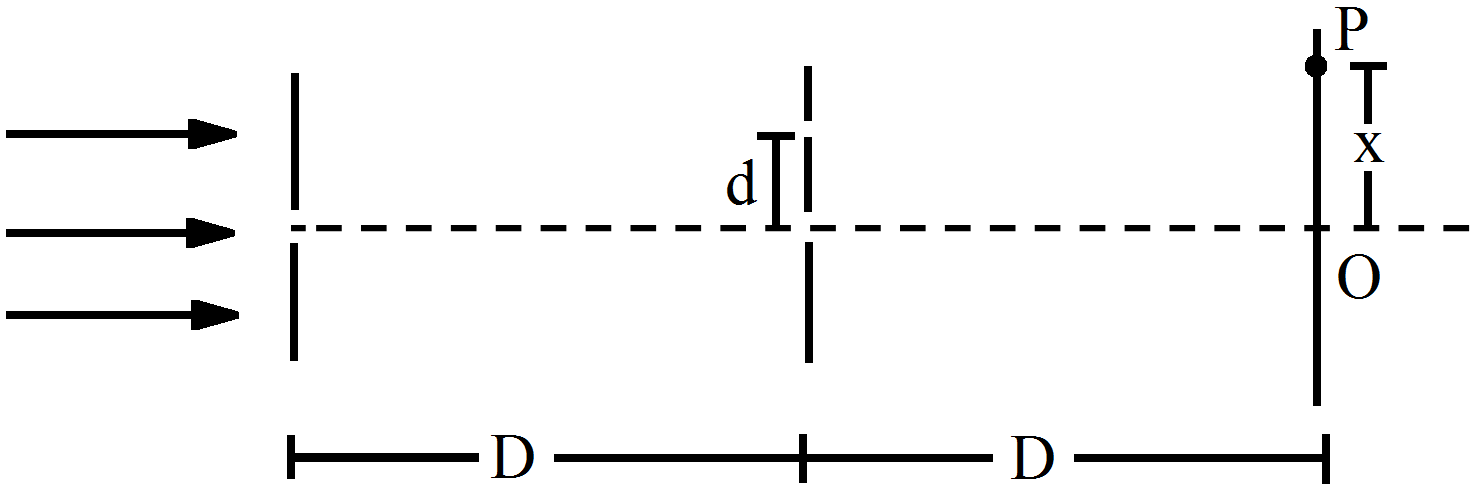
Consider the arrangement shown in figure (17-E4). The distance D is large compared to the separation d between the slits.
  1. Find the minimum value of d so that there is a dark fringe at 0.
  2. Suppose d has this value. Find the distance x at which the next bright fringe is formed.
  3. Find the fringe-width.
A beam of white light is incident normally on a plane surface absorbing 70% of the light and reflecting the rest. If the incident beam carries 10W of power, find the force exerted by it on the surface.
Consider the situation of the previous problem. Suppose the block of mass $m_1$ is pulled by a constant force $F_1$ and the other block is pulled by a constant force $F_2$. Find the maximum elongation that the spring will suffer.