MCQ
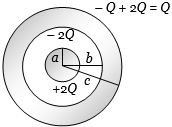
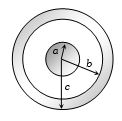
A solid conducting sphere of radius $a$ has a net positive charge $2Q$. A conducting spherical shell of inner radius $b$ and outer radius $c$ is concentric with the solid sphere and has a net charge $-Q$. The surface charge density on the inner and outer surfaces of the spherical shell will be
  • $ - \frac{{2Q}}{{4\pi {b^2}}},\frac{Q}{{4\pi {c^2}}}$
  • B
    $ - \frac{Q}{{4\pi {b^2}}},\frac{Q}{{4\pi {c^2}}}$
  • C
    $0,\frac{Q}{{4\pi {c^2}}}$
  • D
    None of the above

Answer

Correct option: A.
$ - \frac{{2Q}}{{4\pi {b^2}}},\frac{Q}{{4\pi {c^2}}}$
a
(a) Surface charge density ($\sigma$) $ = \frac{{{\rm{Charge}}}}{{{\rm{Surface area}}}}$
So ${\sigma _{inner}} = \frac{{ - 2Q}}{{\,4\pi {b^2}}}$ and ${\sigma _{Outer}} = \frac{Q}{{\,4\pi {c^2}}}$

Need a full question paper?

Generate a complete, print-ready paper with questions like this in minutes — across 16+ boards, with answer keys.

Start Generating Free

Similar questions

A photosensitive substance emits $........$ when illuminated by light:
What is the equivalent resistance of the circuit
The given figure represents a material which is
An electron moves along the line AB, which lies in the same plane as a circular loop of conducting wires as shown in the diagram. What will be the direction of current induced if any, in the loop

In a Young's double slit experiment $15$ fringes are observed on a small portion of the screen when light of wavelength $500 \;\mathrm{nm}$ is used. Ten fringes are observed on the same section of the screen when another light source of wavelength $\lambda$ is used. Then the value of $\lambda$ is (in $\mathrm{nm})$
A non.monochromatic light is used in an experiment on photoelectric effect. The stopping potential:
The stopping potential for photoelectrons emitted from a surface illuminated by light of wavelength $6630 \; \mathring A$ is $0.42 \; V$. If the threshold frequency is $x \times$ $10^{13}  / s$, where $x$ is$\dots$ (nearest integer).

(Given, speed light $=3 \times 10^{8} \; m / s$, Planck's constant $=6.63 \times 10^{-34} \; Js$ )

The line of force in a magnetic field represents the direction at each point that a magnetic needle placed at the point takes up. Do they also represent the direction of the force on a moving charge at each point?
The graph between the de Broglie wavelength and the momentum of a photon is a:
For the circuit shown in the Figure, the current through the inductor is $0.9$ A while the current through the condenser is $0.4 A.$
Image