Question

A solid conducting sphere of radius R1 is surrounded by another concentric hollow conducting sphere of radius R2. The capacitance of this assembly is proportional to

(a)  

(b)

(c)

(d)

Answer

(d)

Need a full question paper?

Generate a complete, print-ready paper with questions like this in minutes — across 16+ boards, with answer keys.

Start Generating Free

Similar questions

According to the Rutherford’s atomic model, the electrons inside the atom are

(a) Stationary

(b) Not stationary

(c) Centralized

(d) None of these

As the intensity of incident light increases

(a) Photoelectric current increases

(b) Photoelectric current decreases

(c) Kinetic energy of emitted photoelectrons increases

(d) Kinetic energy of emitted photoelectrons decreases

The Rutherford α-particle experiment shows that most of the α-particles pass through almost unscattered while some are scattered through large angles. What information does it give about the structure of the atom?

If a long hollow copper pipe carries a direct current, the magnetic field associated with the current will be

(a) Only inside the pipe

(b) Only outside the pipe

(c) Neither inside nor outside the pipe

(d) Both inside and outside the pipe

Two voltameters, one of copper and another of silver, are joined in parallel. When a total charge q flows through the voltameters, equal amount of metals are deposited. If the electrochemical equivalents of copper and silver are   and  respectively the charge which flows through the silver voltameter is

(a)   

(b)

(c)    

(d)

A dry cell has an e.m.f. of 1.5 V and an internal resistance of 0.05Ω. The maximum current obtainable from this cell for a very short time interval is

(a) 30 A

(b) 300 A

(c) 3 A

(d) 0.3 A

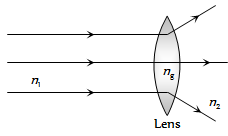
The ray diagram could be correct

(a) If  

(b) If   and  

(c) If   and  

(d) Under no circumstances

A 4 mF condenser is charged to 400 V and then its plates are joined through a resistance. The heat produced in the resistance is

(a) 0.16 J                                            

(b) 0.32 J

(c) 0.64 J

(d) 1.28 J

Magnetic field does not cause deflection in:

Assertion  :   Self-inductance is called the inertia of electricity.

Reason      : Self-inductance is the phenomenon, according to which an opposing induced e.m.f. is produced in a coil as a result of change in current or magnetic flux linked in the coil.

(a) If both assertion and reason are true and the reason is the correct explanation of the assertion.

(b) If both assertion and reason are true but reason is not the correct explanation of the assertion.

(c) If assertion is true but reason is false.

(d) If the assertion and reason both are false.