Question
A solid consisting of a right cone standing on a hemisphere is placed upright in a right circular cylinder full of water and touches the bottom. Find the volume of water left in the cylinder, if the radius of the cylinder is $60 \ cm$ and its height is $180 \ cm,$ the radius of the hemisphere is $60 \ cm$ and height of the cone is $120 \ cm,$ assuming that the hemisphere and the cone have common base.
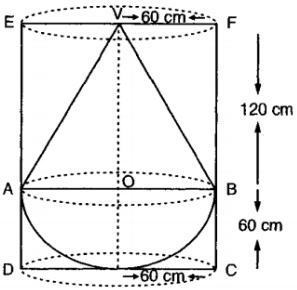
Answer

We have radius of cylinder $=$ radius of cone $=$ radius of hemisphere $= 60 \ cm$
Height of cone $= 120 \ cm$
$\therefore$ Height of cylindrical vessel $=120+60=180 \ cm$
$\therefore V =$ Volume of water that the cylinder contains $=\pi r^2 h=\left\{\pi \times(60)^2 \times 180\right\} \ cm ^3$
Let $V_1$ be the volume of the conical part. Then,
Image
$V_1=\frac{1}{3} \pi r^2 h_1$
$\Rightarrow V_1=\frac{1}{3} \times \pi \times 60^2 \times 120 \ cm^3=\left\{\pi \times 60^2 \times 40\right\} \ cm ^3$
For hemispherical part $r =$ Radius $= 60 \ cm$
Let $V_2$ be the volume of the hemisphere.
Then, $V_2=\left\{\frac{2}{3} \pi \times 60^3\right\} \ cm ^3$
$\Rightarrow V_2=\left\{2 \pi \times 20 \times 60^2\right\} \ cm ^3=\left\{40 \pi \cdot 60^2\right\} \ cm ^3$
Let $V_3$ the the volume of the water left$-$out in the cylinder. Then,
$V_3=V-V_1-V_2$
$V_3=\left\{\pi \times 60^2 \times 180-\pi \times 60^2 \times 40-40 \pi \times 60^2\right\} \ cm ^3$
$V_3=\pi \times 60^2 \times\{180-40-40\} \ cm ^3$
$V_3=\frac{22}{7} \times 3600 \times 100 \ cm^3$
$\Rightarrow V_3=\frac{22 \times 360000}{7} \ cm^3$
$=\frac{22 \times 360000}{7 \times(100)^3} m^3$
$=\frac{22 \times 36}{700} m^3$
$=1.1314 m^3$

Need a full question paper?

Generate a complete, print-ready paper with questions like this in minutes — across 16+ boards, with answer keys.

Start Generating Free

Similar questions

Solve the following system of equations by the method of cross-multiplication:$\frac{57}{\text{x}+\text{y}}+\frac{6}{\text{x}-\text{y}}=5,$
$\frac{38}{\text{x}+\text{y}}+\frac{21}{\text{x}-\text{y}}=9.$
A solid is in the shape of a cone surmounted on a hemisphere with both their diameters being equal to $7 \ cm$ and the height of the cone is equal to its radius. Find the volume of the solid.
A well with inner radius 4m is dug 14m deep. Earth taken out of it has been spread evenly all around a width of 3m it to form an embankment. Find the height of the embankment.
The ratio of the $11^{\text {th }}$ term to the $18^{\text {th }}$ term of an AP is $2: 3$. Find the ratio of the $5^{\text {th }}$ term to the $21^{\text {st }}$ term, and also the ratio of the sum of the first five terms to the sum of the first 21 terms.
It can take 12 hours to fill a swimming pool using two pipes. If the pipe of larger diameter is used for four hours and the pipe of smaller diameter for 9 hours, only half of the pool can be filled. How long would it take for each pipe to fill the pool separately?
Points $A$ and $B$ are $70 \ km$. apart on a highway. $A$ car starts from $A$ and another car starts from $B$ simultaneously. If they travel in the same direction, they meet in $7$ hours, but if they travel towards each other, they meet in one hour. Find the speed of the two cars.
Solve the following system of equations by the method of cross-multiplication:
$\frac{\text{a}^2}{\text{x}}-\frac{\text{b}^2}{\text{y}}=0$
$\frac{\text{a}^2\text{b}}{\text{x}}+\frac{\text{b}^2\text{a}}{\text{y}}=\text{a}+\text{b}$ $\text{x},\text{y}\neq0$
Solve for x and y:
$\frac{\text{x}-\text{y}-8}{2}=\frac{\text{x}+\text{2y}-14}{3}=\frac{\text{3x}+\text{y}-12}{11}$
Hint: a = b = c ⇒ a = b and b = c.
Prove the following trigonometric identities.
If $\text{T}_\text{n}=\sin^\text{n}\theta+\cos^\text{n}\theta,$ porve that $\frac{\text{T}_3-\text{T}_5}{\text{T}_1}=\frac{\text{T}_5-\text{T}_7}{\text{T}_3}.$
The cost of 2kg of apples and 1kg of grapes on a day was found to be Rs. 160. After a month, the cost of 4kg of apples and 2kg of grapes is Rs. 300 Represent the situation algebraically and geometrically.