MCQ
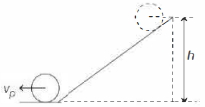
A solid cylinder $P$ rolls without slipping from rest down an inclined plane attaining a speed $v_p$ at the bottom. Another smooth solid cylinder $Q$ of same mass and dimensions slides without friction from rest down the inclined plane attaining a speed $v_q$ at the bottom. The ratio of the speeds $\frac{v_q}{v_p}$ is
  • A
    $\sqrt{\frac{3}{4}}$
  • $\sqrt{\frac{3}{2}}$
  • C
    $\sqrt{\frac{2}{3}}$
  • D
    $\sqrt{\frac{4}{3}}$

Answer

Correct option: B.
$\sqrt{\frac{3}{2}}$
b
(b)

In presence of friction, cylinder rolls and by energy conservation, we have

Initial potential energy $=$ Kinetic energy at bottom

$m g h =( KE )_{\text {translation }}+( KE )_{\text {rotation }}$

$=\frac{1}{2} m v^2+\frac{1}{2} I \omega^2$

$=\frac{1}{2} m v^2+\frac{1}{2}\left(\frac{1}{2} m r^2\right) \omega^2$

$=\frac{3}{4} m v^2 \quad[\therefore v=r \omega]$

So, $\quad v_p=\sqrt{\frac{4}{3} g h}$

In absence of friction, cylinder slips without rolling.

Hence, $\frac{1}{2} m v^2=m g h$

$\Rightarrow \quad v_q=\sqrt{2 g h}$

So, ratio of $v_q / v_p=\frac{\sqrt{2 g h}}{\sqrt{\frac{4}{3} g h}}=\sqrt{\frac{3}{2}}$

Need a full question paper?

Generate a complete, print-ready paper with questions like this in minutes — across 16+ boards, with answer keys.

Start Generating Free

Similar questions

If two soap bubbles of equal radii $r$ coalesce then the radius of curvature of interface between two bubbles will be
A ball of mass $400\, gm$ is dropped from a height of $5\,m.$ A boy on the ground hits the ball vertically upwards with a bat with an average force of $100$ newton so that it attains a vertical height of $ 20 \,m$. The time for which the ball remains in contact with the bat is  ........... $\sec$. $[g = 10\,m/{s^2}]$
Work done in converting one gram of ice at $-10°C$ into steam at $100°C$ is ....... $J$
If diagonals of a parallelogram are $\left( {5\hat i - 4\hat j + 3\hat k} \right)$ and $\left( {3\hat i + 2\hat j - \hat k} \right)$ then its area is
The number of significant figures in 0.06900 is:
Two satellites, $A$ and $B,$ have masses $m$ and $2\,m$ respectively. $A$ is in a circular orbit of radius $R,$ and $B$ is in a circular orbit of radius $2R$ around the earth. The ratio of their kinetic energies, $K.E._A / K.E._B ,$ is
A cylinder rolls up an inclined plane, reaches some height and then rolls down $($without slipping throughout these motions$).$ The directions of frictional force acting on the cylinder are:
The magnetic field energy in an inductor changes from maximum value to minimum value in 5.0ms when connected to an AC source. The frequency of the source:
A projectile is thrown into space so as to have a maximum possible horizontal range of $400$ metres. Taking the point of projection as the origin, the co-ordinates of the point where the velocity of the projectile is minimum are
A particle located at $x= 0$ at time $ t= 0 $, starts moving along with the positive $x-$direction with a velocity $v$ that varies as $v$ $=$ $\alpha \sqrt x $. The displacement of the particle varies with time as