Question
A solid disc and a ring, both of radius 10cm are placed on a horizontal table simultaneously, with initial angular speed equal to 10 π rad s-1. Which of the two will start to roll earlier? The co-efficient of kinetic friction is $\mu_\text{k}=0.2$
Answer

Given,
Radii of the ring and the disc, r = 5cm = 0.05m
Initial angular speed, $\omega_0=8\pi\text{rads}^{-1}$
Coefficient of kinetic friction, $\mu_\text{k}=0.2$
Initial velocity of both the objects, u = 0a
Motion of the two objects is caused by force of friction. According Newton’s second,
force of friction, $\text{f}=\text{ma}$
$\mu_\text{k}\text{mg}=\text{ma}$
Where,
a = Acceleration produced in the disc and the ring
m = Mass
$\therefore\ \text{a}=\mu_{\text{k}}\text{g}\ ...(\text{i})$
Using the first equation of motion,
$\text{v}=\text{u}+\text{at}$
$=0+\mu_\text{k}\text{gt}$
$=\mu_\text{k}\text{gt}\ ...(\text{ii})$
The frictional force applies a torque in perpendicularly outward direction and reduces the initial angular speed.
Torque, $\text{T}=-\text{I}\alpha$
Where, $\alpha=$ Angular acceleration
$\mu_\text{k}\text{mgr}=-\text{I}\alpha$
$\therefore\alpha=\frac{-\mu_\text{k}\text{mgr}}{\text{I}}\ ...(\text{iii})$
According to the first equation of rotational motion, we have,
$\omega=\omega_0+\alpha\text{t}$
$=\omega_0+\Big(\frac{-\mu_\text{k}\text{mgr}}{\text{I}}\Big)\text{t}\ ...(\text{iv})$
Rolling starts when linear velocity, $\text{v}=\text{r}\omega$
$\therefore\ \text{v}=\text{r}\Big(\omega_0-\frac{\mu_\text{k}\text{mgrt}}{\text{I}}\Big)\ ...(\text{v})$
Using equation (ii) and equation (v), we have,
$\mu_\text{k}\text{gt}=\text{r}\Big(\omega_0-\frac{\mu_\text{k}\text{mgrt}}{\text{I}}\Big)$
$=\text{r}\omega_0-\frac{\mu_\text{k}\text{mgr}^2\text{t}}{\text{I}}\ ....(\text{vi})$
For the ring,
$\text{I}=\text{mr}^2$
$\therefore\ \mu_\text{k}\text{gt}=\text{r}\omega_0-\frac{\mu_\text{k}\text{mgr}^2\text{t}}{\text{mr}^2}$
$=\text{r}\omega_0-\mu_\text{k}\text{gt}$
$2\mu_\text{k}\text{gt}=\text{r}\omega_0$
$\therefore\ \text{t}=\frac{\text{r}\omega_0}{2\mu_\text{k}\text{g}}$
$=\frac{(0.05\times8\times3.14)}{(2\times0.2\times9.8)}=0.32\text{s}\ ...(\text{vii})$
For the disc, $\text{I}=\Big(\frac{1}{2}\Big)\text{mr}^2$
$\therefore\ \mu_\text{k}\text{gt}=\text{r}\omega_0-\frac{\mu_\text{k}\text{mgr}^2\text{t}}{\big(\frac{1}{2}\big)\text{mr}^2}$
$=\text{r}\omega_0-2\mu_\text{k}\text{gt}$
$3\mu_\text{k}\text{gt}=\text{r}\omega_0$
$\therefore\ \text{t}=\frac{\text{r}\omega_0}{3\mu_\text{k}\text{g}}$
$=\frac{(0.05)\times8\times3.14}{(3\times0.2\times9.8)}=0.213\text{s}\ ...(\text{viii})$
Since $\text{t}_\text{D}>\text{t}_\text{R},$ the disc will start rolling before the ring.

Need a full question paper?

Generate a complete, print-ready paper with questions like this in minutes — across 16+ boards, with answer keys.

Start Generating Free

Similar questions

Define thermal conductivity and write its practical applications.
A U-shaped wire is placed before a concave mirror having radius of curvature 20cm. Find the total length of the image.

Prove that the center of mass of a cone of height $h$ is located at $\left(\frac{h}{4}\right)$ height from its base.
A ball is thrown vertically upwards with a velocity of $20 m s ^{-1}$ from the top of a multistorey building. The height of the point from where the ball is thrown is $25.0 m$ from the ground. (a) How high will the ball rlse? and (b) how long will it be before the ball hits the ground? Take $g =10 m s ^{-2}$.
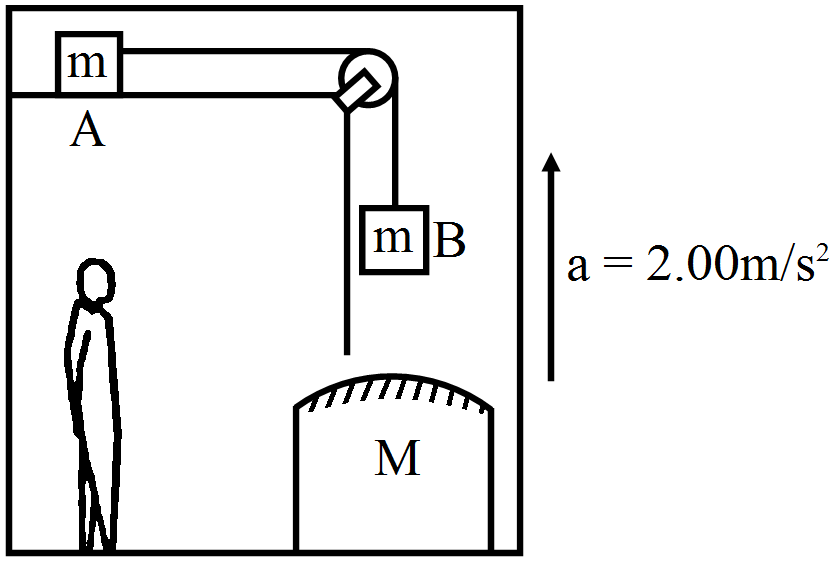
Consider the situation shown in figure. The elevator is going up with an acceleration of 2.00m/s2 and the focal length of the mirror is 12.0cm. All the surfaces are smooth and the pulley is light. The mass-pulley system is released from rest (with respect to the elevator) at t = 0 when the distance of B from the mirror is 42.0cm. Find the distance between the image of the block B and the mirror at t = 0.200s. Take g = 10m/s2.

On an open ground, a motorist follows a track that turns to his left by an angle of 60º after every 500 m. Starting from a given turn specify the displacement of the motorist at the third, sixth and eighth turn. Compare the magnitude of the displacement with the total path length covered by the motorist in each case.
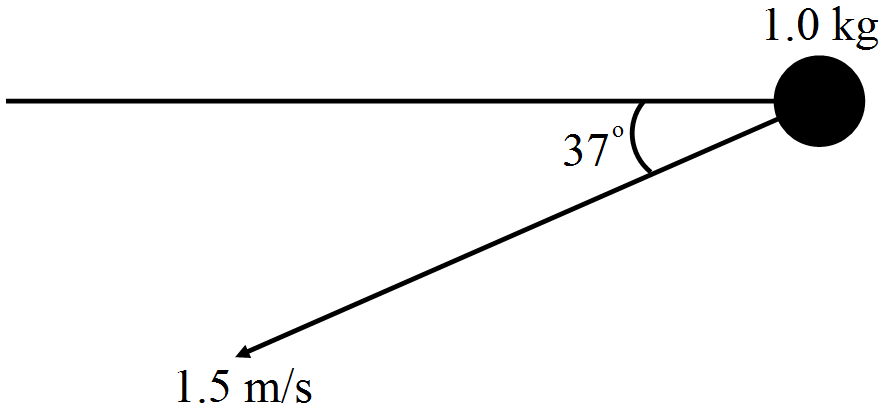
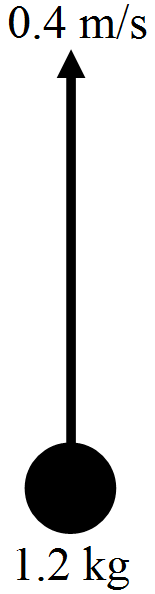
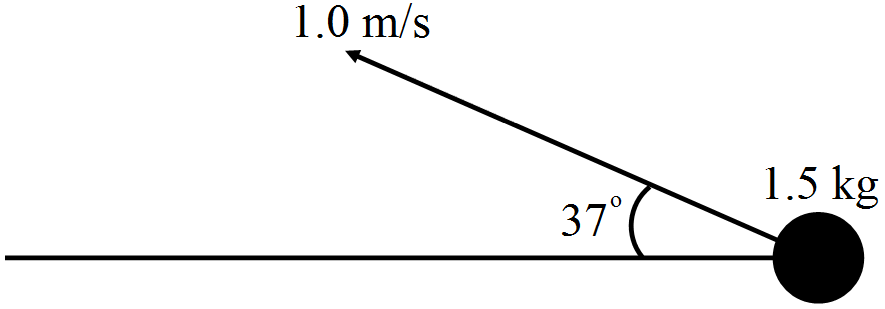
Calculate the velocity of the centre of mass of the system of particles shown in figure.


Find the time period of small oscillations of the following systems.
  1. A metre stick suspended through the 20cm mark.
  2. A ring of mass in and radius r suspended through a point on its periphery.
  3. A uniform square plate of edge a suspended through a corner.
  4. A unifrom disc of mass m and radius r suspended through a point $\frac{\text{r}}{2}$ away from the centre.
A 100kg gun fires a ball of 1kg horizontally from a cliff of height 500m. It falls on the ground at a distance of 400m from the bottom of the cliff. Find the recoil velocity of the gun. (acceleration due to gravity = 10m s–2)
Describe stress-strain relationship for a loaded steel wire and hence explain the terms : Elastic limit, yield point, tensile strength.