MCQ
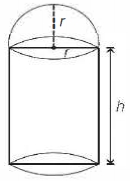
A solid hemisphere is mounted on a solid cylinder, both having equal radii. If the whole solid is to have a fixed surface area and the maximum possible volume, then the ratio of the height of the cylinder to the common radius is
  • $1: 1$
  • B
    $1: 2$
  • C
    $2: 1$
  • D
    $\sqrt{2}: 1$

Answer

Correct option: A.
$1: 1$
a
(a)

Surface area of solid i.e. $\quad S=2 \pi r^2+2 \pi r h+\pi r^2$

$S=3 \pi r^2+2 \pi r h$

$h=\frac{S-3 \pi r^2}{2 \pi r}$

Volume of solid

$\text { i.e. } \quad V=\pi r^2 h+\frac{2}{3} \pi r^3$

$\Rightarrow \quad V=\pi r^2\left(\frac{S-3 \pi r^2}{2 \pi r}\right)+\frac{2}{3} \pi r^3$

$\Rightarrow \quad \quad V=\frac{1}{2}\left(S r-3 \pi r^3\right)+\frac{2}{3} \pi r^3$

$\Rightarrow \quad \frac{d V}{d r}=\frac{S}{2}-\frac{9 \pi r^2}{2}+2 \pi r^2$

$\text { For maximum or minimum } \frac{d V}{d r}=0$

$\therefore \quad S=5 \pi r^2$

$\Rightarrow \quad h=\frac{S-3 \pi r^2-5 \pi r^2-3 \pi r^2}{2 \pi r}=r$

$\therefore \quad h=r \Rightarrow h: r=1: 1$
Need a full question paper?

Generate a complete, print-ready paper with questions like this in minutes — across 16+ boards, with answer keys.

Start Generating Free

Similar questions

For $x \in \left( {0,\frac{3}{2}} \right)$, let $f\left( x \right) = \sqrt x $, $g\left( x \right) = \tan \,x$ and $h\left( x \right) = \frac{{1 - {x^2}}}{{1 + {x^2}}}$. If $\phi \left( x \right) = \left( {\left( {hof} \right)og} \right)\left( x \right)$, then $\phi \left( {\frac{\pi }{3}} \right)$ is equal to
$\int_{}^{} {\left[ {\log (\log x) + \frac{1}{{{{(\log x)}^2}}}} \right]} \;dx = $
If the function $f(x)=\left\{\begin{array}{l}\frac{\left(e^{k x}-1\right) \tan k x}{4 x^2}, x \neq 0 \\ 16, x=0\end{array}\right.$ is continuous at $x=0$, then $k=$
The solution to the differential equation $y\, \ln y + xy' = 0,$ where $y (1) = e,$ is
lf $\int {\frac{{\tan \,\,x\,}}{{1 + \,\tan \,x\, + {{\tan }^2}\,x}}dx} $ $ = x - \frac{K}{{\sqrt A }}{\tan ^{ - 1}}\,\left( {\frac{{K\,\,\tan \,x + 1}}{{\sqrt A }}} \right) + C,$ ($C$ is a constant ofintegration), then the ordered pair $(K, A)$  is euqal to
Let $\text{f(x)}=|\cos\text{x}|.$ Then,
  1. f(x) is everywhere differentiable.
  2. f(x) is everywhere continuous but not differentiable at $\text{x}=\text{n}\pi,\text{n}\in\text{Z}$
  3. f(x) is everywhere continuous but not differentiable at $\text{x}=(2\text{n}+1)\frac{\pi}{2},\text{n}\in\text{Z}.$
  4. None of these.
For $a>0,$ let the curves $C_{1}: y^{2}=a x$ and $\mathrm{C}_{2}: \mathrm{x}^{2}=$ ay intersect at origin $\mathrm{O}$ and a point $\mathrm{P}$ Let the line $\mathrm{x}=\mathrm{b}(0<\mathrm{b}<\mathrm{a})$ intersect the chord $OP$ and the $\mathrm{x}$ -axis at points $\mathrm{Q}$ and $\mathrm{R}$, respectively. If the line $x=b$ bisects the area bounded by the curves, $\mathrm{C}_{1}$ and $\mathrm{C}_{2},$ and the area of $\Delta \mathrm{OQR}=\frac{1}{2},$ then '$a$' satisfies the equation
If $\overrightarrow {{F_1}} = i - j + k,$ $\overrightarrow {{F_2}} = - i + 2j - k,$ $\overrightarrow {{F_3}} = j - k,$ $\vec A = 4i - 3j - 2k$ and $\vec B = 6i + j - 3k,$ then the scalar product of $\overrightarrow {{F_1}} + \overrightarrow {{F_2}} + \overrightarrow {{F_3}} $and $\overrightarrow {AB} $ will be
Let $f(x)=\frac{x^2-6 x+5}{x^2-5 x+6}$.

Match the conditions / expressions in Column $I$ with statements in Column $II$ and indicate your answers by darkening the appropriate bubbles in $4 \times 4$ matrix given in the $ORS$.

Column $I$ Column $II$
$(A)$ If $-1 < x < 1$, then $f$ ( $x$ ) satisfies $(p)$ $ 0 < $ f (x) $ < 1$
$(B)$ If $1 < x < 2$, then $f(x)$ satisfies $(q)$ $\mathrm{f}(\mathrm{x}) < 0$
$(C)$ If $3 < x < 5$, then $f(x)$ satisfies $(r)$ $ \mathrm{f}(\mathrm{x}) > 0$
$(D)$ If $x > 5$, then $f(x)$ satisfies $(s)$ $ f (\mathrm{x}) < 1$
The domain of the function

$f(x)=\frac{\cos ^{-1}\left(\frac{x^{2}-5 x+6}{x^{2}-9}\right)}{\log _{e}\left(x^{2}-3 x+2\right)} \text { is }$