MCQ
A solid is hemispherical at the bottom and conical (of same radius) above it. If the surface areas of the two parts are equal, then what will be the ratio of its radius and the slant height of the conical part?
  • A
    $2: 1$
  • $1: 2$
  • C
    $3: 2$
  • D
    $2: 3$

Answer

Correct option: B.
$1: 2$
(b) : Let $r$ be the radius of hemisphere and conical part. Also, let $l$ be the slant height of conical part.
Given that, surface area of hemisphere
$=$ surface area of conical part
$\Rightarrow 2 \pi r^2=\pi r l \Rightarrow 2 r=l$
$\Rightarrow \frac{r}{l}=\frac{1}{2}$ i.e., $r: l=1: 2$

Need a full question paper?

Generate a complete, print-ready paper with questions like this in minutes — across 16+ boards, with answer keys.

Start Generating Free

Similar questions

Two concentric circles of radii $a$ and $b$ where $a>b$, are given, the length of a chord of the larger circle which touches the other circle is
If the area of a circle is $A$, radius of the circle is $r$ and circumference of it is $C$, then
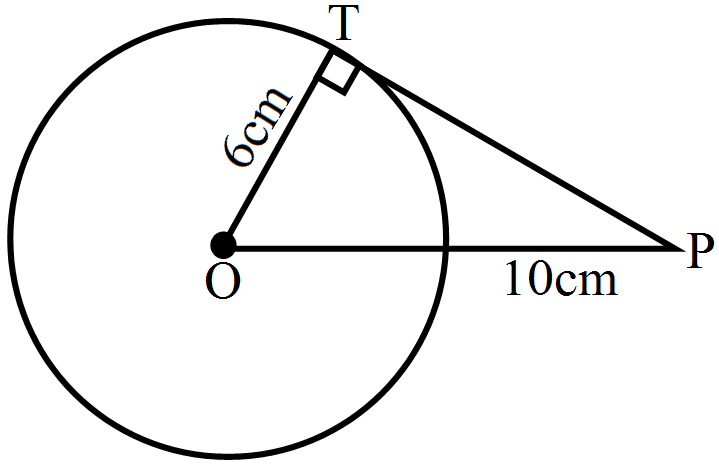
In the given figure, $PT$ is a tangent to a circle with centre $O$. If $OT = 6\ cm$ and $OP = 10\ cm,$ then the length of tangent $PT$ is:
If the mean of the following distribution is 2.6, then the value of y is
Variable (x) :12345
Frequency :45y12
Each question consists of two statements, namely, Assertion $(A)$ and Reason $(R)$. For selecting the correct answer : use the following code:
Assertion $(A)$
Consider the following frequency distribution:
Class interval
$3-6$ $6-9$ $9-12$ $12-15$ $15-18$ $18-21$
Frequency
$2$ $5$ $21$ $23$ $10$ $12$
The mode of the above data is $12.4.$
Reason $(R)$
The value of the variable which occurs most often is the mode.
If the distance between the points A(4, p) and B(1, 0) is 5 then:
The probability of happening of an event is denoted by p and the probability of non-happening of the event is denoted by q. Relation between p and q is
If $\alpha, \beta$ and $\gamma$ are the zeroes of the polynomial $x^3-x^2-10 x-8$, then $\alpha \beta+\beta \gamma+\gamma \alpha+\alpha \beta \gamma$ is equal to
The first term of an $AP$ is $p$ and the common difference is $q,$ then its $10^{th}$ term is :