Question
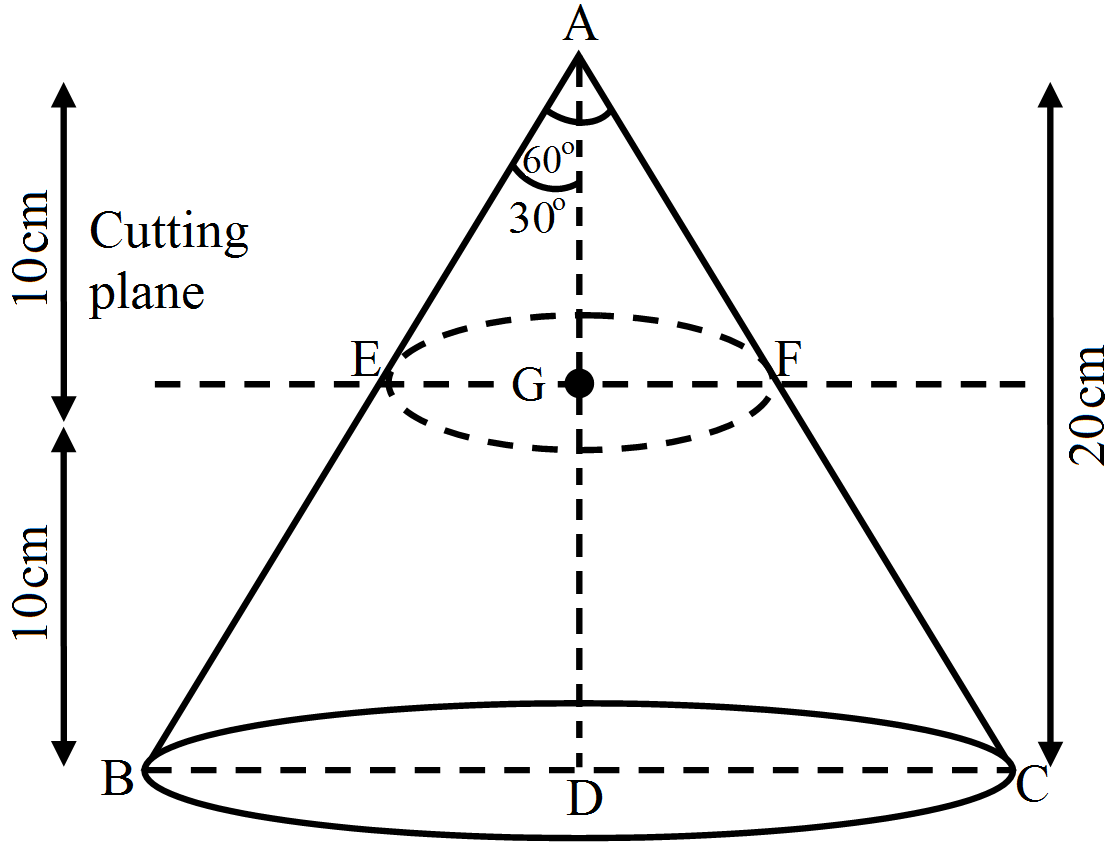
A solid metallic right circular cone $20\ cm$ high and whose vertical angle is $60^\circ $, is cut into two parts at the middle of its height by a plane parallel to its base. If the frustum so obtained be drawn into a wire of diameter $\frac{1}{12}\text{cm},$ then find the length of the wire.
Answer


We have,
Height of the solid metallic cone, $H = 20cm,$
Height of the frustom, $\text{h}=\frac{20}{2}=10\text{cm}$ and
Radius of the wire $=\frac{1}{24}\text{cm}$
Let the length of the wire be l, $BG = r$ and $BO = R.$
In $\triangle\text{AEG},$
$\tan30^\circ=\frac{\text{EG}}{\text{AG}}$
$\Rightarrow\frac{1}{\sqrt3}=\frac{\text{r}}{\text{H}-\text{h}}$
$\Rightarrow\frac{1}{\sqrt3}=\frac{\text{r}}{\text{20}-\text{10}}$
$\Rightarrow\text{r}=\frac{10}{\sqrt3}\text{cm}$
Also, in $\triangle\text{ABD},$
$\tan30^\circ=\frac{\text{BD}}{\text{AD}}$
$\Rightarrow\frac{1}{\sqrt3}=\frac{\text{R}}{\text{H}}$
$\Rightarrow\frac{1}{\sqrt3}=\frac{\text{R}}{\text{20}}$
$\Rightarrow\text{R}=\frac{20}{\sqrt3}\text{cm}$
Now,
Volume of the wire = Volume of the frustum
$\Rightarrow\pi\Big(\frac{1}{24}\Big)^2\text{l}=\frac{1}{3}\pi\text{h}\big(\text{R}^2+\text{r}^2+\text{Rr}\big)$
$\Rightarrow\frac{\text{l}}{576}=\frac{1}{3}\times10\times\bigg[\Big(\frac{20}{\sqrt3}\Big)^2+\Big(\frac{10}{\sqrt3}\Big)^2+\Big(\frac{20}{\sqrt3}\Big)\Big(\frac{10}{\sqrt3}\Big)\bigg]$
$\Rightarrow\text{l}=\frac{576}{3}\times10\times\Big[\frac{400}{3}+\frac{100}{3}+\frac{200}{3}\Big]$
$\Rightarrow\text{l}=\frac{576}{3}\times10\times\frac{700}{3}$
$\Rightarrow\text{l}=448000\text{cm}$
$\therefore\text{l}=4480\text{m}$
So, the length or the wire Is 4460m.

Need a full question paper?

Generate a complete, print-ready paper with questions like this in minutes — across 16+ boards, with answer keys.

Start Generating Free

Similar questions

If $a$ and $b$ are two odd positive integers such that $a > b$, then prove that one of the two numbers $\frac{\text{a}+\text{b}}{2}$ and $\frac{\text{a}-\text{b}}{2}$ is odd and the other is even.
A sum of Rs. $700$ is to be used to give seven cash prizes to students of a school for their overall academic performance. If each prize is Rs. $20$ less than its preceding prize, find the value of each prize.

If $\cos\theta=\frac{3}{5},$ find the value of $\frac{\sin\theta-\frac{1}{\tan\theta}}{2\tan\theta}.$

Find the second term and $n ^{\text {th }}$ term of an $A.P.$ whose $6^{\text {th }}$ term is $12$ and $8^{\text {th }}$ term is $22 .$
The area of a rhombus is $480cm^2$, and one of its diagonals measures $48\ cm.$
Find:
  1. The length of the other diagonal.
  2. The length of each of its sides.
  3. Its perimeter.
A tent is in the shape of a righ circular cylinder up to a height pf $3\ m$ and conical above it. The total height of the tent is 1$3.5\ m$ and the radius of its base is $14\ m$. Find the cost cloth required to make the tent at the rate of Rs.$ 80$ per square metre. $\Big[$Take $\pi=\frac{22}{7}\Big]$
Show that the following points are the vertices of a rectangle:
$A(0, -4), B(6, 2), C(3, 5)$ and $D(-3, -1)$
A natural number when increased by $13$ equals $160$ times its reciprocal. Find the number.
Solve the following systems of equations by using the method of cross multiplication:
$\frac{5}{(\text{x}+\text{y})}-\frac{2}{(\text{x}-\text{y})}+1=0,$
$\frac{15}{(\text{x}+\text{y})}+\frac{7}{(\text{x}-\text{y})}-10=0$ $(\text{x}\neq\text{y},\ \text{x}\neq-\text{y}).$
The median of the distribution given below is 14.4. Find the values of x and y, if the total frequency is 20.
Class interval:
0-6
6-16
12-18
18-24
24+30
Frequency:
4
x
5
y
1