Question
A solid object is placed in water contained in an adiabatic container for some time. The temperature of water falls during this period and there is no appreciable change in the shape of the object. The temperature of the solid object:
  1. Must have increased.
  2. Must have decreased.
  3. May have increased.
  4. May have remained constant.

Answer

  1. Must have increased.

Explanation:

The whole system (water + solid object) is enclosed in an adiabatic container from which no heat can escape. After some time, the temperature of water falls, which implies that the heat from the water has been transferred to the object, leading to increase in its temperature.

Need a full question paper?

Generate a complete, print-ready paper with questions like this in minutes — across 16+ boards, with answer keys.

Start Generating Free

Similar questions

Three liquids of densities d, 2d and 3d are mixed in equal proportion of weights. If density of water is d, then the specific gravity of the mixture is:
A straight rod of length $L$ extends from $x = a$ to $x = L + a$. The gravitational force it exerts on a point mass $‘m’$ at $x = 0$, if the mass per unit length of the rod is $A + Bx^2$, is given by
An automobile, travelling at $40\, km/h$, can be stopped at a distance of $40\, m$ by applying brakes. If the same automobile is travelling at $80\, km/h$, the minimum stopping distance, in metres, is (assume no skidding)..........$m$
On any planet, the presence of atmosphere implies (${C_{rms}}$= root mean square velocity of molecules and ${V_e}$= escape velocity)
A point source of light is placed at a distance, of 2f from a converging lens of focal length f. The intensity on the other side of the lens is maximum at a distance:
  1. f
  2. between f and 2
  3. 2f
  4. more than 2f.
A bomb of mass 1kg is thrown vertically upwards with a speed of 100m/s. After 5 seconds, it explodes into two fragments. One fragment of mass 400 gm is found to go down with a speed of 25m/s. What will happen to second fragment just after explosion? (g = 10m/s2).
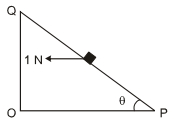
A small block of mass of $0.1 \ kg$ lies on a fixed inclined plane $P Q$ which makes an angle $\theta$ with the horizontal. A horizontal force of $1 \ N$ on the block through its center of mass as shown in the figure. The block remains stationary if (take $g =10 \ m / s ^2$ ) $Image$

$(A)$ $\theta=45^{\circ}$

$(B)$ $\theta>45^{\circ}$ and a frictional force acts on the block towards $P$.

$(C)$ $\theta>45^{\circ}$ and a frictional force acts on the block towards $Q$.

$(D)$ $\theta<45^{\circ}$ and a frictional force acts on the block towards $Q$.

Measurement of a physical quantity is essentially the
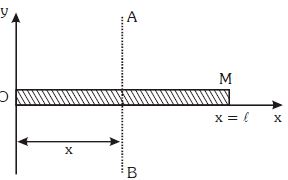
A nonuniform rod $OM$ (of length $l$ ) is kept along $x-$ axis and is rotating about an axis $AB$ , which is perpendicular to rod as shown in the figure. The rod has linear mass density that varies with the distance $x$ from left end of the rod according to $\lambda  = {\lambda _0}\left( {\frac{{{x^3}}}{{{L^3}}}} \right)$ ; where $\lambda_0$ is constant. What is the value of $x$ so that moment of inertia of rod about axis $AB (I_{AB})$ is minimum?
The ratio of speed of sound in hydrogen gas to the speed of sound in oxygen gas at the same temperature is