Question
A solid sphere, a hollow sphere and a disc, all having same mass and radius, are placed at the top of an incline and released. The friction coefficients between the objects and the incline are same and not sufficient to allow pure rolling. Least time will be taken in reaching the bottom by:
  1. The solid sphere.
  2. The hollow sphere.
  3. The disc.
  4. All will take same time.

Answer

  1. All will take same time.

Explanation:

Let $\theta$ be the inclination angle.

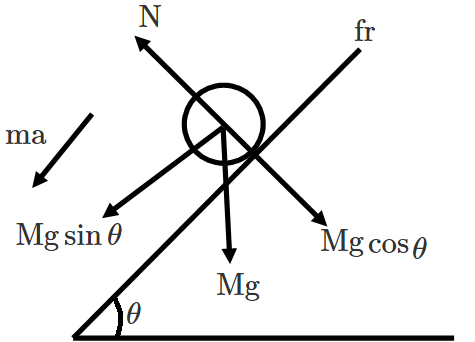
From the free body diagram, we have:

$\text{N}=\text{mg}\cos\theta\ \dots(\text{i})$

$\text{ma}=\text{mg}\sin\theta-\text{f}_{\text{r}}\ \dots(\text{ii})$

Putting $\text{f}_{\text{r}}=\mu\text{N}$ in (ii) we get,

$\text{a}=\text{g}(\sin\theta-\mu\cos\theta)$

The friction coefficients between the objects and the incline are same and not sufficient to allow pure rolling; therefore, all the bodies come down with the same acceleration.

Need a full question paper?

Generate a complete, print-ready paper with questions like this in minutes — across 16+ boards, with answer keys.

Start Generating Free

Similar questions

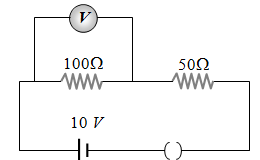
In the given circuit, the voltmeter records 5 volts. The resistance of the voltmeter in ohms is

(a) 200

(b) 100

(c) 10       

(d) 50

A rod of length L and magnetic moment M is bent to form a semicircle. Now its magnetic moment will be:

A heater coil connected to a supply of a 220 V is dissipating some power  The coil is cut into half and the two halves are connected in parallel. The heater now dissipates a power  The ratio of power  is

(a) 2 : 1

(b) 1 : 2

(c) 1 : 4

(d) 4 : 1


To form a composite 16Μf, 1000 V  capacitor from a supply of identical capacitors marked 8 μF, 250 V we require a minimum number of capacitors

(a) 40

(b) 32

(c) 8  

(d) 2

A dip circle is at right angle to the magnetic meridian. What will be the apparent dip

(a) 0°

(b) 30°

(c) 60°     

(d) 90°

The binding energy of a H-atom, considering an electron moving around a fixed nuclei (proton), is $\text{B}=-\frac{\text{me}^4}{8\text{n}^2\in_0^2\text{h}^2}$. (m = electron mass).
If one decides to work in a frame of reference where the electron is at rest, the proton would be moving arround it. By similar arguments, the binding energy would be,
$\text{B}=-\frac{\text{me}^4}{8\text{n}^2\in_0^2\text{h}^2}$ (M = proton mass)
This last expression is not correct because:

99% of a radioactive element will decay between

(a) 6 and 7 half lives

(b) 7 and 8 half lives

(c) 8 and 9 half lives

(d) 9 half lives

In a cathode ray tube, the screen is coated with fluorescent material:

After 1α and 2β emissions

(a) Mass number reduces by 3

(b) Mass number reduces by 4

(c) Mass number reduces by 6

(d) Atomic number remains unchanged

In a single slit diffraction experiment first minimum for red light (660 nm) coincides with first maximum of some other wavelength l'. The value of l' is

(a) 4400 Å

(b) 6600 Å

(c) 2000 Å

(d) 3500 Å