Question
A solid sphere is set into motion on a rough horizontal surface with a linear speed v in the forward direction and an angular speed $\frac{\text{v}}{\text{R}}$ in the anticlockwise direction as shown in figure. Find the linear speed of the sphere:
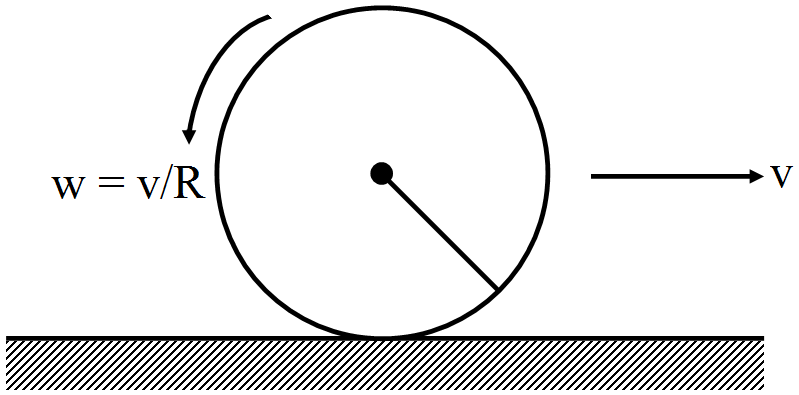
  1. When it stops rotating.
  2. When slipping finally ceases and pure rolling starts.
Answer


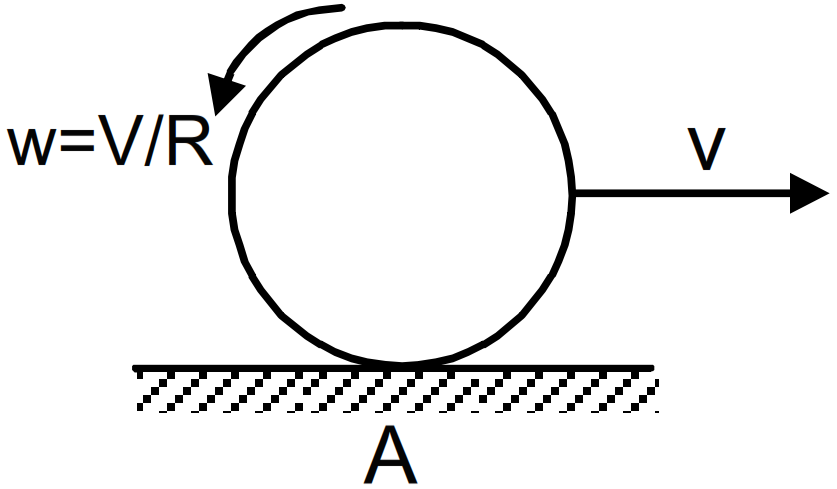
  1. If we take moment at A then external torque will be zero.
Therefore, the initial angular momentum = the angular momentum after rotation stops (i.e. only leniar velocity exits)
$\text{Mv}\times\text{R}-\ell\omega=\text{Mv}_0\times\text{R}$
$\Rightarrow\text{MvR}-\frac{2}{5}\times\frac{\text{MR}^2\text{V}}{\text{R}}=\text{Mv}_0\text{R}$
$\Rightarrow\text{v}_0=\frac{\text{3V}}{5}$
  1. Again, after some time pure rolling starts
Therefore,
$\Rightarrow\text{M}\times\text{v}_0\times\text{R}=\Big(\frac{2}{5}\Big) \text{MR}^2\times\Big(\frac{\text{V}'}{\text{R}}\Big)+\text{Mv}'\text{R}$
$\Rightarrow\text{m}\times\Big(\frac{\text{3V}}{5}\Big)\times\text{R}=\Big(\frac{2}{5}\Big)\text{Mv}'\text{R}+\text{Mv}'\text{R}$
$\Rightarrow\text{V}'=\frac{3\text{V}}{7}$

Need a full question paper?

Generate a complete, print-ready paper with questions like this in minutes — across 16+ boards, with answer keys.

Start Generating Free

Similar questions

A ship is moving at a speed of $56km/ h^{-1}$. One second later, it is moving at a speed of $58km/ h^{-1}$. What is its acceleration?
At what temperature the mean speed of the molecules of hydrogen gas equals the escape epeed from the earth?
When a force of 6.0N is exerted at 30° to a wrench at a distance of 8cm from the nut, it is just able to loosen the nut. What force F would be sufficient to loosen it if it acts perpendicularly to the wrench at 16cm from the nut?
A body of mass 2 kg is being dragged with a uniform velocity of $2 \mathrm{~ms}^{-1}$ on a rough horizontal plane. The coefficient of friction between the body and the surface is 0.2 . Calculate the amount of heat generated per second.
Take $\mathrm{g}=9.8 \mathrm{~ms}^{-2}$ and $\mathrm{J}=4.2 \mathrm{~J} / \mathrm{cal}^{-1}$.
Isothermal curves for a given mass of gas are shown at two different temperatures $T_1$ and $T_2$. State whether $T_1 > T_2$ or $T_2 > T_1$. Justify your answer.
If the radius of the Earth were increased by a factor of 3, by what factor would its density have to be changed to keep 'g' the same?
Why does a solid sphere have smaller moment of inertia than a hollow cylinder of same mass and radius, about an axis passing through their axes of symmetry?
Show that the child’s new kinetic energy of rotation is more than the initial kinetic energy of rotation. How do you account for this increase in kinetic energy?
A monkey of mass 40 kg climbs on a rope which can stand a maximum tension 600 N . In which of the following cases will the rope break?
The monkey
a. climbs up with an acceleration of $6 m / s ^2$
b. climbs down with an acceleration of $4 m / s ^2$
c. climbs up with a uniform speed of $5 m / s$
d. falls down the rope freely under gravity. Take $g=10 m / s ^2$ and ignore the mass of the rope.
  1. What is echo?
  2. If a reflector is situated at a distance of $860m$ from a sound source, what is the time of echo? Speed of sound in air at a room temperature can be taken as $344m/ s.$