Question
A solid sphere is set into motion on a rough horizontal surface with a linear speed v in the forward direction and an angular speed $\frac{\text{v}}{\text{R}}$ in the anticlockwise direction as shown in figure. Find the linear speed of the sphere:
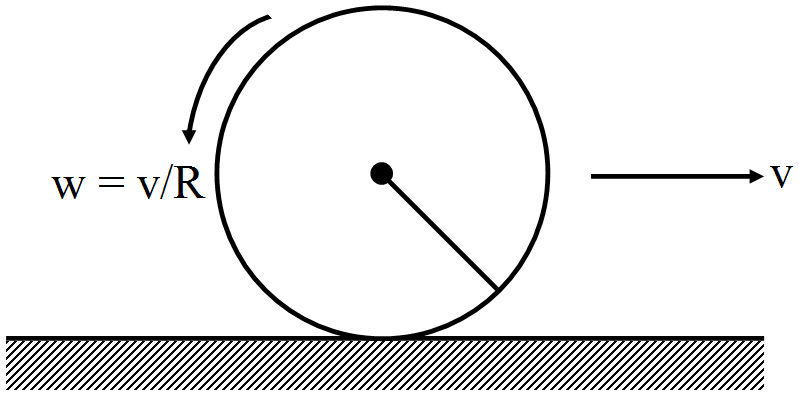
  1. When it stops rotating.
  2. When slipping finally ceases and pure rolling starts.
Answer


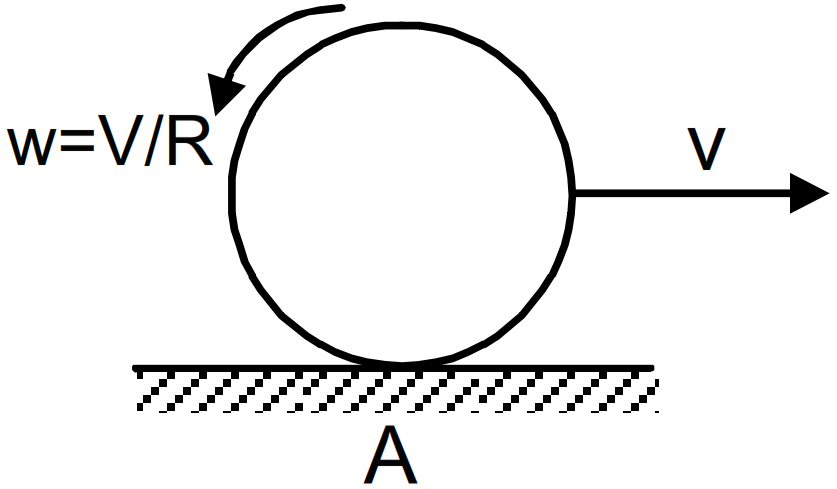
  1. If we take moment at A then external torque will be zero.

Therefore, the initial angular momentum = the angular momentum after rotation stops (i.e. only leniar velocity exits)

$\text{Mv}\times\text{R}-\ell\omega=\text{Mv}_0\times\text{R}$

$\Rightarrow\text{MvR}-\frac{2}{5}\times\frac{\text{MR}^2\text{V}}{\text{R}}=\text{Mv}_0\text{R}$

$\Rightarrow\text{v}_0=\frac{\text{3V}}{5}$

  1. Again, after some time pure rolling starts

Therefore,

$\Rightarrow\text{M}\times\text{v}_0\times\text{R}=\Big(\frac{2}{5}\Big) \text{MR}^2\times\Big(\frac{\text{V}'}{\text{R}}\Big)+\text{Mv}'\text{R}$

$\Rightarrow\text{m}\times\Big(\frac{\text{3V}}{5}\Big)\times\text{R}=\Big(\frac{2}{5}\Big)\text{Mv}'\text{R}+\text{Mv}'\text{R}$

$\Rightarrow\text{V}'=\frac{3\text{V}}{7}$

Need a full question paper?

Generate a complete, print-ready paper with questions like this in minutes — across 16+ boards, with answer keys.

Start Generating Free

Similar questions

By what fraction does the mass of a boy increase when he starts running at a speed of 12km/h?
A cart of mass M is at rest on a frictionless horizontal surface and a pendulum bob of mass m hangs from the roof of the cart. The string breaks, the bob falls on the floor, makes several collisions on the floor and finally lands up in a small slot made in the floor. The horizontal distance between the string and the slot is L. Find the displacement of the cart during this process.

Average lifetime of a hydrogen atom excited to n = 2 state is 10-8s. Find the number of revolutions made by the electron on the average before it jumps to the ground state.
A long cylindrical wire of radius b carries a current i distributed uniformly over its cross-section. Find the magnitude of the magnetic field at a point inside the wire at a distance a from the axis.
Two particles, carrying charges -q and +q and having equal masses m each, are fixed at the ends of a light rod of length a to form a dipole. The rod is clamped at an end and is placed in a uniform electric field E with the axis of the dipole along the electric field. The rod is slightly tilted and then released. Neglecting gravity find the time period of small oscillations.
A thin but long, hollow, cylindrical tube of radius r carries a current i along its length. Find the magnitude of the magnetic field at a distance $\frac{\text{r}}{2}$ from the surface (a) inside the tube (b) outside the tube.
A flint glass prism and a crown glass prism are to be combined in such a way that the deviation of the mean ray is zero. The refractive index of flint and crown glasses for the mean ray are 1.620 and 1.518 respectively. If the refracting angle of the flint prism is 6.0°, what would be the refracting angle of the crown prism?
Does focal length of a lens depend on the colour of the light used? Does focal length of a mirror depend on the colour?
A compound microscope uses an objective lens of focal length 4 cm and eyepiece lens of focal length 10 cm. An object is placed at 6 cm from the objective lens. Calculate the magnifying power of the compound microscope. Also calculate the length of the microscope.
The magnifying power of a simple microscope is given by $1+\frac{\text{D}}{\text{f}},$ where D is the least distance for clear vision. For farsighted persons, D is greater than the usual. Does it mean that the magnifying power of a simple microscope is greater for a farsighted person as compared to a normal person? Does it mean that a farsighted person can see an insect more clearly under a microscope than a normal person?