Question
A solid sphere of diameter \(50 cm\) and mass \(25 kg\) rotates about an axis through its centre. Calculate its moment of inertia. If its angular velocity changes from \(2 rad / s\) to \(1 rad / s\) in 5 seconds, calculate the torque applied.
Answer

I \(=0.625 kg \cdot m ^2 ; \tau=1.25 N \cdot m\)

Need a full question paper?

Generate a complete, print-ready paper with questions like this in minutes — across 16+ boards, with answer keys.

Start Generating Free

Similar questions

In a single slit diffraction pattern, the distance between first minima on the right and first minima on the left of central maximum is \(4 mm\). The screen on which the pattern is displaced, is \(2 m\) from the slit and wavelength of light used is 6000Å. Calculate width of the slit and width of the central maximum.
Prove the Mayer's relation $C_p-C_v=\frac{R}{J}$
Explain the effect of temperature on the angle of contact (or surface tension of a liquid).
If the frequency of revolution of a proton $\left( q =1.6 \times 10^{-19} C \right)$ in a uniform magnetic induction is $10^6 \ Hz,$ what is the corresponding electric current?
The refractive index of a medium is $\sqrt{3}$. What is the angle of refraction, if the unpolarized light is incident on it at the polarizing angle of the medium?
A boy standing at the centre of a turntable with his arms outstretched is set into rotation with angular speed $\omega \mathrm{rev} / \mathrm{min}$. When the boy folds his arms back, his moment of inertia reduces to $\frac{2}{5}$ th its initial value. Find the ratio of his final kinetic energy of rotation to his initial kinetic energy.
You have already studied in earlier classes that a short bar magnet suspended freely always aligns in North South direction. Now if you try to forcefully move and bring it in the direction along East West and leave it free, you will observe that the magnet starts turning about the axis of suspension. Do you know from where does the torque which is necessary for rotational motion come from? (as studied in rotational dynamics a torque is necessary for rotational motion).
What is an isothermal process? Obtain an expression for work done by a gas in an isothermal process.
Define photoelectric effect and Explain the experimental set-up of photoelectric effect.
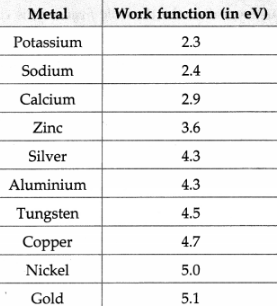
Using the values of work function given in Table $14.1$, tell which metal will require the highest frequency of incident radiation to generate photocurrent.

Image