Question
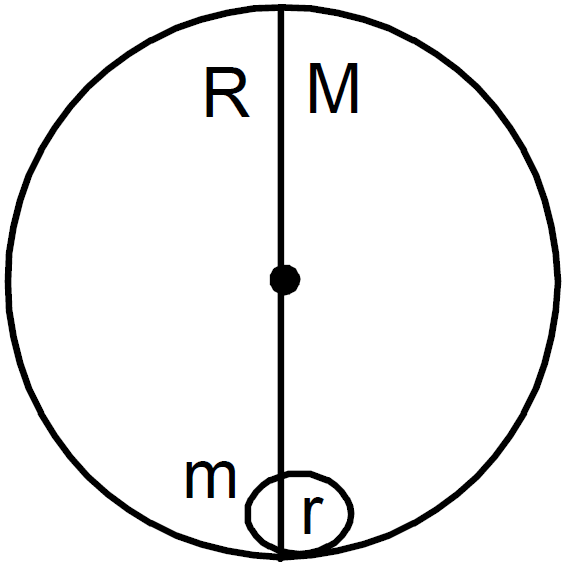
A solid sphere of mass m and radius r is placed inside a hollow thin spherical shell of mass M and radius R as shown in A particle of mass m' is placed on the line joining the two centres at a distance x from the point of contact of the sphere and the shell. Find the magnitude of the resultant gravitational force on this particle due to the sphere and the shell if,
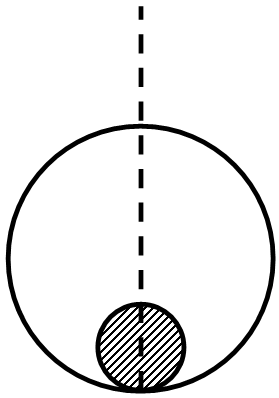
  1. r < x < 2r.
  2. 2r < x < 2R.
  3. x > 2R.

Answer

  1. m' is placed at a distance x from ‘O’.

If r < x, 2r, Let’s consider a thin shell of man

$\text{dm}=\frac{\text{m}}{\big(\frac{4}{3}\big)\pi\text{r}^2}\times\frac{4}{3}\pi\text{x}^3=\frac{\text{mx}^3}{\text{r}^3}$

Thus $\int\text{dm}=\frac{\text{mx}^3}{\text{r}^3}$

Then gravitational force $\text{F}=\frac{\text{Gmdm}}{\text{x}^2}=\frac{\frac{\text{Gmx}^3}{\text{r}^3}}{\text{x}^2}=\frac{\text{Gmx}}{\text{r}^3}$

  1. x < 2R, then F is due to only the sphere.

$\text{F}=\frac{\text{Gmm'}}{(\text{x}-\text{r})^2}$

  1. If x > 2R, then Gravitational force is due to both sphere & shell, then due to shell,

$\text{F}=\frac{\text{GMm'}}{(\text{x}-\text{R})^2}$

due to the sphere $=\frac{\text{Gmm'}}{(\text{x}-\text{r})^2}$

So, Resultant force $=\frac{\text{Gmm'}}{(\text{x}-\text{r})^2}+\frac{\text{GMm'}}{(\text{x}-\text{R})^2}$

Need a full question paper?

Generate a complete, print-ready paper with questions like this in minutes — across 16+ boards, with answer keys.

Start Generating Free

Similar questions

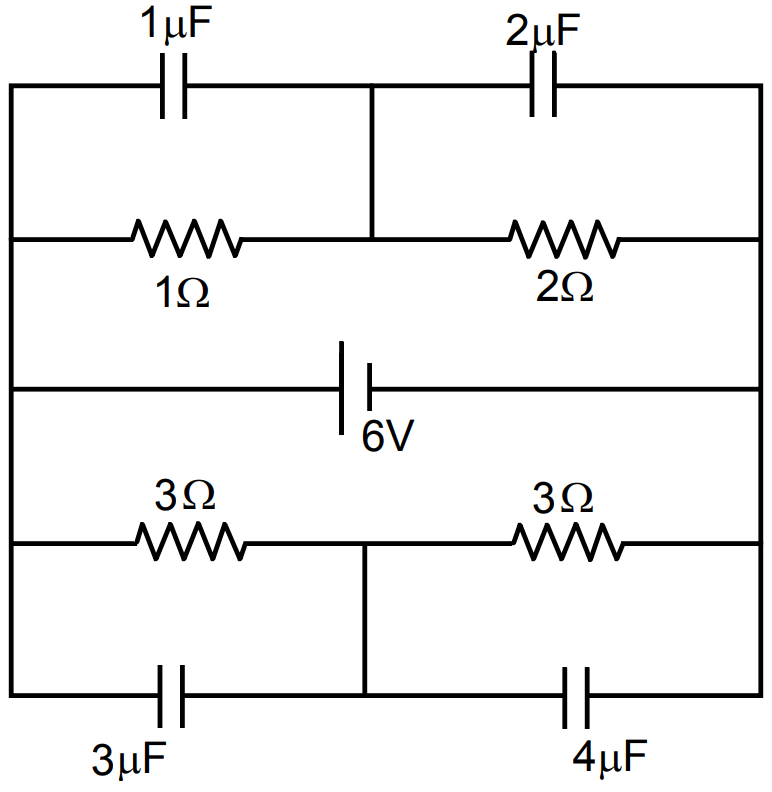
Find the charges on the four capacitors of capacitances $1\mu\text{F},2\mu\text{F},3\mu\text{F}$ and $4\mu\text{F}$ shown in the figure.

A block of mass m moves on a horizontal circle against the wall of a cylindrical room of radius R. The floor of the room on which the block moves is smooth but the friction coefficient between the wall and the block is $\mu.$ The block is given an initial speed $\nu_0.$ As a function of the speed $\nu$ write,
  1. The normal force by the wall on the block.
  2. The frictional force by the wall.
  3. The tangential acceleration of the block.
  4. Integrate the tangential acceleration $\Big(\frac{\text{d}\nu}{\text{dt}}=\nu\frac{\text{d}\nu}{\text{ds}}\Big)$ to obtain the speed dt ds of the block after one revolution.
A circular loop of string rotates about its axis on a frictionless horizontal plane at a uniform rate so that the tangential speed of any particle of the string is v. If a small transverse disturbance is produced at. a point of the loop, with what speed (relative to the string) will this disturbance travel on the string?
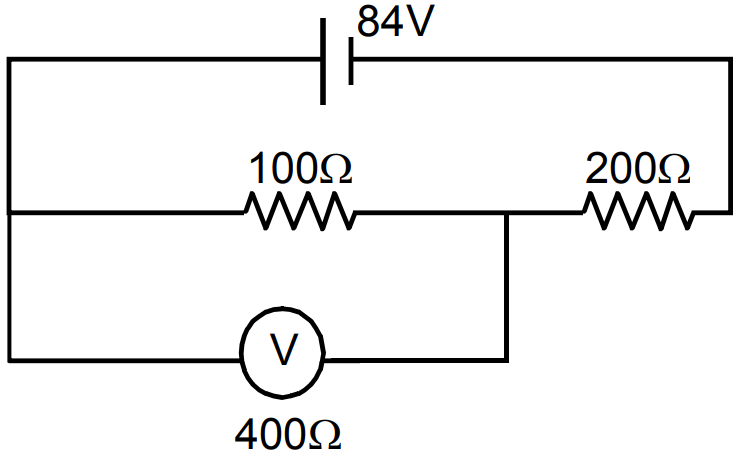
A voltmeter of resistance $400\Omega$ is used to measure the potential difference across the $100\Omega$ resistor in the circuit shown in the figure. (a) What will be the reading of the voltmeter? (b) What was the potential difference across $100\Omega$ before the voltmeter was connected?

Two point charges of +5 × 10-19C and +20 × 10-19C are separated by a distance of 2m. Find the point on the line joining them at which electric field intensity is zero.
By explaining diamagnetic, paramagnetic and ferromagnetic substances, analyse their characteristic properties.###Define diamagnetic, paramagnetic and ferromagnetic substances and analyse their characteristics on the basis of (a) reason for magnetic property (b) relative magnetic permeability (c) magnetic susceptibility (d) intensity of magnetisation (e) magnetic induction.
In an experiment on photoelectric effect, the stopping potential is measured for monochromatic light beams corresponding to different wavelengths. The data collected are 11s follows:

wavelength (nm) 350 400 450 500 550
stopping potential(V): 1.45 1.00 0.66 0.38 0.16

Plot the stopping potential against inverse of wavelength $\big(\frac{1}{\lambda}\big) $ on a graph paper and find

  1. The Planck constant,
  2. The work function of the emitter and.
  3. The threshold wavelength.
With the help of a labelled diagram, state the underlying principle of a cyclotron.
Explain clearly how it works to accelerate the charged particles. Show that cyclotron frequency is independent of energy of the particle. Is there an upper limit on the energy acquired by the particle? Give reason.
By defining electric dipole and dipole moment, find the necessary formula for the field intensity at any point located on the neutral (equatorial plane) of the dipole.
The separation between the plates of a parallel-plate capacitor is 0.500cm and its plate area is 100cm2. A 0.400cm thick metal plate is inserted into the gap with its faces parallel to the plates. Show that the capacitance of the assembly is independent of the position of the metal plate within the gap and find its value.