Question
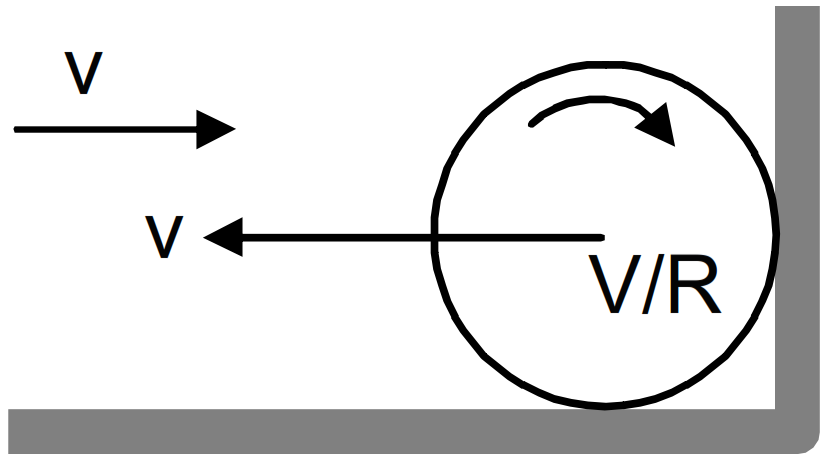
A solid sphere rolling on a rough horizontal surface with a linear speed v collides elastically with a fixed, smooth, vertical wall. Find the speed of the sphere after it has started pure rolling in the backward direction.
Answer


When the solid sphere collides with the wall, it rebounds with velocity ‘v’ towards left but it continues to rotate in the clockwise direction.
So, the angular momentum $=\text{mvR}-\Big(\frac{2}{5}\Big)\text{mR}^2\times\frac{\text{v}}{\text{R}}$
After rebounding, when pure rolling starts let the velocity be v' and the corresponding angular velocity is $\frac{\text{v}'}{\text{R}}$
Therefore angular momentum $=\text{mv}'\text{R}+\Big(\frac{2}{5}\Big)\text{mR}^2\Big(\frac{\text{v}'}{\text{R}}\Big)$
So, $\text{mvR}-\Big(\frac{2}5{}\Big)\text{mR}^2,\ \frac{\text{v}}{\text{R}}=\text{mvR}+\Big(\frac{2}{5}\Big)\text{mR}^2\Big(\frac{\text{v}'}{\text{R}}\Big)$
$\text{mvR}\times\Big(\frac{3}{5}\Big)=\text{mvR}\times\Big(\frac{7}{5}\Big)$
So, the sphere will move with velocity $\frac{\text{3v}}{7}.$

Need a full question paper?

Generate a complete, print-ready paper with questions like this in minutes — across 16+ boards, with answer keys.
Start Generating Free

Similar questions

In the given circuit, the potential difference across the inductor L and resistor R are 200V and 150V respectively and the rms. value of current is 5A. Calculate (i) the impedance of the circuit and (ii) the phase angle between the voltage and the current.
(i) What is meant by electric power? Prove that $P=\frac{V^2}{R}$ or $P=I^2 R$. Define one-watt electric power.(ii) Define electric energy. Prove that $P = I ^2 R \Delta t$
State Kirchhoff's rules of current distribution in an electrical network. Using these rules determine the value of the current I1 in the electric circuit given below.
  1. Explain the processes of nuclear fission and nuclear fusion by using the plot of binding energy per nucleon (BE/ A) versus the mass number A.
  2. A radioactive isotope has a half-life of 10 years. How long will it take for the activity to reduce to 3·125%?
Consider the situation of the previous problem. A particle having charge q and mass m is projected from the point Q in a direction going into the plane of the diagram. It is found to describe a circle of radius r between the two plates. Find the speed of the charged particle.
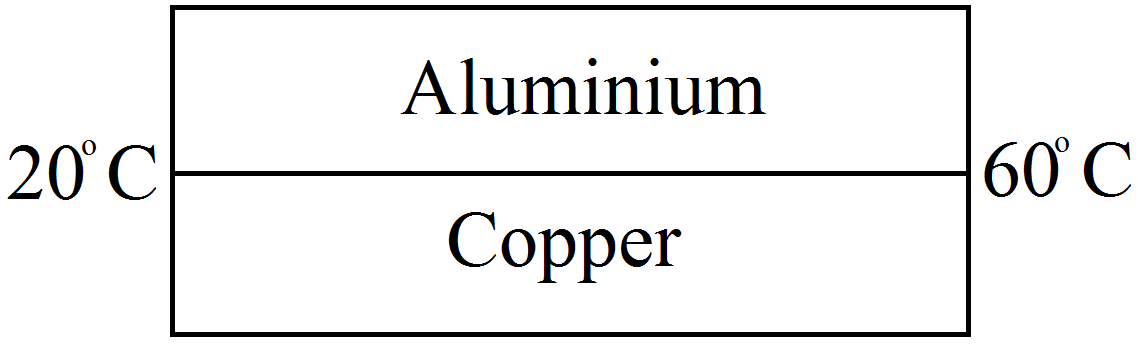
An aluminium rod and a copper rod of equal length $1.0m$ and cross$-$sectional area $1\ cm^2$ are welded together as shown in figure. One end is kept at a temperature of $20^\circ C$ and the other at $60^\circ C.$ Calculate the amount of heat taken out per second from the hot end. Thermal conductivity of aluminium $= 200\ Wm^{-1^\circ }C^{-1}$ and of copper $= 390\ Wm^{-1^\circ }C^{-1}.$
A capacitance C charged to a potential difference V is discharged by connecting its plates through a resistance R. Find the heat dissipated in one time constant after the connections are made. Do this by calculating $\int\text{i}^2\text{R}$ dt and also by finding the decrease in the energy stored in the capacitor.
Using $\text{B}=\mu_0\text{H},$ find the ratio $\frac{\text{E}_0}{\text{H}_0}$ for a plane electromagnetic wave propagating through vacuum. Show that it has the dimensions of electric resistance. This ratio is a universal constant called the impedance of free space.
A sinusoidal voltage of peak value $283 V$ and frequency $50 Hz$ is applied to a series $L C R$ circuit in which $R =3 \Omega, L=25.48 mH$, and $C =796 \mu F$. Find (a) the impedance of the circuit; (b) the phase difference between the voltage across the source and the current; (c) the power dissipated in the circuit; and (d) the power factor.
A long cylindrical wire of radius b carries a current i distributed uniformly over its cross-section. Find the magnitude of the magnetic field at a point inside the wire at a distance a from the axis.