Question
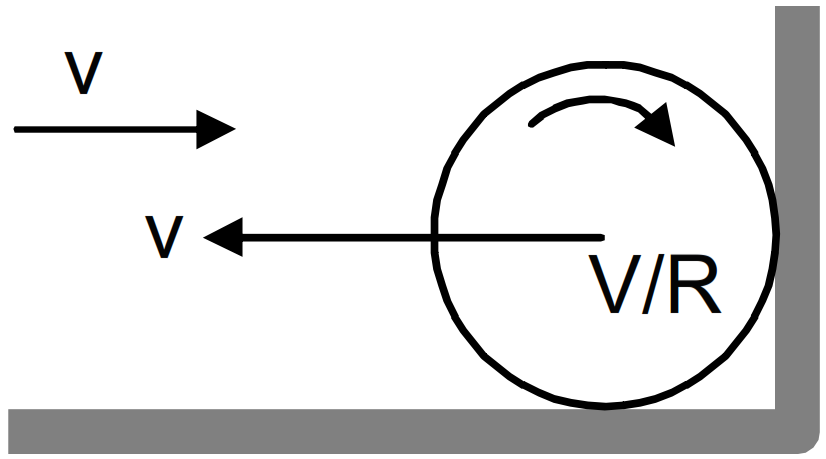
A solid sphere rolling on a rough horizontal surface with a linear speed v collides elastically with a fixed, smooth, vertical wall. Find the speed of the sphere after it has started pure rolling in the backward direction.
Answer


When the solid sphere collides with the wall, it rebounds with velocity ‘v’ towards left but it continues to rotate in the clockwise direction.

So, the angular momentum $=\text{mvR}-\Big(\frac{2}{5}\Big)\text{mR}^2\times\frac{\text{v}}{\text{R}}$

After rebounding, when pure rolling starts let the velocity be v' and the corresponding angular velocity is $\frac{\text{v}'}{\text{R}}$

Therefore angular momentum $=\text{mv}'\text{R}+\Big(\frac{2}{5}\Big)\text{mR}^2\Big(\frac{\text{v}'}{\text{R}}\Big)$

So, $\text{mvR}-\Big(\frac{2}5{}\Big)\text{mR}^2,\ \frac{\text{v}}{\text{R}}=\text{mvR}+\Big(\frac{2}{5}\Big)\text{mR}^2\Big(\frac{\text{v}'}{\text{R}}\Big)$

$\text{mvR}\times\Big(\frac{3}{5}\Big)=\text{mvR}\times\Big(\frac{7}{5}\Big)$

So, the sphere will move with velocity $\frac{\text{3v}}{7}.$

Need a full question paper?

Generate a complete, print-ready paper with questions like this in minutes — across 16+ boards, with answer keys.
Start Generating Free

Similar questions

What is called P-N junction? Name the methods of making P-N junction. Explain the diffusion method of making $P - N$ junction.
What will be the effect on placing a metal foil between the plates of a parallel plate capacitor on its capacitance?
What physical quantity is the same for X - rays of wavelength 10-10 m, red light of wavelength 6800 Å and radiowaves of wavelength 500m?
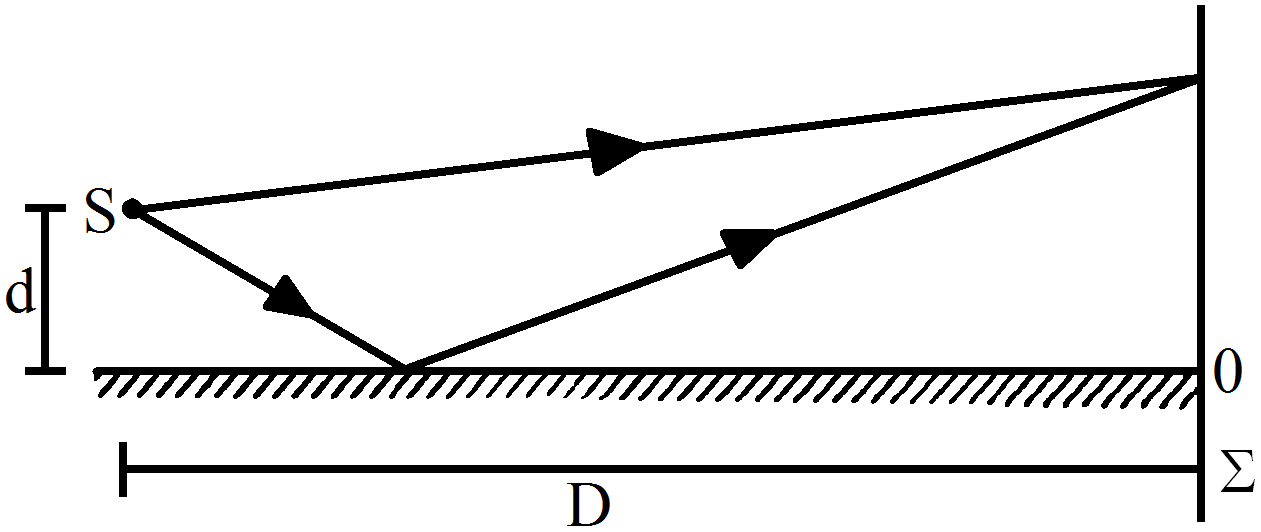
A narrow slit S transmitting light of wavelength $\lambda$ is placed a distance d above a large plane mirror as shown in figure (17-E1). The light coming directly from the slit and that coming after the reflection interfere at a screen $\sum$ placed at a distance D from the slit.

  1. What will be the intensity at a point just above the mirror, i.e., just above O?
  2. At what distance from 0 does the first maximum occur?
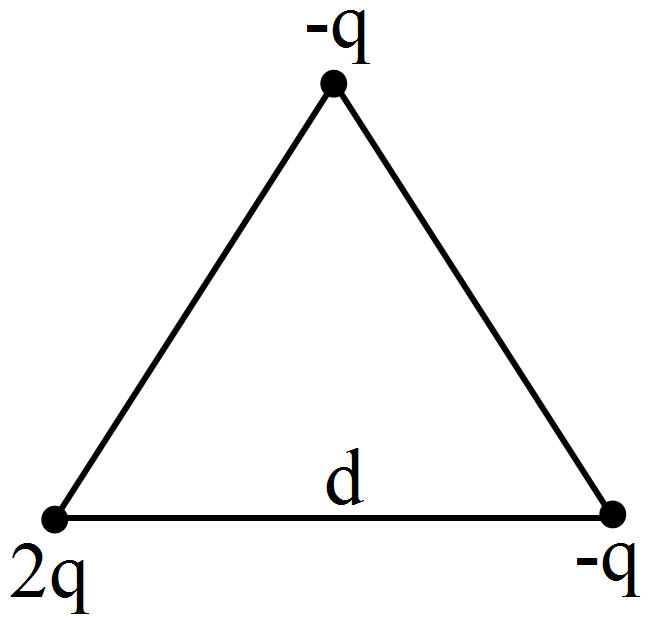
Three charges are arranged on the vertices of an equilateral triangle as shown in figure. Find the dipole moment of the combination.

In a single slit diffraction experiment, when a tiny circular obstacle is placed in the path of light from a distant source, a bright spot is seen at the centre of the shadow of the obstacle. Explain why?

State two points of difference between the interference pattern obtained in Young’s double slit experiment and the diffraction pattern due to a single slit.

A carrom board (4ft × 4ft square) has the queen at the centre. The queen, hit by the striker moves to the front edge, rebounds and goes in the hole behind the striking line. Find the magnitude of displacement of the queen:
  1. From the centre to the front edge.
  2. From the front edge to the hole.
  3. From the centre to the hole.
A circular ring of radius r made of a nonconducting material is placed with its axis parallel to a uniform electric field. The ring is rotated about a diameter through 180°. Does the flux of electric field change? If yes, does it decrease or increase?
A capacitance C charged to a potential difference V is discharged by connecting its plates through a resistance R. Find the heat dissipated in one time constant after the connections are made. Do this by calculating $\int\text{i}^2\text{R}$ dt and also by finding the decrease in the energy stored in the capacitor.
Suppose A and B in the previous problem change their positions in such a way that the line joining them becomes perpendicular to the direction of wind while maintaining the separation x. What will be the time lag B finds between seeing and hearing the drum beating by A?