Question
A solid sphere rolls down two different inclined planes of the same heights but different angles of inclination.
  1. Will it reach the bottom with the same speed in each case?
  2. Will it take longer to roll down one plane than the other?
  3. If so, which one and why?

Answer

  1. Mass of the sphere = m
Height of the plane = h
Velocity of the sphere at the bottom of the plane = v
At the top of the plane, the total energy of the sphere = Potential energy = mgh
At the bottom of the plane, the sphere has both translational and rotational kinetic energies.
Hence, total energy $=\Big(\frac{1}{2}\Big)\text{mv}^2+\bigg(\frac{\frac{1}{2}}{\omega^2}\bigg)$
Using the law of conservation of energy, we can write,
$\Big(\frac{1}{2}\Big)\text{mv}^2+\bigg(\frac{\frac{1}{2}}{\omega^2}\bigg)=\text{mgh}$
For a solid sphere, the moment of inertia about its centre, $\text{I}=\Big(\frac{2}{5}\Big)\text{mr}^2$
Hence, equation (i) becomes,
$\Big(\frac{1}{2}\Big)\text{mv}^2+\Big(\frac{1}{2}\Big)\Big[\Big(\frac{2}{5}\Big)\text{mr}^2\Big]\omega^2=\text{mgh}$
$\Big(\frac{1}{2}\Big)\text{v}^2+\Big(\frac{1}{5}\Big)\text{r}^2\omega^2=\text{gh}$
But we have the relation, $\text{v}=\text{r}\omega$
$\therefore\Big(\frac{1}{2}\Big)\text{v}^2+\Big(\frac{1}{5}\Big)\text{v}^2=\text{gh}$
$\text{v}^2\Big(\frac{7}{10}\Big)=\text{gh}$
$\text{v}=\sqrt{\Big(\frac{10}{7}\Big)}\text{gh}$
Hence, the velocity of the sphere at the bottom depends only on height (h) and acceleration due to gravity (g). Both these values are constants. Therefore, the velocity at the bottom remains the same from whichever inclined plane the sphere is rolled.
  1. Consider two inclined planes with inclinations $\theta_1$ and $\theta_2$ related as,
$\theta_1<\theta_2$
The acceleration produced in the sphere when it rolls down the plane inclined at $\theta_1$ is,
$\text{g}\sin\theta_1$
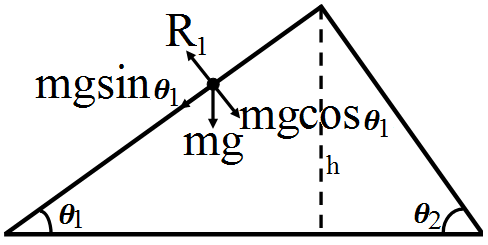
The various forces acting on the sphere are shown in the following figure:

$R_1$ is the normal reaction to the sphere.
Similarly, the acceleration produced in the sphere when it rolls down the plane inclined at $\theta_2$ is,
$\text{g}\sin\theta_2$
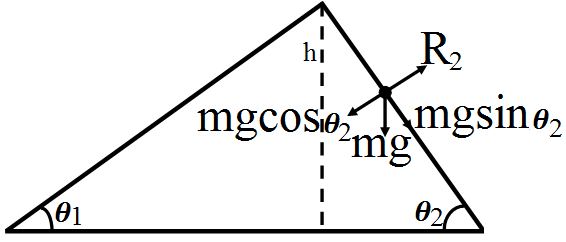
  1. The various forces acting on the sphere are shown in the following figure:

$R_2$ is the normal reaction to the sphere.
$\theta_2>\theta_1,\sin\theta_2>\sin\theta_1\ ...(\text{i})$
$\therefore\text{ a}_2>\text{a}_1\ ...(\text{ii})$
Initial velocity, u = 0
Final velocity, v = Constant
Using the first equation of motion, we can obtain the time of roll as,
$\text{v}=\text{u}+\text{at}$
$\therefore\ \text{t}\propto\Big(\frac{1}{\alpha}\Big)$
For inclination $\theta_1: \text{t}\propto\Big(\frac{1}{\alpha_1}\Big)$
For inclination $\theta_2: \text{t}\propto\Big(\frac{1}{\alpha_2}\Big)$
From above equations, we get,
$t_2< t_1$
Hence, the sphere will take a longer time to reach the bottom of the inclined plane having the smaller inclination.

Need a full question paper?

Generate a complete, print-ready paper with questions like this in minutes — across 16+ boards, with answer keys.

Start Generating Free

Similar questions

Explain the concept of potential energy.
Particles of masses $1g, 2g, 3g, ........, 100g$ are kept at the marks $1cm, 2cm, 3cm, ........, 100cm$ respectively on a metre scale. Find the moment of inertia of the system of particles about a perpendicular bisector of the metre scale.
The volume of a glass vessel is $1000 cc$ at $20^{\circ} \mathrm{C}$. What volume of mercury should be poured into it at this temperature so that the volume of the remaining space does not change with temperature? Coefficients of cubical expansion of mercury and glass are $1.8 \times 10^{-4}{ }^{\circ} \mathrm{C}$ and $9.0 \times 10^{-6}{ }^{\circ} \mathrm{C}^{-1}$ respectively.
Is it possibe for a body to have inertia but no weight?
Explain the international system of units. Explain its characteristics.
Consider the situation of the previous problem. If $1.0\mu\text{C}$ is placed on the upper plate instead of the middle, what will be the potential difference between:
  1. The upper and the middle plates?
  2. The middle and the lower plates?
The left end of a copper rod (length $=20 \mathrm{~cm}$ area of cross section $=0.20 \mathrm{~cm}$ ) is maintained at $20^{\circ} \mathrm{C}$ and the right end is maintained at $80^{\circ} \mathrm{C}$. Neglecting any loss of heat through radiation, find,
  1. The temperature at a point $11cm$ from the left end
  2. The heat current through the rod. Thermal conductivity of copper $=385\text{Wm}^{-1}{^{\circ}}\text{C}^{-1}.$
An electron is emitted with negligible speed from the negative plate of a parallel-plate capacitor charged to a potential difference V. The separation between the plates is d and a magnetic field Bexists in the space, as shown in the figure. Show that the electron will fail to strike the upper plates if $\text{d}>\Big(\frac{2\text{m}_\text{e}\text{v}}{\text{eB}^2}\Big)^{\frac{1}{2}}.$
Consider the case of two bodies of mass $m_1$ and $m_2$ connected by a string and placed on a smooth horizontal surface as shown. Calculate the acceleration of the system, and tension in the string when the force F is applied on $m_2$.
​​​​​​​
A body of mass 5kg is acted upon by two perpendicular forces 8N and 6N. Give the magnitude and direction of the acceleration of the body.