Question
A solid sphere rolls down two different inclined planes of the same heights but different angles of inclination.
  1. Will it reach the bottom with the same speed in each case?
  2. Will it take longer to roll down one plane than the other?
  3. If so, which one and why?

Answer

  1. Mass of the sphere = m

Height of the plane = h

Velocity of the sphere at the bottom of the plane = v

At the top of the plane, the total energy of the sphere = Potential energy = mgh

At the bottom of the plane, the sphere has both translational and rotational kinetic energies.

Hence, total energy $=\Big(\frac{1}{2}\Big)\text{mv}^2+\bigg(\frac{\frac{1}{2}}{\omega^2}\bigg)$

Using the law of conservation of energy, we can write,

$\Big(\frac{1}{2}\Big)\text{mv}^2+\bigg(\frac{\frac{1}{2}}{\omega^2}\bigg)=\text{mgh}$

For a solid sphere, the moment of inertia about its centre, $\text{I}=\Big(\frac{2}{5}\Big)\text{mr}^2$

Hence, equation (i) becomes,

$\Big(\frac{1}{2}\Big)\text{mv}^2+\Big(\frac{1}{2}\Big)\Big[\Big(\frac{2}{5}\Big)\text{mr}^2\Big]\omega^2=\text{mgh}$

$\Big(\frac{1}{2}\Big)\text{v}^2+\Big(\frac{1}{5}\Big)\text{r}^2\omega^2=\text{gh}$

But we have the relation, $\text{v}=\text{r}\omega$

$\therefore\Big(\frac{1}{2}\Big)\text{v}^2+\Big(\frac{1}{5}\Big)\text{v}^2=\text{gh}$

$\text{v}^2\Big(\frac{7}{10}\Big)=\text{gh}$

$\text{v}=\sqrt{\Big(\frac{10}{7}\Big)}\text{gh}$

Hence, the velocity of the sphere at the bottom depends only on height (h) and acceleration due to gravity (g). Both these values are constants. Therefore, the velocity at the bottom remains the same from whichever inclined plane the sphere is rolled.

  1. Consider two inclined planes with inclinations $\theta_1$ and $\theta_2$ related as,

$\theta_1<\theta_2$

The acceleration produced in the sphere when it rolls down the plane inclined at $\theta_1$ is,

$\text{g}\sin\theta_1$

The various forces acting on the sphere are shown in the following figure:
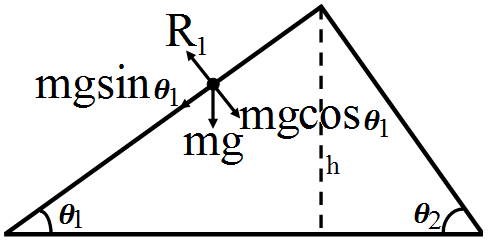
R1 is the normal reaction to the sphere.

Similarly, the acceleration produced in the sphere when it rolls down the plane inclined at $\theta_2$ is,

$\text{g}\sin\theta_2$

  1. The various forces acting on the sphere are shown in the following figure:
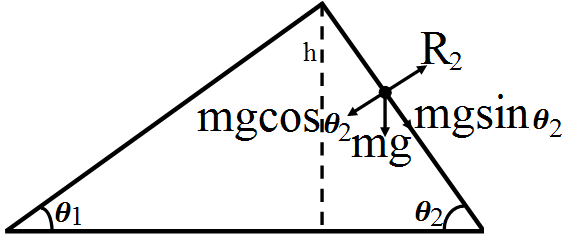
R2 is the normal reaction to the sphere.

$\theta_2>\theta_1,\sin\theta_2>\sin\theta_1\ ...(\text{i})$

$\therefore\text{ a}_2>\text{a}_1\ ...(\text{ii})$

Initial velocity, u = 0

Final velocity, v = Constant

Using the first equation of motion, we can obtain the time of roll as,

$\text{v}=\text{u}+\text{at}$

$\therefore\ \text{t}\propto\Big(\frac{1}{\alpha}\Big)$

For inclination $\theta_1: \text{t}\propto\Big(\frac{1}{\alpha_1}\Big)$

For inclination $\theta_2: \text{t}\propto\Big(\frac{1}{\alpha_2}\Big)$

From above equations, we get,

t< t1

Hence, the sphere will take a longer time to reach the bottom of the inclined plane having the smaller inclination.
Need a full question paper?

Generate a complete, print-ready paper with questions like this in minutes — across 16+ boards, with answer keys.

Start Generating Free

Similar questions

A body of mass 5kg is acted upon by two perpendicular forces 8N and 6N. Give the magnitude and direction of the acceleration of the body.
At what temperature is the root mean square speed of an atom in an argon gas cylinder equal to the rms speed of a helium gas atom at-20°C? (atomic mass of Ar = 39.9u, of He = 4.0u).
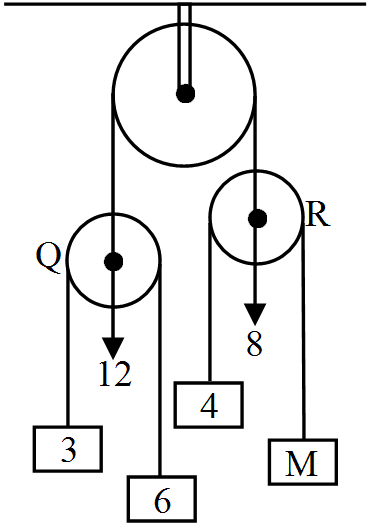
Two pulleys of masses 12kg and 8kg are connected by a fine string hanging over a fixed pulley as shown. Over the 8kg pulley is hung a fine string with masses 4kg and M. Over the 12kg pulley is hung another fine string with masses 3kg and 6kg. Calculate M so that the string over the fixed pulley remains stationary.

In a harbour, wind is blowing at the speed of 72km/h and the flag on the mast of a boat anchored in the harbour flutters along the N-E direction. If the boat starts moving at a speed of 51km/h to the north, what is the direction of the flag on the mast of the boat?
An object falling through a fluid is observed to have acceleration given by a = g - bv where g = gravitational acceleration and b is constant. After a long time of release, it is observed to fall with constant speed. What must be the value of constant speed?
A cricketer can throw a ball to a maximum horizontal distance of 100m. How much high above the ground can the cricketer throw the same ball?
A rod, when suspended in a magnetic field, stays in the east-west direction. Can we be sure that the field is in the east-west direction? Can it be in the north-south direction?
The Marina trench is located in the Pacific Ocean, and at one place it is nearly eleven km beneath the surface of water. The water pressure at the bottom of the trench is about 1.1 × 10⁸ Pa. A steel ball of initial volume 0.32m3 is dropped into the ocean and falls to the bottom of the trench. What is the change in the volume of the ball when it reaches to the bottom?
Can $\text{L}_\alpha$ X-ray of one material have shorter wavelength than $\text{K}_\alpha$ X-ray of another?
  1. In a carnot engine, temperature of sink is increased. What will happen to its efficiency?
  2. A carnot engine absorbs 1000J of heat from a reservoir at 127°C and rejects 600J of heat during each cycle. Calculate the
  1. Efficiency of engine.
  2. Temperature of the sink.
  3. Amount of the useful work done during each cycle.