MCQ
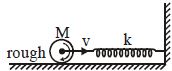
A solid sphere rolls without slipping and presses a spring of spring constant $k$ as shown in figure. Then, the maximum compression in the spring will be
  • A
    $v\sqrt {\frac{{2M}}{{3k}}} $
  • B
    $v\sqrt {\frac{{2M}}{{5k}}} $
  • C
    $v\sqrt {\frac{{5k}}{{7M}}} $
  • $v\sqrt {\frac{{7M}}{{5k}}} $

Answer

Correct option: D.
$v\sqrt {\frac{{7M}}{{5k}}} $
d
Total $KE$ of sphere

$=\frac{1}{2} \mathrm{Mv}^{2}\left(1+\frac{\mathrm{k}^{2}}{\mathrm{R}^{2}}\right)=\frac{1}{2} \mathrm{Mv}^{2}\left(1+\frac{2}{5}\right)$

$=\frac{7}{10} \mathrm{Mv}^{2}$

Which is utilised in compression in the spring.

So $\frac{1}{2} \mathrm{kx}_{\mathrm{m}}^{2}=\frac{7}{10} \mathrm{Mv}^{2} \Rightarrow \mathrm{x}_{\mathrm{m}}=\mathrm{v} \sqrt{\frac{7 \mathrm{M}}{5 \mathrm{k}}}$

Need a full question paper?

Generate a complete, print-ready paper with questions like this in minutes — across 16+ boards, with answer keys.

Start Generating Free

Similar questions

A body is thrown vertically upwards with a velocity of $19.6\, ms^{-1}$. The position of the body after $4\, s $ will be
A wire of length $50\, cm$ and cross sectional area of $1$ sq. mm is extended by $1\, mm.$ The required work will be      $(Y = 2 \times {10^{10}}\,N{m^{ - 2}})$
A Spherical ball of radius $1 mm$ and density $10.5 g / cc$ is dropped in glycerine of coefficient of viscosity $9.8$ poise and density $1.5 g / cc$. Viscous force on the ball when it attains constant velocity is $3696 \times 10^{-x} N$. The value of $x$ is $\text { (Given, } g =9.8 m / s ^2 \text { and } \pi=\frac{22}{7} \text { ) }$
The $K.E.$ and $P.E.$ of a particle executing $SHM$ with amplitude $A$ will be equal when its displacement is
Suppose there is a hole in a copper plate. On heating the plate, diameter of hole, would
A large tank filled with water to a height ‘h’ is to be emptied through a small hole at the bottom. The ratio of time taken for the level of water to fall from $ h$  to $\frac{h}{2}$ and from $\frac{h}{2}$ to zero is
The displacement of a particle is proportional to the cube of time elapsed. How does the acceleration of the particle depends on time obtained
The position vector of the centre of mass $\vec r\, cm$ of an asymmetric uniform bar of negligible area of cross-section as shown in figure is
A liquid disturbed by stirring comes to rest after some time due to its property of
The initial pressure and volume of an ideal gas are $P_0$ and $V_0$. The final pressure of the gas when the gas is suddenly compressed to volume $\frac{ V _0}{4}$ will be (Given $\gamma=$ ratio of specific heats at constant pressure and at constant volume)