MCQ
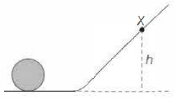
A solid sphere rolls without slipping, first horizontally and then up to a point $X$ at height $h$ on an inclined plane before rolling down, as shown in the figure below. The initial horizontal speed of the sphere is
  • $\sqrt{10 g h / 7}$
  • B
    $\sqrt{7 g h / 5}$
  • C
    $\sqrt{5 g h / 7}$
  • D
    $\sqrt{2 g h}$

Answer

Correct option: A.
$\sqrt{10 g h / 7}$
a
(a)

Let initial horizontal speed of sphere is $v$.

Then, total kinetic energy of sphere on horizontal part

$=( KE )_{\text {translation }}+( KE )_{\text {rotation }}$

$=\frac{1}{2} m v^2+\frac{1}{2} I \omega^2$

$=\frac{1}{2} m v^2+\frac{1}{2} \times \frac{2}{5} m R^2 \times \frac{v^2}{R^2}=\frac{7}{10} m v^2$

If sphere rises upto height $h$ then, by conservation of energy, we have

$m g h=\frac{7}{10} m v^2$

$\text { or } \quad v=\sqrt{\frac{10}{7} g h}$

Need a full question paper?

Generate a complete, print-ready paper with questions like this in minutes — across 16+ boards, with answer keys.

Start Generating Free

Similar questions

An object is projected from ground with speed $u$ at angle $\theta$ with horizontal. the radius of curvature of its trajectory at maximum height from ground is ..........
The dimensions of the product $\mu_{0} \varepsilon_{0}$ are related to those of velocity as
A particle of mass $m$ is acted upon by a force $F$ given by the empirical law $F = \frac{R}{{{t^2}}}\,v(t)$. If this law is to be tested experimentally by observing the motion starting from rest, the best way is to plot 
A projectile is thrown with an initial velocity of $(a \hat{ i }+b \hat{ j }) ms ^{-1}$. If the range of the projectile is twice the maximum height reached by it, then
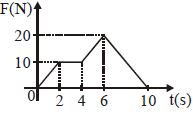
A particle of mass $2\, kg$ is initially at rest. A force acts on it whose magnitude changes  with time. The force time graph is shown below. The velocity of the particle after $10\, s$ is ......... $ms^{-1}$
Match List-$I$ with List-$II$ :

List-$I$ List-$II$
$(A)$  A force thatrestores anelastic body of unit area to its original state $(I)$ Bulkmodulus
$(B)$  Two equal andopposite forcesparallel toopposite faces $(II)$Young'smodulus
$(C)$Forcesperpendiculareverywhere tothe surface perunit areasameeverywhere $(III)$ Stress
$(D)$Two equal andopposite forceperpendicular toopposite faces $(IV)$ Shearmodulus

Choose the correct answer from the options given below:

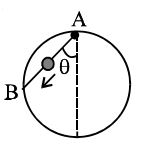
A bead is free to slide down a smooth wire tightly stretched between points $A$ and $B$ on a vertical circle. If the bead starts from rest at $A$, the highest point on the circle
An artificial satellite is moving around earth in a circular orbit with speed equal to one fourth the escape speed of a body from the surface of earth. The height of satellite above earth's surface is ............ ($R$ is radius of earth)
A man carrying a monkey on his shoulder does cycling smoothly on a circular track of radius $9 \mathrm{~m}$ and completes $120$ revolutions in $3$ minutes. The magnitude of centripetal acceleration of monkey is (in $\mathrm{m} / \mathrm{s}^2$ ):
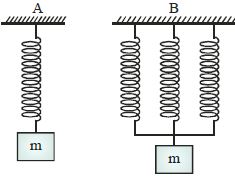
The springs in figure. $A$ and $B$ are identical but length in $A$ is three times that in $B$. The ratio of period $T_A/T_B$ is