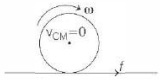
MCQ
A solid sphere spinning about a horizontal axis with an angular velocity $\omega$ is placed on a horizontal surface. Subsequently it rolls without slipping with an angular velocity of
  • A
    $2 \omega / 5$
  • B
    $7 \omega / 5$
  • $2 \omega / 7$
  • D
    $\omega$

Answer

Correct option: C.
$2 \omega / 7$
c
(c)

Initially slipping occurs at point of contact and friction acts in forward direction.

Friction produces acceleration of centre of mass.

Acceleration of centre of mass caused by friction is

$a_{ CM }=\frac{F}{m}=\frac{\mu_k m g}{m}=\mu_k g$

Angular deacceleration caused by friction is

$\alpha=\frac{\tau}{I}=\frac{f R}{I}=\frac{-\mu_k m g R}{\frac{2}{\tilde{\partial}} m R^2}=-\frac{5 \mu_k g}{2 R}$

After time $t$, velocity of centre of mass is

$v_{ CM }=u_{ CM }+a_{ CM } t=0+\mu_k g t=\mu_k g t$

and angular velocity is

$\omega=\omega_0+\alpha t=\omega_{0}-\frac{5 \mu_k g}{2 R}, t$

Pure rolling begins

when $\omega-\frac{v_{ CM }-\mu_k g t}{R} \frac{R}{R-\mu_k}$

So, $\quad \frac{\mu_k g t}{R}=\omega_0-\frac{5}{2} \frac{\mu_k g t}{R}$

$\Rightarrow \quad \frac{7}{2} \frac{\mu_k g t}{R}=\omega \Rightarrow t=\frac{2 R \omega_0}{7 \mu_k g}$

So, angular speed when pure rolling occurs is

$\omega_f=\omega+\alpha t=\omega-\frac{5 \mu_k g}{2 R} \cdot \frac{2 R \omega}{7 \mu_k g}$

$=\omega\left(1-\frac{5}{7}\right)=\frac{2}{7} \omega$
Need a full question paper?

Generate a complete, print-ready paper with questions like this in minutes — across 16+ boards, with answer keys.
Start Generating Free

Similar questions

A wire is suspended by one end. At the other end a weight equivalent to $20\, N$ force is applied. If the increase in length is $1.0\, mm,$ the ratio of the increase in energy of the wire to the decrease in gravitational potential energy when load moves downwards by $1\, mm,$ will be
The particle executing $SHM$ of amplitude $'a'$ has displacement $-\frac {a}{2}$ at $t = \frac {T}{4}$ and a positive velocity. Find the initial phase of particle
Water from a tap emerges vertically downwards with an initial speed of $1.0\,ms^{-1}.$ The cross-sectional area of the tap is $10^{-4}\,m^2.$ Assume that the pressure is constant throughout the stream of water and that flow is streamlined. The cross-sectional area of the stream, $0.15\,m$ below the tap would be: (take $g = 10\,ms^{-2}$ )
A particle is released from rest at the point $x = a$ and moves along the $x$ axis subject to the potential energy function $U(x)$ shown. The particle:
The adjoining figure shows a disc of mass $M$ and radius $R$ lying in the $X-Y$ plane with its centre on $X - $ axis at a distance $a$ from the origin. Then the moment of inertia of the disc about the $X-$ axis is
The dimensional formula for thermal resistance is
The diatomic molecule is treated as:
The earth is assumed to be a sphere of radius $R.$ A platform is arranged at a height $R$ from the surface of the earth. The escape velocity of a body from this platform is $fv$, where $v$ is its escape velocity from the surface of the Earth. The value of $f$ is
A $20\, kg$ block is initially at rest on a rough horizontal surface. A horizontal force of $75 \,N$ is required to set the block in motion. After it is in motion, a horizontal force of $60\, N$ is required to keep the block moving with constant speed. The coefficient of static friction is
1 mole of an ideal gas is contained in a cubical volume V, ABCDEFGH at 300K (figure). One face of the cube (EFGH) is made up of a material which totally absorbs any gas molecule incident on it. At any given time,