Question
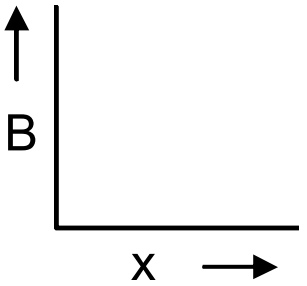
A solid wire of radius $10\ cm$ carries a current $5.0\ A$ distributed uniformly over its cross-section. Find the magnetic field B at a point at a distance (a) $2\ cm$ (b) $10\ cm$ and (c) $20\ cm$ away from the axis. Sketch a graph of $B$ versus $x$ for $0 < x < 20\ cm$.

Answer

  1. $r = 10cm = 10 \times 10^{-2}m$
$x = 2 \times 10^{-2}m,$
$i = 5A$
i in the region of radius 2cm
$\frac{5}{\pi(10\times\times10^{-2})^2}\times\pi(2\times10^{-2})^2=0.2\text{A}$
$\text{B}\times\pi(2\times10^{-2})^2=\mu_0(0-2)$
$\Rightarrow\text{B}=\frac{4\pi\times10^{-7}\times0.2}{\pi\times4\times10^{-4}}=\frac{0.2\times10^{-7}}{10^{-4}}=2\times10^{-4}$
  1. $10\ cm$ radius
$\text{B}\times\pi(10\times10^{-2})^2=\mu_0\times5$
$\Rightarrow\text{B}=\frac{4\pi\times10^{-7}\times5}{\pi\times10^{-2}}=20\times10^{-5}$​​​​​​​
  1. $x = 20\ cm$
$\text{B}\times\pi(20\times10^{-2})^2=\mu_0\times5$
$\Rightarrow\text{B}=\frac{\mu_0\times5}{\pi\times(20\times10^{-2})^2}=\frac{4\pi10^{-7}\times5}{\pi\times400\times10^{-4}}=5\times10^{-5}$​​​​​​​

Need a full question paper?

Generate a complete, print-ready paper with questions like this in minutes — across 16+ boards, with answer keys.

Start Generating Free

Similar questions

A 45 kg boy whose leg bones are $5 \mathrm{~cm}^2$ in area and 50 cm long falls through a height of 2 m without breaking his leg bones. If the bones can withstand a stress of $0.9 \times 10^8 \mathrm{~N} / \mathrm{m}^2$, calculate the Young's modulus for the material of the bone. Use, $g=10 \mathrm{~ms}^{-2}$.
A particle executes S.H.M of time period $10s$. The displacement at any instant is given by the relation $\text{x}=10\sin\omega\text{t}$ Find
  1. Velocity of the body 2s after it passes through the mean position and
  2. The acceleration 2s after it passes the mean position (Amplitude is given in cm).
In an experiment to estimate the size of a molecule of oleic acid $1mL$ of oleic acid is dissolved in $19mL$ of alcohol. Then $1mL$ of this solution is diluted to $20mL$ by adding alcohol. Now $1$ drop of this diluted solution is placed on water in a shallow trough. The solution spreads over the surface of water forming one molecule thick layer. Now, lycopodium powder is sprinkled evenly over the film and its diameter is measured. Knowing the volume of the drop and area of the film we can calculate the thickness of the film which will give us the size of oleic acid molecule. Read the passage carefully and answer the following questions:
  1. Why do we dissolve oleic acid in alcohol?
  2. What is the role of lycopodium powder?
  3. What would be the volume of oleic acid in each $mL$ of solution prepared?
  4. How will you calculate the volume of $n$ drops of this solution of oleic acid?
  5. What will be the volume of oleic acid in one drop of this solution?
Three blocks are connected as shown on a horizontal frictionless table, and pulled to the right with a force of $T_3 = 60N$.
If $m_1 = 10kg, m_2 = 20kg$ and $m_3 = 30kg$. Prove that $\frac{\text{T}_1}{\text{T}_2}=\frac{1}{3}.$
Suppose the friction coefficient between the ground and the ladder of the previous problem is 0.540. Find the maximum weight of a mechanic who could go up and do the work from the same position of the ladder.
Two bodies A and B of masses 5kg and 10kg in contact with each other rest on a table against a rigid wall (Fig.). The coefficient of friction between the bodies and the table is 0.15. A force of 200N is applied horizontally to A. What are (a) the reaction of the partition (b) the action-reaction forces between A and B? What happens when the wall is removed? Does the answer to (b) change, when the bodies are in motion? Ignore the difference between $µ_s$ and $µ_k$.
A mild steel wire of length $1.0m$ and cross-sectional area $0.50 \times 10^{-2}cm^2$ is stretched, well within its elastic limit, horizontally between two pillars. A mass of $100g$ is suspended from the mid-point of the wire. Calculate the depression at the midpoint.
The molecules of a given mass of a gas have root mean square speeds of 1 $100ms− at 27C ^\circ$ and $1.00$ atmospheric pressure. What will be the root mean square speeds of the molecules of the gas at $127^\circ C$ and $2.0$ atmospheric pressure?
A non-uniform bar of weight W is suspended at rest by two strings of negligible weight as shown in. The angles made by the strings with the vertical are $36.9°$ and $53.1°$ respectively. The bar is $2m$ long. Calculate the distance d of the centre of gravity of the bar from its left end.
When a body slides down from rest along a smooth inclined plane making an angle of 45° with the horizontal, it takes time T. When the same body slides down from rest along a rough inclined plane making the same angle and through the same distance, it is seen to take time pT, where p is some number greater than 1. Calculate the co-efficient of friction between the body and the rough plane.