MCQ
A solid $XY$ kept in an evacuated sealed container undergoes decomposition to form a mixture of gases $X$ and $Y$ at temperature $T$. The equilibrium pressure is $10\, bar$ in the vessel. $K_p$ for this reaction is
- ✓$25$
- B$100$
- C$10$
- D$5$
At eq.,
Total pressure $ = 2P = 10\,bar$
$\therefore \,p = 5;\,Now\,{K_p} = ({P_x})({P_y}) = {p^2} = 25$
Generate a complete, print-ready paper with questions like this in minutes — across 16+ boards, with answer keys.
(ii) Silver metal does not react with $1 M$ zinc nitrate solution
(iii) Zinc metal dissolves in $1M$ copper sulphate solution and copper metal gets depositedHence the order of decreasing strength of the three metals as reducing agents will be
$\begin{array}{*{20}{c}}
{^{C{H_3}}} \\
{_H}
\end{array}\begin{array}{*{20}{c}}
{{\text{ }}\backslash {\text{ }}} \\
/
\end{array}\mathop C\limits^{} {\mkern 1mu} = \mathop C\limits^{} {\mkern 1mu} \begin{array}{*{20}{c}}
/ \\
{{\text{ }}\backslash {\text{ }}}
\end{array}_{\mathop C\limits^{} {\kern 1pt} \equiv \mathop C\limits^{} {\kern 1pt} - \mathop C\limits^{} {\kern 1pt} {H_2}\mathop C\limits^{} {\kern 1pt} {H_3}}^H{\mkern 1mu} $
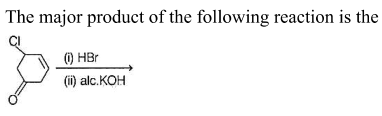
| Column $-I$ | Column $-II$ |
| $(A)$ Ionisation potential | $(P)$ $O < F < N$ |
| $(B)$ Electronegativity | $(Q)$ $N < O < F$ |
| $(C)$ $Z_{eff}$ | $(R)$ $O < N < F$ |
| $(D)$ Electron affinity | $(S)$ $N < C< O$ |