- A$I_2$ will be reduced to $I^-$
- Bthere will be no redox reaction
- ✓$I^-$ will be oxidised to $I_2$
- D$Fe^{2+}$ will be oxidised to $Fe^{3+}$
If $\mathrm{Fe}^{3+} / \mathrm{Fe}^{2+}(=+0.77 \mathrm{V})$ is greater than that of $I_{2} / 2 \mathrm{I}^{-}(=0.536 \mathrm{V}),$ Fe $^{3+}$ will be reduced to $\mathrm{Fe}^{2+}$ and $I^-$ will be oxidised to $I_2$.
Generate a complete, print-ready paper with questions like this in minutes — across 16+ boards, with answer keys.
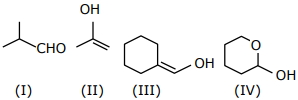
structure of $(A)$ is
$E_{\frac{1}{2}Cl_2/Cl^- }^o = 1.36\,V\,,\,E_{C{r^{3 + }}/Cr}^o = - 0.74\,V$
$E_{C{r_2}O_7^{2 - }/C{r^{3 + }}}^o = 1.33\,V\,,\,E_{MnO_4^ - /M{n^{2 + }}}^o = 1.51\,V$
The correct order of reducing power of the species $(Cr, Cr^{3+}, Mn^{2+}$ and $Cl^-)$ will be

Statement $I$: The boiling point of hydrides of Group $16$ elements follow the order
$\mathrm{H}_2 \mathrm{O}>\mathrm{H}_2 \mathrm{Te}>\mathrm{H}_2 \mathrm{Se}>\mathrm{H}_2 \mathrm{~S}$.
Statement $II$: On the basis of molecular mass, $\mathrm{H}_2 \mathrm{O}$ is expected to have lower boiling point than the othe members of the group but due to the presence of extensive $\mathrm{H}$-bonding in $\mathrm{H}_2 \mathrm{O}$, it has higher boiling point.
In the light of the above statements, choose the correct answer from the options given below:
Statement $I:$ Iron $(III)$ catalyst, acidified $K _{2} Cr _{2} O _{7}$ and neutral $KMnO _{4}$ have the ability to oxidise $I$ to $I _{2}$ independently.
Statement $II$: Manganate ion is paramagnetic in nature and involves $p \pi- p \pi$ bonding.
In the light of the above statements, choose the correct answer from the options.