MCQ
A solution that obeys Raoult's law is
  • A
    Normal
  • B
    Molar
  • Ideal
  • D
    Saturated

Answer

Correct option: C.
Ideal
c
A solution that obeys Raoult's law is known as ideal solution.

Since Raoult's Law only works for ideal solutions. An ideal solution is defined as one which obeys Raoult's Law.

Need a full question paper?

Generate a complete, print-ready paper with questions like this in minutes — across 16+ boards, with answer keys.

Start Generating Free

Similar questions

A metal $M$ which is not affected by strong acids like conc. $HNO_3$ , conc. $H_2SO_4$ and conc. solution of alkalies like $NaOH, KOH$ forms $MCl_3$, which finds use for ranning in photography ? The metal $M$ is
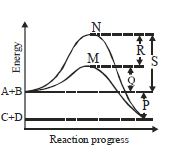
${\text{A(g)  +  B(g) }} \rightleftharpoons {\text{C(g)  +  D(g)}}$ 

The curves $M$ and $N$ represent the variation of energy with reaction coordinate for the reaction in absence and presence of catalyst

Which value represents the activation energy $(E_a)$ for the backward reaction in the presence of catalyst
$(i)$ ${K_4}[Fe{(CN)_6}]$ $(ii)$ ${K_3}[Cr{(CN)_6}]$ $(iii)$ ${K_3}[Fe{(CN)_6}]$ $(iv)$ ${K_2}[Ni{(CN)_4}$ Choose the complex which is paramagnetic
Cyclohexane, a hydrocarbon floats on water because
When ethyl bromide reacts with sodium acetylide the main product is
Which of the following salts undergoes hydrolysis
If $p_x$ and $p_y$ orbital participate in $sp^2$ hybridisation of sulphur atom in $SO_3$ , then the $d$ orbitals which are used in $p\pi  -d\pi $ bonds are
An organic compound $^1C{H_3}{ - ^2}C{H_2}{ - ^3}C{H_2}{ - ^4}C{H_2}{ - ^5}C{H_2}{ - ^6}C{H_2}{ - ^7}C{H_3}$

To make it chiral compound the attack should be on which carbon atom

Product $(A)$ of the above reaction is
Total enthalpy change for freezing of 1 mol of water at $10^{\circ} \mathrm{C}$ to ice at $-10^{\circ} \mathrm{C}$ is __________
(Given: $\Delta_{\text {fus }} \mathrm{H}=\mathrm{x} \mathrm{kJ} / \mathrm{mol}$
$\mathrm{C}_{\mathrm{p}}\left[\mathrm{H}_{2} \mathrm{O}(\mathrm{l})\right]=\mathrm{y}$ $\mathrm{J} \mathrm{mol}^{-1} \mathrm{~K}^{-1}$
$\mathrm{C}_{\mathrm{p}}\left[\mathrm{H}_{2} \mathrm{O}(\mathrm{s})\right]=\mathrm{z}$ $\mathrm{J} \mathrm{mol}^{-1} \mathrm{~K}^{-1}$