Question
 A source and an observer are approaching one another with velocity $4 m / s$. If the true frequency is $1200 Hz$ , deduce the observed frequency under the following conditions:
i. All velocity is in the source alone.
ii. All velocity is in the observer alone.
Take the velocity of sound waves in air to be $340 ms^{-1}$.
Answer

  1. $\text{v}'=\text{v}\Big(\frac{\nu}{\nu-\nu_\text{s}}\Big)=1200\Big(\frac{340}{336}\Big)\text{ft}$
$=1214.28\text{Hz}$
  1. $\text{v}'=\text{v}\Big(\frac{\nu+\nu_0}{\nu_0}\Big)=1200\Big(\frac{344}{340}\Big)$
$=1214.11\text{Hz}$

Need a full question paper?

Generate a complete, print-ready paper with questions like this in minutes — across 16+ boards, with answer keys.

Start Generating Free

Similar questions

State the law of conservation of momentum. Establish the same for a 'n' body system.
The bottom of a dip on a road has a radius of curvature R. A rickshaw of mass M left a little away from the bottom oscillates about this dip. Deduce an expression for the period of oscillation.
A particle of mass 4m which is at rest explodes into three fragments. Two of these fragments each of mass m, are found to move with a speed of v, each in mutually perpendicular direction. What is the total energy released in this process?
A vessel contains $1.60g$ of oxygen and $2.80g$ of nitrogen. The temperature is maintained at $300K$ and the volume of the vessel is $0.166m^3$. Find the pressure of the mixture.
A liquid drop of diameter $4mm$ breaks into $1000$ droplets of equal size. Calculate the resultant change in surface energy. The surface tension of the liquid is $0.07Nm^{-1}$
Molar volume is the volume occupied by 1mol of any (ideal) gas at standard temperature and pressure: (STP: 1 atmospheric pressure, $0°C$). Show that it is $22.4$ litres.
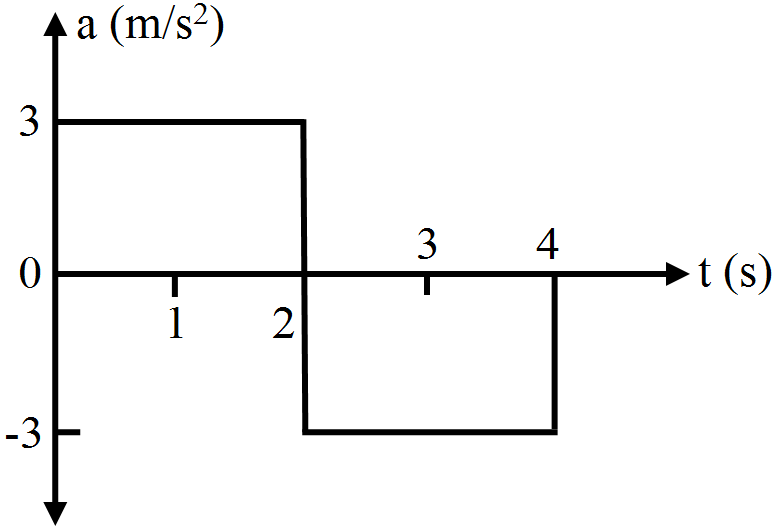
A particle starts from rest at $t = 0$ and has an acceleration as given in the figure below. Draw the v-t graph for $4$ seconds.
If a satellite is revolving around a planet of mass M in an elliptical orbit of semi major axis a, show that orbital speed v of the satellite when at a distance r from the focus will be given by $\text{v}^2=\text{GM}\Big(\frac{2}{\text{r}}-\frac{1}{\text{a}}\Big)$
Calculate the root-mean square speed of oxygen molecules at $1092K$. Density of oxygen at STP = $1.424kg-m^{-3}$.
Prove that for an earth satellite, the ratio of its velocity at apogee (when farthest from earth) to its velocity at perigee (when nearest to earth) is equal to the inverse ratio of its distances from apogee and perigee.