Question
A source and an observer are approaching one another with velocity 4m/s. If the true frequency is 1200Hz, deduce the observed frequency under the following conditions:
  1. All velocity is in the source alone.
  2. All velocity is in the observer alone.
Take the velocity of sound waves in air to be 340ms-1.

Answer

  1. $\text{v}'=\text{v}\Big(\frac{\nu}{\nu-\nu_\text{s}}\Big)=1200\Big(\frac{340}{336}\Big)\text{ft}$

$=1214.28\text{Hz}$

  1. $\text{v}'=\text{v}\Big(\frac{\nu+\nu_0}{\nu_0}\Big)=1200\Big(\frac{344}{340}\Big)$

$=1214.11\text{Hz}$

Need a full question paper?

Generate a complete, print-ready paper with questions like this in minutes — across 16+ boards, with answer keys.

Start Generating Free

Similar questions

What is the ratio of maxmimum acceleration to the maximum velocity of a simple harmonic oscillator?
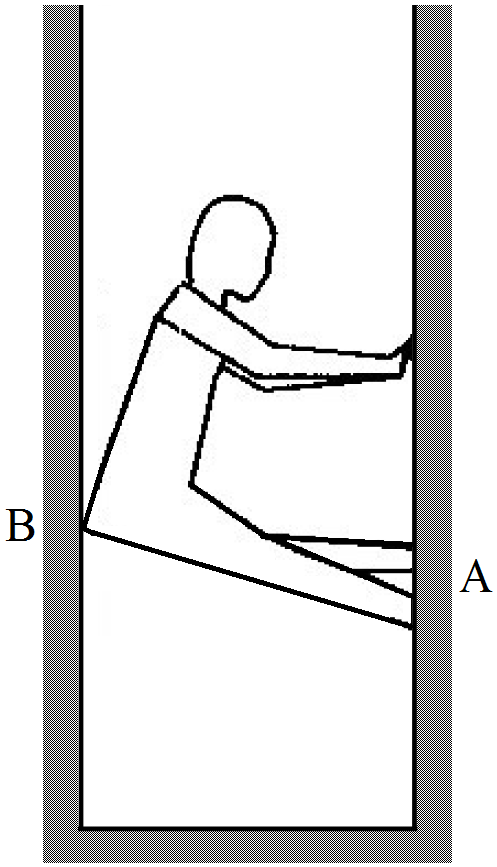
A person (40kg) is managing to be at rest between two vertical walls by pressing one wall A by his hands and feet and the other wall B by his back. Assume that the friction coefficient between his body and the walls is 0.8 and that limiting friction acts at all the contacts.
  1. Show that the person pushes the two walls with equal force.
  2. Find the normal force exerted by either wall on the person. Take g = 10m/s2.
​​​​​​​
A shell bursts on contact with the ground and the fragments fly in all directions with speeds upto 39.2m/ s. Show that a man 78.4m away is in danger for $4\sqrt{2}$ seconds.
A man uses a concave mirror for shaving. He keeps his face at a distance of 25cm from the mirror and gets an image which is 1.4 times enlarged. Find the focal length of the mirror.
Draw areal velocity versus time graph for mars.
A child running a temperature of $101^{\circ} F$ is given an antipyrin (i.e. a medicine that lowers fever) which causes an increase in the rate of evaporation of sweat from his body. If the fever is brought down to $98^{\circ} F$ in 20 min , what is the average rate of extra evaporation caused by the drug. Assume the evaporation mechanism to be the only way by which heat is lost. The mass of the child is 30 kg . The specific heat of human body is approximately the same as that of water and latent heat of evaporation of water at that temperature is about 580 cal $g ^{-1}$.
The weight of a body at the poles is greater than the weight at the equator. Is it the actual weight or the apparent weight we are talking about? Does your answer depend on whether only the earth's rotation is taken into account or the flattening of the earth at the poles is also taken into account?​​​​​
Draw the following graphs for an object projected upward with a velocity $v _0$, which comes back to the same point after some time:
i. Acceleration versus time graph,
ii. Speed versus time graph,
iii. Velocity versus time graph.
A body is projected with velocity u at an angle $\theta_0$ upward from horizontal. Deduce the expression for:
  1. Horizontal range.
  2. Maximum height attained.
Why does a metal bar appear hotter than a wooden bar at the same temperature? Equivalently it also appears cooler than wooden bar if they are both colder than room temperature.