Question
A source of sound with adjustable frequency produces 2 beats per second with a tuning fork when its frequency is either 476Hz or 480Hz. What is the frequency of the tuning fork?

Answer

Given,

First Frequency f1 = 476Hz

Second frequency f2 = 480Hz

Number of beats produced per second by the tuning fork m = 2

As the tuning fork produces 2 beats, its frequency should be an average of two. This is given by,

$\text{f}=\frac{(\text{f}_1+\text{f}_2)}{2}$

$\text{f}=\frac{(476+480)}{2}=478\text{Hz}$

Need a full question paper?

Generate a complete, print-ready paper with questions like this in minutes — across 16+ boards, with answer keys.
Start Generating Free

Similar questions

Explain why:
A body with large reflectivity is a poor emitter.
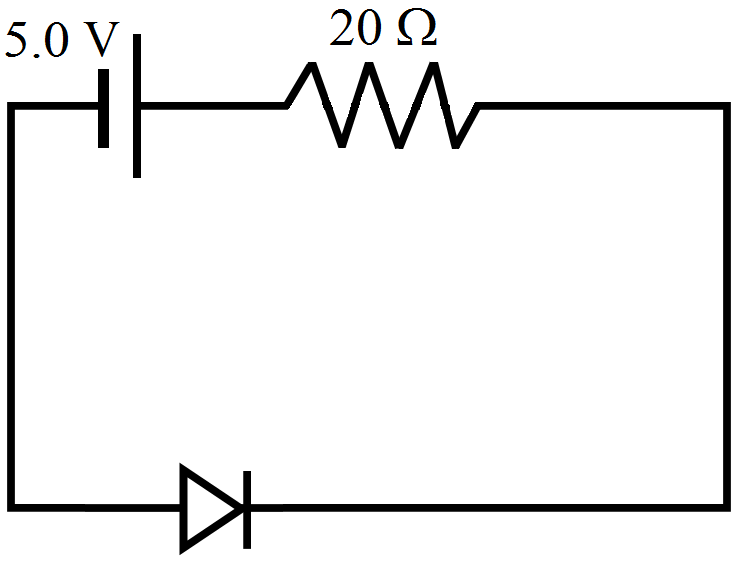
Calculate the current through the circuit and the potential difference across the diode shown in figure. The drift current for the diode is $20\mu\text{A}.$

A point source emitting 628 lumen of luminous flux uniformly in all directions is placed at the origin. Calculate the illuminance on a small area placed at (1.0m, 0, 0) in such a way that the normal to the area makes an angle of 37º with the X-axis.
What should be the maximum average velocity of water in a tube of diameter 0.5cm. So that the flow is laminar? The viscosity of water is 0.00125Nm-2s.
Two bodies are thrown from the same point with the same velocity at two different angles. Range is same as $R$ for both the bodies and time of flight is $t$ and $t^{\prime}$ then prove that
$R=\frac{1}{2} g t t^{\prime}$
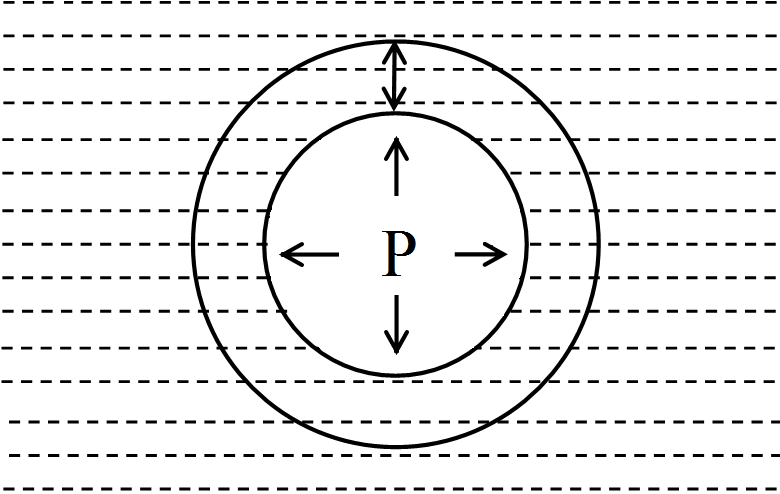
Derive an expression for the excess of pressure inside an air bubble.

Given the moment of inertia of a disc of mass M and R radius R about any of its diameters to be $\frac{\text{MR}^2}{4},$ find its moment of inertia about an axis normal to the disc and passing through a point on its rim.
Does it matter if one uses gauge instead of absolute pressures in applying Bernoulli’s equation? Explain.
A shell explodes while at rest. Discuss the momentum and energy conservation in the explosion.
A wooden block of mass 0.5kg and density 800kg/m3 is fastened to the free end of a vertical spring of spring constant 50N/m fixed at the bottom. If the entire system is completely immersed in water, find.
  1. The elongation (or compression) of the spring in equilibrium and.
  2. The time-period of vertical oscillations of the block when it is slightly depressed and released.