Question
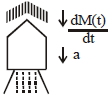
A spaceship in space sweeps stationary interplanetary dust. As a result, its mass increases at a rate $\frac{ dM ( t )}{ dt }= bv ^{2}( t ),$ where $v ( t )$ is its instantaneous velocity. The instantaneous acceleration of the satellite is

Answer

$\frac{\operatorname{dm}( t )}{ dt }= bv ^{2}$

$F _{\text {thast }}= v \frac{ dm }{ dt }$

Force on statellile $=-\overrightarrow{ v } \frac{ dm ( t )}{ dt }$

$M ( t ) a =- v \left( bv ^{2}\right)$

$a = - \frac{ bv ^{3}}{ M ( t )}$
Need a full question paper?

Generate a complete, print-ready paper with questions like this in minutes — across 16+ boards, with answer keys.
Start Generating Free

Similar questions

$A$ uniform rod of mass $m$ and length $l$ hinged at its end is released from rest when it is in the horizontal position. The normal reaction at the hinge when the rod becomes vertical is :
An $npn$ transistor operates as a common emitter amplifier, with a power gain of $60\, dB$. The input circuit resistance Is $100\,\Omega $ and the output load resistance is $10 \,k\,\Omega $. the common emitter current gain $\beta $ is
A $5.0\, amp$ current is setup in an external circuit by a $6.0\, volt$ storage battery for $6.0$ minutes. The chemical energy of the battery is reduced by
A $100 \,g$ mass stretches a particular spring by $9.8 \,cm$, when suspended vertically from it. ....... $g$ large a mass must be attached to the spring if the period of vibration is to be $6.28 \,s$.
A particle of mass $m$ undergoes oscillations about $x=0$ in a potential given by $V(x)-\frac{1}{2} k x^2-V_0 \cos \left(\frac{x}{a}\right)$, where $V_0, k, a$ are constants. If the amplitude of oscillation is much smaller than $a$, the time period is given by
A lens of power $+2$ diopters is placed in contact with a lens of power $-1$ diopter. The combination will behave like
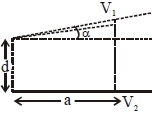
A capacitor is made of two square plates each of side $a$ making a very small angle $\alpha$ between them, as shown in figure. The capacitance will be close to
A particle of mass $m$ moving with kinetic energy $E$ collides head on elastically with another particle of mass $2m$ at rest. After collision the kinetic energy of first particle is
Adielectric slab is inserted between the plates of an isolated charged capacitor. Which of the following quantities will remain the same?
Heat is being supplied at a constant rate to a sphere of ice which is melting at the rate of $0.1 \,\,gm/sec$. It melts completely in $100\,\,sec$. The rate of rise of temperature thereafter will be ........$^oC/\sec$ (Assume no loss of heat.)