MCQ
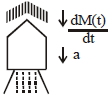
A spaceship in space sweeps stationary interplanetary dust. As a result, its mass increases at a rate $\frac{ dM ( t )}{ dt }= bv ^{2}( t ),$ where $v ( t )$ is its instantaneous velocity. The instantaneous acceleration of the satellite is
  • A
    $-\frac{2 b v^{3}}{M(t)}$
  • B
    $-\frac{ bv ^{3}}{2 M ( t )}$
  • C
    $-b v^{3}(t)$
  • $-\frac{b v^{3}}{M(t)}$

Answer

Correct option: D.
$-\frac{b v^{3}}{M(t)}$
d
$\frac{\operatorname{dm}( t )}{ dt }= bv ^{2}$

$F _{\text {thast }}= v \frac{ dm }{ dt }$

Force on statellile $=-\overrightarrow{ v } \frac{ dm ( t )}{ dt }$

$M ( t ) a =- v \left( bv ^{2}\right)$

$a = - \frac{ bv ^{3}}{ M ( t )}$

Need a full question paper?

Generate a complete, print-ready paper with questions like this in minutes — across 16+ boards, with answer keys.

Start Generating Free

Similar questions

The Poisson's ratio cannot have the value
A cell of $emf$ $E$ and internal resistance $r$ is connected in series with an external resistacne $nr.$ Then, the ratio of the terminal potential difference to $emf$ is
The coefficient of restitution $e$ for a perfectly elastic collision is
A convex mirror of focal length $10\,cm$ is shown in figure. A linear object $AB = 5\,cm$ is placed along the optical axis. Point $B$ is at distance $20\,cm$ from the pole of mirror. Then size of image of $AB$ will be
The resistance of a heater coil is $110\, ohm$. A resistance $R$ is connected in parallel with it and the combination is joined in series with a resistance of $11\, ohm$ to a $220\, volt$ main line. The heater operates with a power of $110\, watt$. The value of $R$ in $ohm$ is
A proton and an alpha particle are separately projected in a region where a uniform magnetic field exists. Their initial velocities are perpendicular to direction of magnetic field. If both the particles move around magnetic field in circles of equal radii, the ratio of momentum of proton to alpha particle $\left( {\frac{{{P_p}}}{{{P_\alpha }}}} \right)$ is
The de-Broglie wavelength of a neutron at $27^oC$ is $\lambda$ What will be its wavelength at $927^oC$
Which of the following will form stable hydrate ?
An electron in hydrogen atom first jumps from second excited state to first excited state and then, from first excited state to ground state. Let the ratio of wavelength, momentum and energy of photons in the two cases be $x, y$ and $z,$ then select the wrong answer/(s) :
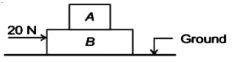
Blocks shown in figure moves with constant velocity $10 \,m / s$ towards right. All surfaces in contact are rough. The friction force applied by $B$ on $A$ is ...........$N$