MCQ
A sphere and a cube of same material and same volume are heated upto same temperature and allowed to cool in the same surroundings. The ratio of the amounts of radiations emitted will be
  • A
    $1:1$
  • B
    $\frac{{4\pi }}{3}\,\,:\,\,1$
  • ${\left( {\frac{\pi }{6}} \right)^{1/3}}:\,\,1$
  • D
    $\frac{1}{2}\,{\left( {\frac{{4\pi }}{3}} \right)^{2/3}}:\,\,1$

Answer

Correct option: C.
${\left( {\frac{\pi }{6}} \right)^{1/3}}:\,\,1$
c
(c) $Q$ = $\sigma$ $A$ t ($T_4$ -$T_0^4$)

If $T, T_0, \sigma $ and t are same for both bodies then $\frac{{{Q_{sphere}}}}{{{Q_{cube}}}} = \frac{{{A_{sphere}}}}{{{A_{cube}}}} = \frac{{4\pi {r^2}}}{{6{a^2}}}$ …..$(i)$

But according to problem, volume of sphere = Volume of cube

==> $\frac{4}{3}\pi {r^3} = {a^3}$

==> $a = {\left( {\frac{4}{3}\pi } \right)^{1/3}}r$

Substituting the value of a in equation $(i)$ we get

$\frac{{{Q_{sphere}}}}{{{Q_{cube}}}} = \frac{{4\pi {r^2}}}{{6{a^2}}} = \frac{{4\pi {r^2}}}{{6{{\left\{ {{{\left( {\frac{4}{3}\pi } \right)}^{1/3}}r} \right\}}^2}}}$

$ = \frac{{4\pi {r^2}}}{{6\,{{\left( {\frac{4}{3}\pi } \right)}^{2/3}}{r^2}}} = {\left( {\frac{\pi }{6}} \right)^{1/3}}:1$
Need a full question paper?

Generate a complete, print-ready paper with questions like this in minutes — across 16+ boards, with answer keys.

Start Generating Free

Similar questions

A bungee jumper is jumping with help of elastic ideal rope (Force constant $K$). Jumper steps off the bridge and falls from the rest towards the river below. He does not hit the water. The mass of jumper is $m$, natural length of rope is $l$. Gravity is $g$, assume every thing ideal. then, choose the incorrect option
An air bubble of diameter $6\,mm$ rises steadily through a solution of density $1750\,kg / m ^3$ at the rate of $0.35\,cm / s$. The co-efficient of viscosity of the solution (neglect density of air) is $..........\,Pas$ (given, $g =10\,ms ^{-2}$)
Two stones of masses $m_1$ and $m_2$ (such that $m_1 > m_2$ ) are dropped $\Delta t$ time apart from the same height towards the ground. At a later time $t$, the difference in their speed is $\Delta v$ and their mutual separation is $\Delta \varepsilon$. While both stones are in flight
Let $\mathop A\limits^ \to  $ be a unit vector along the axis of rotation of a purely rotating body and $\mathop B\limits^ \to  $ be a unit vector along the velocity of a particle $ P$ of the body away from the axis. The value of $\mathop A\limits^ \to  .\mathop B\limits^ \to  $ is
Entropy of a system decreases .........
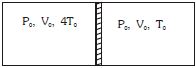
Figure shows a cylindrical adiabatic container of total volume $2V_0$ divided into two equal parts by a conducting piston (which is free to move). Each part containing identical gas at pressure $P_0$ . Initially temperature of left and right part is $4T_0$ and $T_0$ respectively. An external force is applied on the piston to keep the piston at rest. Find the value of external force required when thermal equilibrium is reached. ( $A =$ Area of piston)
The displacement of a particle is given by $y = a + bt + c{t^2} - d{t^4}$. The initial velocity and acceleration are respectively
A container $X$ has volume double that of contianer $Y$ and both are connected by a thin tube. Both contains same ideal gas. The temperature of $X$ is $200\,\,K$ and that of $Y$ is $400\,\,K$. If mass of gas in $X$ is $m$ then in $Y$ it will be:
If an electric fan is run in a heat-insulated closed room, then the temperature of the roons air will be:
Two mole of oxygen is mixed with eight mole of helium. The effective specific heat of the mixture  at constant volume is: