Question
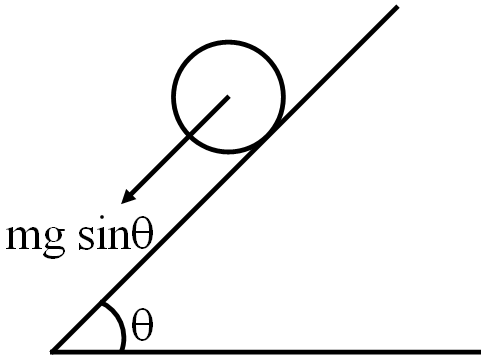
A sphere cannot roll on:
  1. A smooth horizontal surface.
  2. A smooth inclined surface.
  3. A rough horizontal surface.
  4. A rough inclined surface.

Answer

  1. A smooth horizontal surface.
  2. A smooth inclined surface.
Explanation:
A sphere cannot roll on a smooth inclined surface and on a smooth horizontal surface because there is no backward force (force of friction) to prevent its slipping.

Need a full question paper?

Generate a complete, print-ready paper with questions like this in minutes — across 16+ boards, with answer keys.

Start Generating Free

Similar questions

If an electron moves from rest from a point at which potential is $50$ volt to another point at which potential is $70$ volt, then its kinetic energy in the final state will be
The dielectric constant K of an insulator will be-
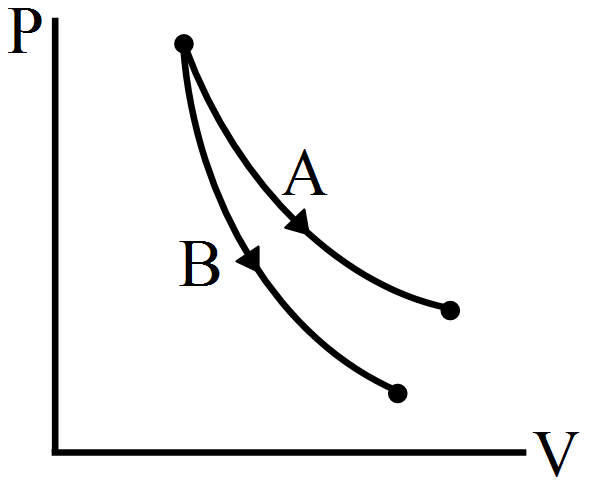
Consider the processes A and B shown in the figure. It is possible that:
  1. Both the processes are isothermal.
  2. Both the processes are adiabatic.
  3. A is isothermal and B is adiabatic.
  4. A is adiabatic and B is isothermal.
On connecting a battery to the two corners of a diagonal of a square conductor frame of side a the magnitude of the magnetic field at the centre will be
Two voltameters, one of copper and another of silver, are joined in parallel. When a total charge $q$ flows through the voltameters, equal amount of metals are deposited. If the electrochemical equivalents of copper and silver are $\mathrm{z}_1$ and $\mathrm{z}_2$ respectively the charge which flows through the silver voltameter is
The two alpha particles are released along with energy, when Li-7 is bombarded with a proton. It was found that the mass of the two alpha particles weighs less that the original product in the reaction. Now the mass that was converted to energy is called as:
An LR circuit with a battery is connected at t = 0. Which of the following quantities is not zero just after the connection?
  1. Current in the circuit.
  2. Magnetic field energy in the inductor.
  3. Power delivered by the battery.
  4. Emf induced in the inductor.
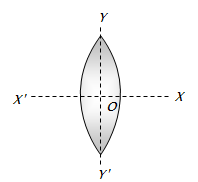
An equiconvex lens is cut into two halves along $\ce{(i) XOX¢}$ and $\ce{(ii) YOY¢}$ as shown in the figure. Let $\ce{f, f ¢, f ¢¢}$ be the focal lengths of the complete lens, of each half in case $(i),$ and of each half in case $(ii),$ respectively

Choose the correct statement from the following
Ionization energy of a hydrogen-like ion A is greater than that of another hydrogen-like ion $B.$ Let $r, u, E$ and $L$ represent the radius of the orbit, speed of the electron, energy of the atom and orbital angular momentum of the electron respectively. In ground state:
A double convex lens of focal length $20 \ cm$ is made of glass of refractive index $\frac{3}{2}.$ When placed completely in water $\left(\mathrm{a}^{\mu_{\mathrm{w}}=\frac{4}{3}}\right)$, its focal length will be