Question
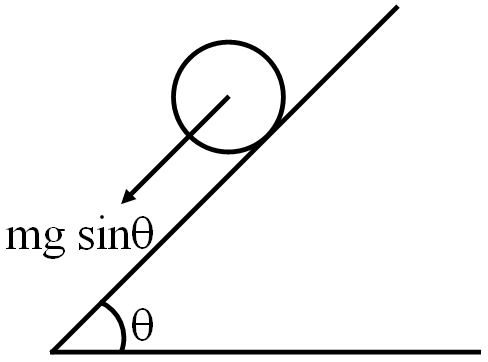
A sphere cannot roll on:
  1. A smooth horizontal surface.
  2. A smooth inclined surface.
  3. A rough horizontal surface.
  4. A rough inclined surface.

Answer

  1. A smooth horizontal surface.
  2. A smooth inclined surface.

Explanation:

A sphere cannot roll on a smooth inclined surface and on a smooth horizontal surface because there is no backward force (force of friction) to prevent its slipping.

Need a full question paper?

Generate a complete, print-ready paper with questions like this in minutes — across 16+ boards, with answer keys.

Start Generating Free

Similar questions

The wave equation is $y = 0.30\sin (314t - 1.57x)$ where $t, x$ and $y$ are in second, meter and centimeter respectively. The speed of the wave is ..... $m/s$
A rope of length $L$ is pulled by a constant force $F$. What is the tension in the rope at a distance $x$ from the end where the force is applied
Two astronauts are floating in gravitational free space after having lost contact with their spaceship. The two will 
A projectile of mass $M$ is fired so that the horizontal range is $4\, km$. At the highest point the projectile explodes in two parts of masses $M/4$ and $3M/4$ respectively and the heavier part starts falling down vertically with zero initial speed. The horizontal range (distance from point of firing) of the lighter part is .................. $\mathrm{km}$
If height of a satellite from the surface of earth is increased, then its
A charged particle moves in a gravity-free space without change in velocity. Which of the following is are possible:

  1. $\text{E}=0,\ \text{B}=0$

  2. $\text{E}=0,\ \text{B}\not=0$

  3. $\text{E}\not=0,\ \text{B}=0$

  4. $\text{E}\not=0,\ \text{B}\not=0$

An artillery piece of mass $M_1$ fires a shell of mass $\mathrm{M}_2$ horizontally. Instantaneously after the firing, the ratio of kinetic energy of the artillery and that of the shell is:
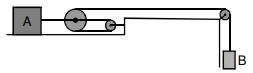
If block $A$ has a velocity of $0.6\,m / s$ to the right, determine the velocity of block $B$.
$Assertion$ : Centripetal and centrifugal forces cancel each other.
$Reason$ : Centrifugal force is a reaction of centripetal force
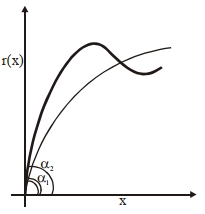
A projectile is launched from the origin in the $xy$ plane ( $x$ is the horizontal and $y$ is the vertically up direction) making an angle $\alpha$ from the $x$-axis. If its distance. $r =\sqrt{ x ^2+ y ^2}$ from the origin is plotted against $x$, the resulting curves show different behaviours for launch angles $\alpha_1$ and $\alpha_2$ as shown in the figure below. For $\alpha_1, r ( x )$ keeps increasing with $x$ while for $\alpha_2$, $r(x)$ increases and reaches a maximum, then decreases and goes through a minimum before increasing again. The switch between these two cases takes place at an angle $\alpha_c\left(\alpha_1 < \alpha_c < \alpha_2\right)$. The value of $\alpha_c$ is [ignore where $v_0$ is the initial speed of the projectile and $g$ is the acceleration due to gravity]