Question
A sphere is rolled on a rough horizontal surface. It gradually slows down and stops. The force of friction tries to:
  1. Decrease the linear velocity.
  2. Increase the angular velocity.
  3. Increase the linear momentum.
  4. Decrease the angular velocity.

Answer

  1. Decrease the linear velocity.
  2. Increase the angular velocity.
Explanation:
If a sphere is rolled on a rough horizontal surface, the force of friction tries to oppose the linear motion and favours the angular motion.

Need a full question paper?

Generate a complete, print-ready paper with questions like this in minutes — across 16+ boards, with answer keys.

Start Generating Free

Similar questions

A molecule with a dipole moment p is placed in an electric field of strength E. Initially the dipole is aligned parallel to the field. If the dipole is to be rotated to be anti-parallel to the field, the work required to be done by an external agency is(a) – 2pE(b) – pE(c) pE       (d) 2pE
       
As the temperature of hot junction of a thermo‑couple is increased (while cold junction is at constant temperature), the thermo e.m.f.(a) Increases uniformly at constant rate(b) Increases slowly in the beginning and more rapidly at higher temperatures(c) Increases more rapidly in the beginning but less rapidly at higher temperatures(d) In minimum at neutral temperature


Let $\vec{\text{F}}$ be a force acting on a particle having position vector $\vec{\text{r}}.$ Let $\vec{\tau}$ be the torque of this force about the origin, then:
  1. $\vec{\text{r}}.\vec{\text{F}}=0$ and $\vec{\text{F}}.\vec{\tau}=0$
  2. $\vec{\text{r}}.\vec{\tau}=0$ but $\vec{\text{F}}.\vec{\tau}\neq0$
  3. $\vec{\text{r}}.\vec{\tau}\neq0$ but $\vec{\text{F}}.\vec{\tau}=0$
  4. $\vec{\text{r}}.\vec{\tau}\neq0$ and $\vec{\text{F}}.\vec{\tau}\neq0$
Temperature above which a ferromagnetic substance becomes paramagnetic is called(a) Critical temperature(b) Boyle's temperature(c) Debye's temperature(d)  Curie temperature
   
   
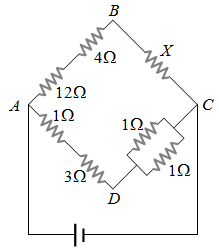
In the circuit shown in the adjoining figure, the current between $B$ and $D$ is zero, the unknown resistance is of
A convex lens makes a real image 4 cm long on a screen. When the lens is shifted to a new position without disturbing the object, we again get a real image on the screen which is 16 cm tall. The length of the object must be(a) 1/4 cm(b) 8 cm(c) 12 cm (d) 20 cm
       
Conventional flow of current will always be from:
In a Young’s double slit experiment, the slit separation is 1 mm and the screen is 1 m from the slit. For a monochromatic light of wavelength 500 nm, the distance of 3rd minima from the central maxima is (a) 0.50 mm(b) 1.25 mm(c) 1.50 mm(d) 1.75 mm
       
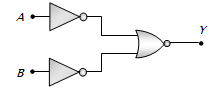
Which logic gate is represented by the following combination of logic gates
An ammeter whose resistance is 180 Ω gives full scale deflection when current is 2 mA. The shunt required to convert it into an ammeter reading 20 mA (in ohms) is(a) 18(b) 20(c) 0.1(d) 10