MCQ
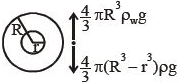
A sphere of solid material of relative density $9$ has a concentric spherical cavity and  floats having just sinked in water. If the radius of the sphere be $R$, then the radius of  the  cavity $(r)$ will be related to $R$ as :-
  • $r^3 = \frac{8}{9} R^3$
  • B
    $r^3 = \frac{2}{3} R^3$
  • C
    $r^3 = \frac{\sqrt 8}{3} R^3$
  • D
    $r^3 = \sqrt { \frac{2}{3}} R^3$

Answer

Correct option: A.
$r^3 = \frac{8}{9} R^3$
a
$\frac{4}{3} \pi\left(\mathrm{R}^{3}-\mathrm{r}^{3}\right) \rho \mathrm{g}=\frac{4}{3} \pi \mathrm{R}^{3} \rho_{\mathrm{w}} \mathrm{g}$

$9\left(R^{3}-r^{3}\right)=R^{3}$

$r^{3}=\frac{8 R^{3}}{9}$

Need a full question paper?

Generate a complete, print-ready paper with questions like this in minutes — across 16+ boards, with answer keys.

Start Generating Free

Similar questions

The equation $y = A{\cos ^2}\left( {2\pi \;nt - 2\pi \frac{x}{\lambda }} \right)$ represents a wave with
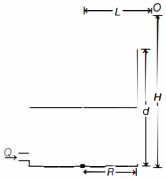
A small coin is fixed at the centre of the base of an empty cylindrical steel container having radius $R=1 \,m$ and height $d=4 \,m$. At time $t=0$, the container starts getting filled with water at a flowrate of $Q=0.1 \,m ^3 / s$ without disturbing the coin.the approximate time .............. $s$ when the coin will first be seen by the observer $O$ from the height of $H=5.75 \,m$ above and $L=1.5 \,m$ radially away from the coin as shown in the figure. (Take, refractive index of water, $n=1.33$ )
A large tank filled with water to a height ‘h’ is to be emptied through a small hole at the bottom. The ratio of time taken for the level of water to fall from $ h$  to $\frac{h}{2}$ and from $\frac{h}{2}$ to zero is
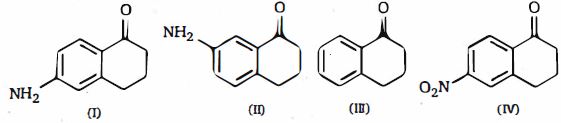
Increasing order of equilibrium constants for the formation of a hydrate
A particle is projected with a velocity ( $10\ m/s$ ) along $y-$ axis from point $(2, 3)$ . Magnetic field of $\left( {3\hat i + 4\hat j} \right)$ Tesla exist uniformly in the space. Its speed when particle passes through $y-$ axis for the third time is : (neglect gravity)
A wire of length $2\, m$ is made from $10\;c{m^3}$ of copper. A force $F$ is applied so that its length increases by $2\, mm.$ Another wire of length 8 m is made from the same volume of copper. If the force $F$ is applied to it, its length will increase by......... $cm$
Light of wavelength $6000\,\mathring A$ is incident on a slit of width $0.30\,mm$ . The screen is placed $2\,m$ from slit. Find position of the first minima
When ${U^{235}}$ is bombarded with one neutron, the fission occurs and the products are three neutrons, $_{36}K{r^{94}}$ and
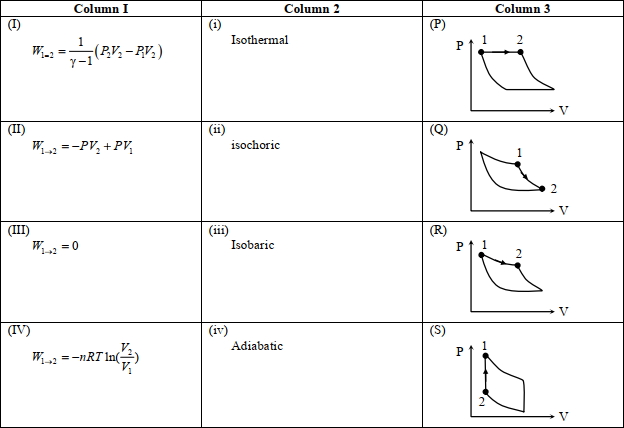
An ideal gas is undergoing a cyclic thermodynamic process in different ways as shown in the corresponding $P$ $V$ diagrams in column $3$ of the table. Consider only the path from state $1$ to $2 . W$ denotes the corresponding work done on the system. The equations and plots in the table have standard notations as used in thermodynamic processes. Here $\gamma$ is the ratio of heat capacities at constant pressure and constant volume. The number of moles in the gas is $n$.

(image)

($1$) Which of the following options is the only correct representation of a process in which $\Delta U=\Delta Q-P \Delta V$ ?

$[A] (II) (iv) (R)$    $[B] (II) (iii) (P)$    $[C] (II) (iii) (S)$   $[D] (III) (iii) (P)$

($2$)  Which one of the following options is the correct combination?

$[A] (III) (ii) (S)$    $[B] (II) (iv) (R)$   $[C] (II) (iv) (P)$   $[D] (IV) (ii) (S)$

($3$) Which one of the following options correctly represents a thermodynamic process that is used as a correction in the determination of the speed of sound in an ideal gas?

$[A] (III) (iv) (R)$  $[B] (I) (ii)$ $(\mathrm{Q})$   $[C] (IV) (ii) (R)$    $[D] (I) (iv) (Q)$
An achromatic prism is made by combining two prisms ${P_1}({\mu _v} = 1.523,\,{\mu _r} = 1.515)$ and ${P_2}({\mu _v} = 1.666,\,{\mu _r} = 1.650)$; where $\mu $ represents the refractive index. If the angle of the prism ${P_1}$ is $10^o $, then the angle of the prism $P_2$ will be.....$^o$