Question
A spherical ball of salt is dissolving in water in such a manner that the rate of decrease of the volume at any instant is propotional to the surface. Prove that the radius is decreasing at a constant rate.

Answer

We have, rate of decrease of the volume of spherical ball of salt at any instant is surface. Let the radius of the spherical ball of the salt be r.
$\therefore$ Volume of the ball $(\text{V})=\frac{4}{3}\pi\text{r}^3$
and surface area $(\text{S})=4\pi\text{r}^2$
$\because\ \frac{\text{dV}}{\text{dT}}\propto\text{S}$
$\Rightarrow\ \frac{\text{d}}{\text{dt}}\Big(\frac{4}{3}\pi\text{r}^3\Big)\propto4\pi\text{r}^2$
$\Rightarrow\ \frac{4}{3}\pi3\text{r}^2\frac{\text{dr}}{\text{dt}}\propto4\pi\text{r}^2$
$\Rightarrow\ \frac{\text{dr}}{\text{dt}}\propto\frac{4\pi\text{r}^2}{4\pi\text{r}^2}$
$\Rightarrow\ \frac{\text{dr}}{\text{dt}}=\text{k.1}$ [where, k is the proportionality constant]
$\Rightarrow\ \frac{\text{dr}}{\text{dt}}=\text{k}$
Hence, the radius of ball is decreasing at a constant rate.

Need a full question paper?

Generate a complete, print-ready paper with questions like this in minutes — across 16+ boards, with answer keys.

Start Generating Free

Similar questions

Read the following passage and answer the questions given below.

Image

The temperature of a person during an intestinal illness is given by $f(x)=-0.1 x^2+m x+98.6,0 \leq x \leq 12, \mathrm{~m}$ being a constant, where $\mathrm{f}(\mathrm{x})$ is the temperature in ${ }^{\circ} \mathrm{F}$ at $x$ days.

(i) Is the function differentiable in the interval $(0,12)$ ? Justify your answer.

(ii) If 6 is the critical point of the function, then find the value of the constant $\mathrm{m}$.

(iii) Find the intervals in which the function is strictly increasing/strictly decreasing.
OR
(iii) Find the points of local maximum/local minimum, if any, in the interval (0, 12) as well as the points of absolute maximum/absolute minimum in the interval [0, 12]. Also, find the corresponding local maximum/local minimum and the absolute maximum/absolute minimum values of the function.
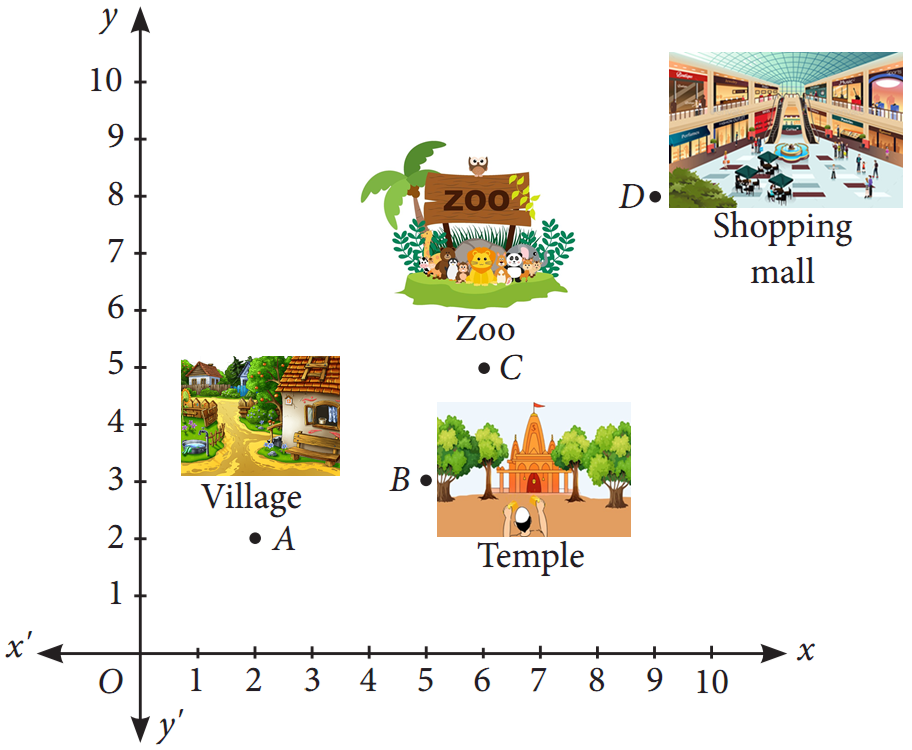
Ishaan left from his village on weekend. First, he travelled up to temple. After this, he left for the zoo. After this, he left for shopping in a mall. The positions of Jshaan at different places is given in the following graph.

Based on the above information, answer the following questions.
  1. Position vector of B is:
  1. $3\hat{\text{i}}+5\hat{\text{j}}$
  2. $5\hat{\text{i}}+3\hat{\text{j}}$
  3. $-5\hat{\text{i}}-3\hat{\text{j}}$
  4. $-5\hat{\text{i}}+3\hat{\text{j}}$
  1. Position vector of D is:
  1. $5\hat{\text{i}}+3\hat{\text{j}}$
  2. $3\hat{\text{i}}+5\hat{\text{j}}$
  3. $8\hat{\text{i}}+9\hat{\text{j}}$
  4. $9\hat{\text{i}}+8\hat{\text{j}}$
  1. Find the vector $\overline{\text{BC}}$ in terms of $\hat{\text{i}},\hat{\text{j}}.$
  1. $\hat{\text{i}}-2\hat{\text{j}}$
  2. $\hat{\text{i}}+2\hat{\text{j}}$
  3. $2\hat{\text{i}}+\hat{\text{j}}$
  4. $2\hat{\text{i}}-\hat{\text{j}}$
  1. Length of vector $\overline{\text{AB}}$ is:
  1. $\sqrt{67}\text{ units}$
  2. $\sqrt{85}\text{ units}$
  3. 90 units
  4. 100 units
  1. If $\vec{\text{M}}=4\hat{\text{j}}+3\hat{\text{k}},$ then its unit vector is:
  1. $\frac{4}{5}\hat{\text{j}}+\frac{3}{5}\hat{\text{k}}$
  2. $\frac{4}{5}\hat{\text{j}}-\frac{3}{5}\hat{\text{k}}$
  3. $-\frac{4}{5}\hat{\text{j}}+\frac{3}{5}\hat{\text{k}}$
  4. $-\frac{4}{5}\hat{\text{j}}-\frac{3}{5}\hat{\text{k}}$
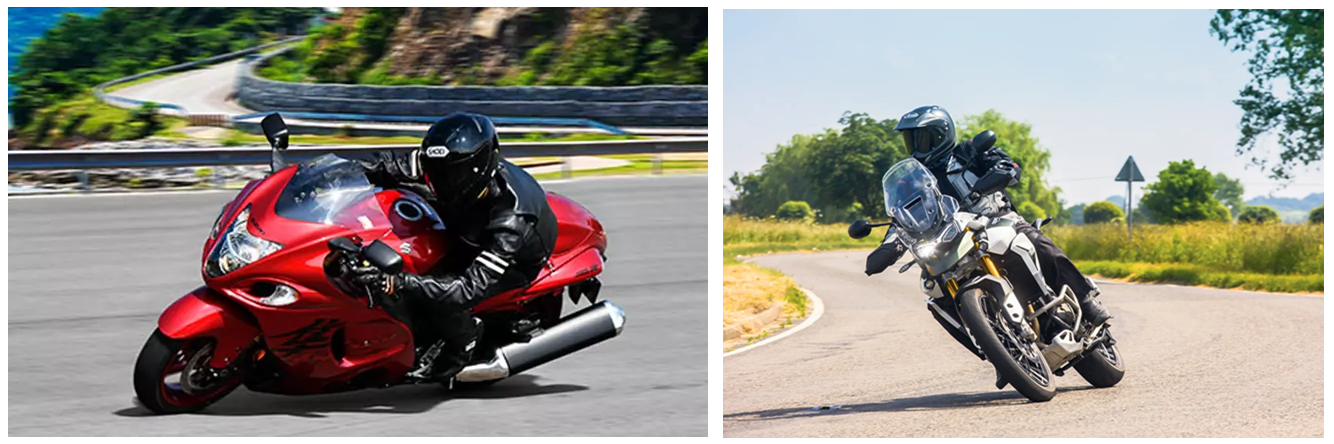
Two motorcycles A and Bare running at the speed more than allowed speed on the road along the lines $\vec{\text{r}}=\lambda(\hat{\text{i}}+2\hat{\text{j}}-\hat{\text{k}})$ and $\vec{\text{r}}=3\hat{\text{i}}+3\hat{\text{j}}+\mu(2\hat{\text{i}+\hat{\text{j}}+\hat{\text{k}}}),$ respectively. Based on the above information, answer the following questions.

  1. The cartesian equation of the line along which motorcycle A is running is:
  1. $\frac{\text{x}+1}{1}=\frac{\text{y}+1}{2}=\frac{\text{z}-1}{-1}$
  2. $\frac{\text{x}}{1}=\frac{\text{y}}{2}=\frac{\text{z}}{-1}$
  3. $\frac{\text{x}}{1}=\frac{\text{y}}{2}=\frac{\text{z}}{1}$
  4. None of these
  1. The direction cosines of line along which motorcycle A is running, are:
  1. < 1, -2, 1 >
  2. < I, 2, -1 >
  3. $<\frac{1}{\sqrt{6}},\frac{-2}{\sqrt{6}},\frac{1}{\sqrt{6}}>$
  4. $<\frac{1}{\sqrt{6}},\frac{2}{\sqrt{6}},\frac{-1}{\sqrt{6}}>$
  1. The direction ratios of line along which motorcycle Bis running, are:
  1. < 1, 0, 2 >
  2. < 2, 1, 0 >
  3. < 1, 1, 2 >
  4. < 2, 1, 1 >
  1. The shortest distance between the gives lines is:
  1. 4 units
  2. $2\sqrt{3}\text{ units}$
  3. $3\sqrt{2}\text{ units}$
  4. 0 units
  1. The motorcycles will meet with an accident at the point:
  1. (-1, 1, 2)
  2. (2, 1, -1)
  3. (1, 2, -1)
  4. Does not exist
Read the following text carefully and answer the questions that follow:
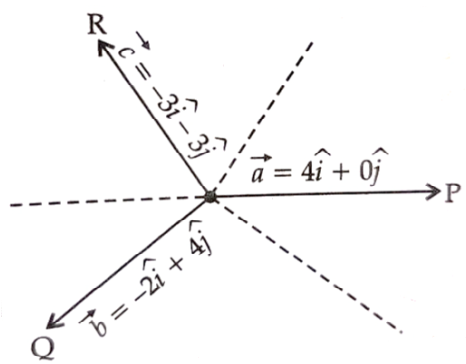
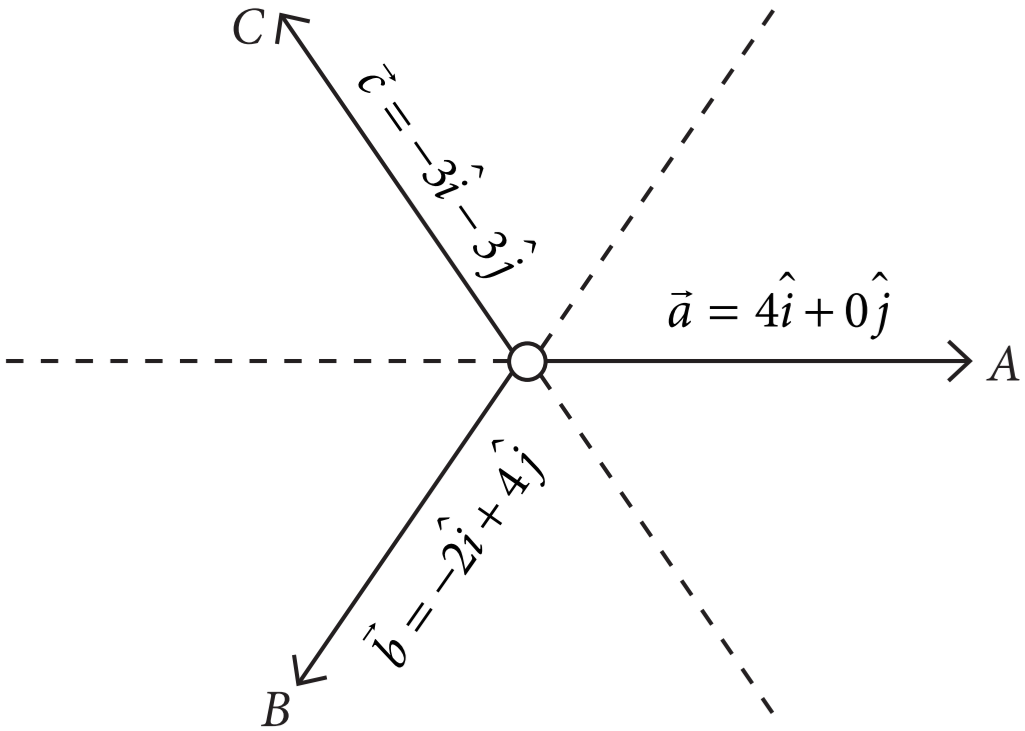
Team $P, Q, R$ went for playing a tug of war game. Teams $P, Q, R$ have attached a rope to a metal ring and is trying to pull the ring into their own areas $($team areas when in the given figure below$)$. Team $P$ pulls with force$F _1=4 \hat{i}+0 \hat{j} KN$
Team $Q$ pull with force $F _2=-2 \hat{i}+4 \hat{j} KN$
Team $R$ pulls with force $F _3=-3 \hat{i}-3 \hat{j} KN$
Image
$i$. What is the magnitude of the teams combined force? $(1)$
$ii$. Find the magnitude of Team $B. (1)$
$iii$. Which team will win the game? $(2)$
OR
Find the probability that she gets grade $A$ in at least one subject. $(2)$
A magazine company in a town has $5000$ subscribers on its list and collects fix charges of $₹\ 3000$ per year from each subscriber. 'The company proposes to increase the annual charges, and it is believed that for every increase of $₹\ 1$ one subscriber will discontinue service.

Based on the above information, answer the following questions.
  1. If $x$ denote the amount of increase in annual charges, then revenue $R,$ as a function of $x$ can be represented as.
  1. $R(x) = 3000 × 5000 × x$
  2. $R(x) = (3000 - 2x)(5000 + 2x)$
  3. $R(x) = (5000 + x)(3000 - x)$
  4. $R(x) = (3000 + x)(5000 - x)$
  1. If magazine company increases $₹\ 500$ as annual charges, then $R$ is equal to.
  1. $₹\ 15750000$
  2. $₹\ 16750000$
  3. $₹\ 17500000$
  4. $₹\ 15000000$
  1. If revenue collected by the magazine company is $₹\ 15640000$, then value of amount increased as annual charges for each subscriber, is.
  1. $400$
  2. $1600$
  3. Both $(a)$ and $(b)$
  4. None of these
  1. What amount of increase in annual charges will bring maximum revenue?
  1. $₹\ 1000$
  2. $₹\ 2000$
  3. $₹\ 3000$
  4. $₹\ 4000$
  1. Maximum revenue is equal to.
  1. $₹\ 15000000$
  2. $₹\ 16000000$
  3. $₹\ 20500000$
  4. $₹\ 25000000$
Teams A, B, Cwent for playing a tug of war game. Teams A, B, C have attached a rope to a metal ring and is trying to pull the ring into their own area ( team areas shown below).
Team A pulls with force $\text{F}_1=4\hat{\text{i}}+0\hat{\text{j}}\text{KN}$
Team $\text{B}\rightarrow\text{F}_2=-2\hat{\text{i}}+4\hat{\text{j}}\text{KN}$
Team $\text{C}\rightarrow\text{F}_3=-3\hat{\text{i}}+3\hat{\text{j}}\text{KN}$

Based on the above information, answer the following questions.
  1. Which team will win the game?
  1. Team B
  2. Team A
  3. Team C
  4. No one
  1. What is the magnitude of the teams combined force?
  1. 7KN
  2. 1.4KN
  3. 1.5KN
  4. 2KN
  1. In what direction is the ring getting pulled?
  1. 2.0 radian
  2. 2.5 radian
  3. 2.4 radian
  4. 3 radian
  1. What is the magnitude of the force of Team B?
  1. $2\sqrt{5}\text{KN}$
  2. 6 KN
  3. 2 KN
  4. $\sqrt{6}\text{KN}$
  1. How many KN force is applied by Team A?
  1. 5KN
  2. 4KN
  3. 2KN
  4. 16KN
In a murder investigation, a corpse was found by a detective at exactly $8$ p.m. Being alert, the detective measured the body temperature and found it to be $70^\circ F$ Two hours later, the detective measured the body temperature again and found it to be $60^\circ F,$ where the room temperature is $50^\circ F$ Also, it is given the body temperature at the time of death was normal, i.e., $98.6^\circ F.$
Let $T$ be the temperature of the body at any time t and initial time is taken to be $8$ p.m.

Based on the above information, answer the following questions.
  1. By Newton's law of cooling, $\frac{\text{dT}}{\text{dt}}$ is proportional to:
  1. $T - 60$
  2. $T - 50$
  3. $T - 70$
  4. $T - 98.6$
  1. When $t = 0,$ then body temperature is equal to:
  1. $50^\circ F$
  2. $60^\circ F$
  3. $70^\circ F$
  4. $98.6^\circ F$
  1. When $t = 2,$ then body temperature is equal to:
  1. $50^\circ F$
  2. $60^\circ F$
  3. $70^\circ F$
  4. $98.6^\circ F$
  1. The value of T at any time t is:
  1. $50+20\Big(\frac{1}{2}\Big)^\text{t}$
  2. $50+20\Big(\frac{1}{2}\Big)^\text{t-1}$
  3. $50+20\Big(\frac{1}{2}\Big)^\frac{\text{t}}{2}$
  4. None of these
  1. If it is given that $\log_\text{e} (2.43) = 0.88789$ and $\log_\text{e} (0.5) = -0.69315,$ then the time at which the murder occur is:
  1. $7:30$ p.m.
  2. $5:30$ p.m.
  3. $6:00$ p.m.
  4. $5:00$ p.m.
Read the following text carefully and answer the questions that follow:
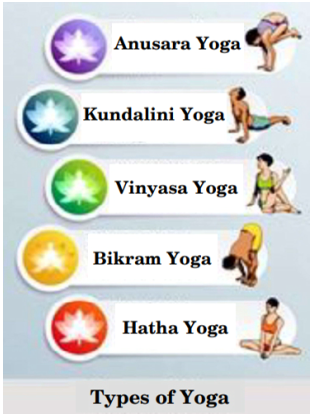
There are different types of Yoga which involve the usage of different poses of Yoga Asanas, Meditation and Pranayam as shown in the figure below:
Image
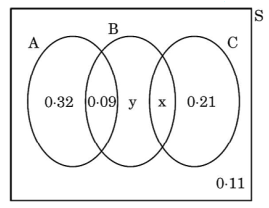
The Venn diagram below represents the probabilities of three different types of Yoga,$ A, B$ and $C$ performed by the people of a society. Further, it is given that probability of a member performing type $C$ Yoga is$ 0.44.$
Image
$i$. Find the value of $x. (1)$
$ii$. Find the value of $y. (1)$
$iii$. Find $P \left(\frac{ C }{ B }\right)$.
OR
Find the probability that a randomly selected person of the society does Yoga of type $A$ or $B$ but not $C.\  (2)$
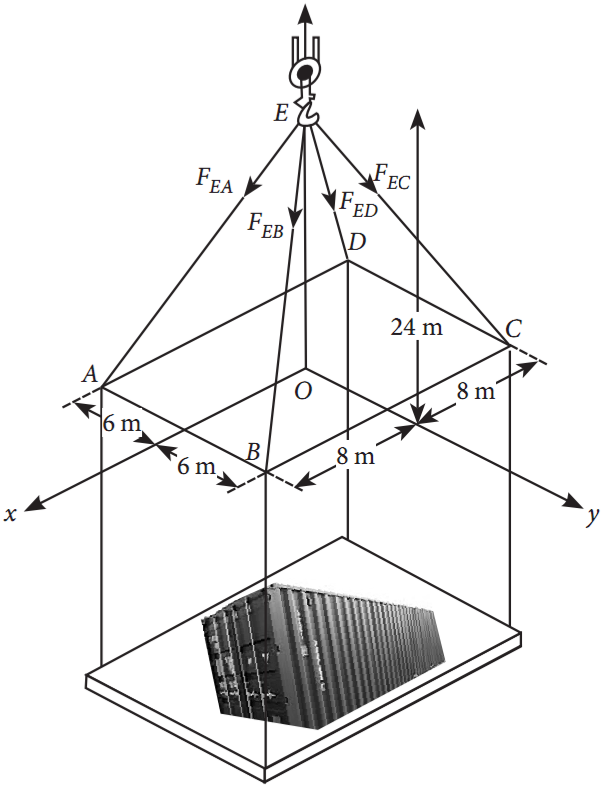
Consider the following diagram, where the forces in the cable are given. Based on the above information, answer the following questions.
  1. The cartesian equation of line along EA is:
  1. $\frac{\text{x}}{-4}=\frac{\text{y}}{3}=\frac{\text{z}}{12}$
  2. $\frac{\text{x}}{-4}=\frac{\text{y}}{3}=\frac{\text{z}-24}{12}$
  3. $\frac{\text{x}}{-3}=\frac{\text{y}}{3}=\frac{\text{z}-12}{12}$
  4. $\frac{\text{x}}{3}=\frac{\text{y}}{4}=\frac{\text{z}-24}{12}$
  1. The vector $\overline{\text{ED}}$ is:
  1. $8\hat{\text{i}}-6\hat{\text{j}}+24\hat{\text{k}}$
  2. $-8\hat{\text{i}}-6\hat{\text{j}}+24\hat{\text{k}}$
  3. $-8\hat{\text{i}}-6\hat{\text{j}}-24\hat{\text{k}}$
  4. $8\hat{\text{i}}+6\hat{\text{j}}+24\hat{\text{k}}$
  1. The length of the cable EB is:
  1. 24 units
  2. 26 units
  3. 27 units
  4. 25 units
  1. The length of cable EC is equal to the length of:
  1. EA
  2. EB
  3. ED
  4. All of these
  1. The sum of all vectors along the cables is:
  1. $96\hat{\text{i}}$
  2. $96\hat{\text{j}}$
  3. $-96\hat{\text{k}}$
  4. $96\hat{\text{k}}$
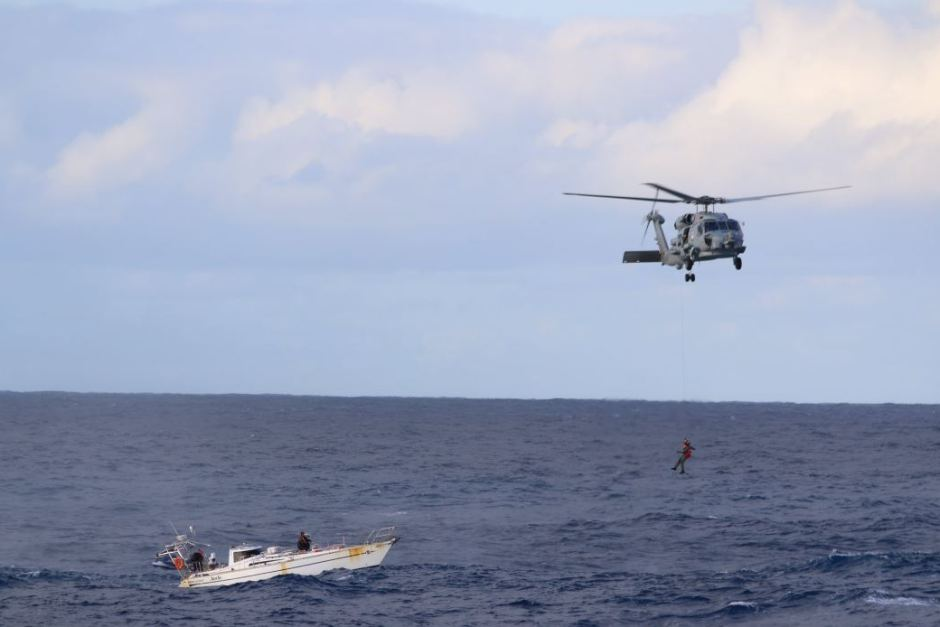
The Indian Coast Guard (ICG) while patrolling, saw a suspicious boat with four men. They were nowhere looking like fishermen. The soldiers were closely observing the movement of the boat for an opportunity to seize the boat. They observe that the boat is moving along a planar surface. At an instant of time, the coordinates of the position of coast guard helicopter and boat are (2, 3, 5) and (1, 4, 2) respectively. Based on the above information, answer the following questions.
  1. If the line joining the positions of the helicopter and boat is perpendicular to the plane in which boat moves, then equation of plane is:
  1. x - y + 3z = 2
  2. x + y + 3z = 2
  3. x - y + 3z = 3
  4. x + y + 3z = 3
  1. If the soldier decides to shoot the boat at given instant of time, where the distance measured in metres then what is the distance that bullet has to travel?
  1. $\sqrt{5}\text{m}$
  2. $\sqrt{8}\text{m}$
  3. $\sqrt{10}\text{m}$
  4. $\sqrt{11}\text{m}$
  1. If the speed of bullet is 30m/ sec, then how much time will the bullet take to hit the boat after the shot is fired?
  1. 30 seconds
  2. 1 second
  3. $\frac{1}{2}\text{second}$
  4. $\frac{\sqrt{11}}{30}\text{seconds}$
  1. At the given instant of time, the equation of line passing through the positions of helicopter and boat is:
  1. $\frac{\text{x}}{1}=\frac{\text{y}}{-1}=\frac{\text{z}}{3}$
  2. $\frac{\text{x}-1}{1}=\frac{\text{y}-4}{-1}=\frac{\text{z}-2}{3}$
  3. $\frac{\text{x}}{1}=\frac{\text{y}}{1}=\frac{\text{z}}{-3}$
  4. $\frac{\text{x}-1}{1}=\frac{\text{y}-4}{1}=\frac{\text{z}-2}{-3}$
  1. At a different instant of time, the boat moves to a different position along the planar surface. What should be the coordinates of the location of the boat for the bullet to hit the boat if soldier shoots the bullet along the line whose equation is $\frac{\text{x}-1}{1}=\frac{\text{y}-1}{-2}=\frac{\text{z}-2}{3}?$
  1. $\Big(\frac{1}{2},\frac{1}{2},\frac{1}{2}\Big)$
  2. $\Big(\frac{3}{4},\frac{3}{2},\frac{5}{4}\Big)$
  3. $\Big(\frac{1}{3},\frac{1}{4},\frac{1}{5}\Big)$
  4. None of these