Question
A spherical shell made of plastic, contains a charge Q distributed uniformly over its surface. What is the electric field inside the shell? If the shell is hammered to deshape it without altering the charge, will the field inside be changed? What happens if the shell is made of a metal?
Answer

As the shell is made of plastic, it is non-conducting. But as the charge is distributed uniformly over the surface of the shell, the sum of all the electric field vectors at the centre due to this kind of distribution is zero. But when the plastic shell is deformed, the distribution of charge on it becomes non-uniform. In other words, the sum of all the electric field vectors is non-zero now or the electric field exists at the centre now.
In case of a deformed conductor, the field inside is always zero.

Need a full question paper?

Generate a complete, print-ready paper with questions like this in minutes — across 16+ boards, with answer keys.

Start Generating Free

Similar questions

Compare the properties of soft iron and steel.
A closely wound solenoid of 2000 turns and area of cross-section 1.6 × 10–4 m2, carrying a current of 4.0 A, is suspended through its centre allowing it to turn in a horizontal plane.
  1. What is the magnetic moment associated with the solenoid?
  2. What is the force and torque on the solenoid if a uniform horizontal magnetic field of 7.5 × 10–2 T is set up at an angle of 30º with the axis of the solenoid?
(a) When a telescope is turned upside down and looked at the objective, it appears very small, why?
(b) Why does this not happen in a microscope?
(I) Draw the energy band diagram for P-type semiconductor at (i) T=0K and (ii) room temperature.
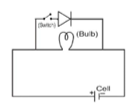
(II) In the given diagram considering an ideal diode, in which condition will the bulb glow
(a) when the switch is open
(b) when the switch is closed
Justify your answer.

Image
In a Coolidge tube, electrons strike the target and stop inside it. Does the target get more and more negatively charged as time passes?
Prove that, if an insulated, uncharged conductor is placed near a charged conductor and no other conductors are present, the uncharged body must be intermediate in potential between that of the charged body and that of infinity.
Define coefficient of mutual induction i.e. mutual inductance.
When the current in a primary coil is changed from zero to 2.0 A within 300 ms, then an induced emf of a 0.80 volt is produced in secondary coil. Calculate coefficient of mutual inductance between the two coils.
  1. Three resistors $2\ \Omega,\ 4\ \Omega\ \text{and}\ 5\ \Omega$ are combined in parallel. What is the total resistance of the combination?
  2. If the combination is connected to a battery of emf 20 V and negligible internal resistance, determine the current through each resistor, and the total current drawn from the battery.
A 12 pF capacitor is connected to a 50 V battery. How much electrostatic energy is stored in the capacitor? If another capacitor of 6 pF is connected in series with it with the same battery connected across the combination, find the charge stored and potential difference across each capacitor.
Prove that the force acting on a current-carrying wire, joining two fixed points a and b in a uniform magnetic field, is independent of the shape of the wire.