Question
A spring compressed by 0.1m develops a restoring force 10N. A body of mass 4kg placed on it. Deduce
  1. The force constant of the spring.
  2. The depression of the spring under the weight of the body(take g = 10 N/ kg).
  3. The period of oscillation, the body is distributed and.
  4. Frequency of oscillation.

Answer

Here,$\text{F}=10\text{N}$$\Delta\text{l}=0.1\text{m}$
$\text{m}=4\text{kg}$
  1. $\text{k}=\frac{\text{F}}{\Delta\text{l}}$
$=\frac{10}{0.1}=100\text{Nm}^{-1}$
  1. $\text{y}=\frac{\text{mg}}{\text{k}}$
$=\frac{4\times10}{100}=0.4\text{m}$
  1. $\text{T}=2\pi\sqrt{\frac{\text{m}}{\text{k}}}$
$=2\times\frac{22}{7}\sqrt{\frac{4}{100}}$
$=1.26\text{s}$
  1. Frequency. $\text{v}=\frac{1}{\text{T}}$
$=\frac{1}{1.26}=0.8\text{Hz}$

Need a full question paper?

Generate a complete, print-ready paper with questions like this in minutes — across 16+ boards, with answer keys.

Start Generating Free

Similar questions

Two identical balls, each having a charge of $2.00 \times 10^{-7}C$ and a mass of $100g$, are suspended from a common point by two insulating strings each 50cm long. The balls are held at a separation 5.0cm apart and then released. Find,
  1. The electric force on one of the charged balls.
  2. The components of the resultant force on it along and perpendicular to the string.
  3. The tension in the string.
  4. The acceleration of one of the balls. Answers are to be obtained only for the instant just after the release.
What is meant by thermal radiation? What is the nature of thermal radiation? Explain.
A spherical ball A of surface area $20cm^2$ is kept at the centre of a hollow spherical shell B of area $80cm^2$. The surface of A and the inner surface of B emit as blackbodies. Both A and B are at $300K$.
  1. How much is the radiation energy emitted per second by the ball A?
  2. How much is the radiation energy emitted per second by the inner surface of B
  3. How much of the energy emitted by the inner surface of B falls back on this surface itself?
When a p-n junction is reverse-biased, the current becomes almost constant at $25\mu\text{A}.$ When it is forwardbiased at 200mV, a current of $75\mu\text{A}$ is obtained. Find the magnitude of diffusion current when the diode is,
  1. Unbiased.
  2. Reverse-biased at 200mV.
  3. Forward-biased at 200mV.
How many is energy states are present in one mole of sodium vapour? Are they all filled in normal conditions? "How many 3s energy states are present in one mole of sodium vapour? Are they all filled in normal conditions?
Two objects of masses $m_1$ and $m_2$ are moving with velocities $u_1$ and $u_2$ respectively collide in an inelastic collision. If after the collision both the objects move together then calculate the change in the value of energy
  1. What is the largest average velocity of blood flow in an artery of radius $2 \times 10 – 3m$ if the flow must remain lanimar?
  2. What is the corresponding flow rate ? (Take viscosity of blood to be $2.084 \times 10–3 Pa/ s$).
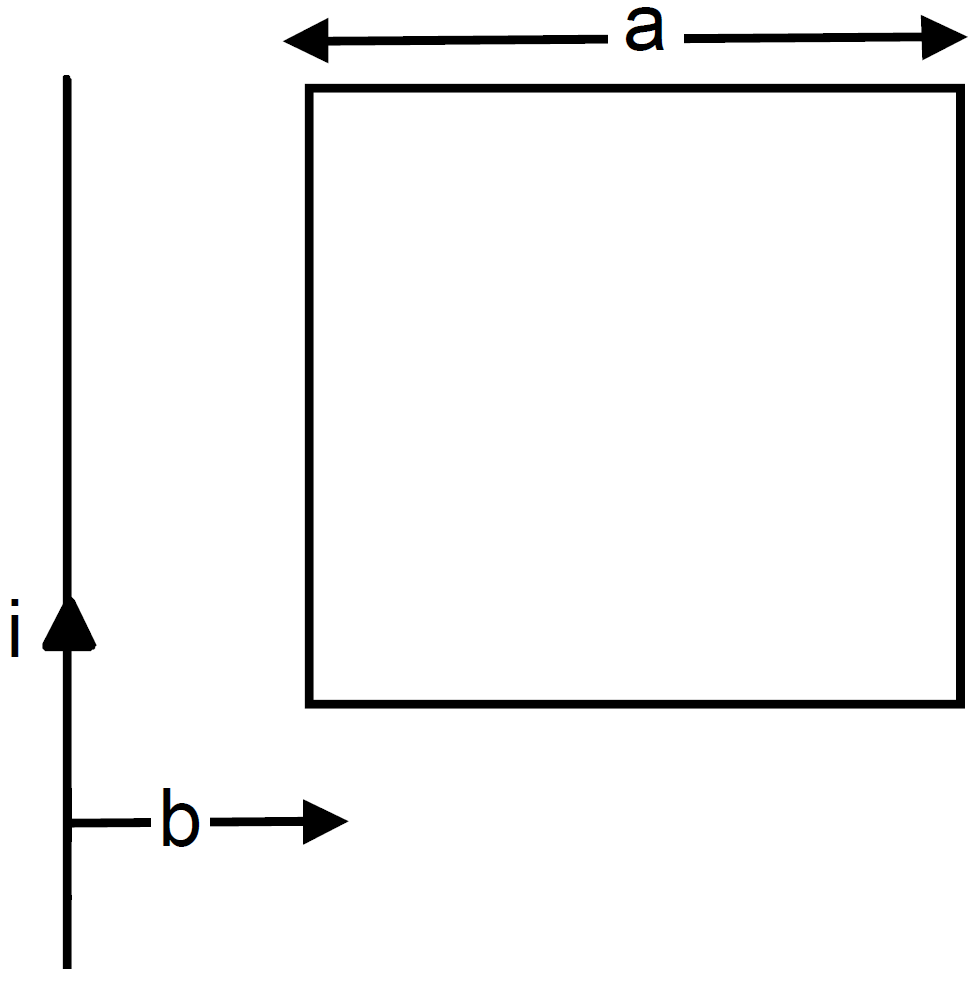
Find the mutual inductance between the straight wire and the square loop of figure.
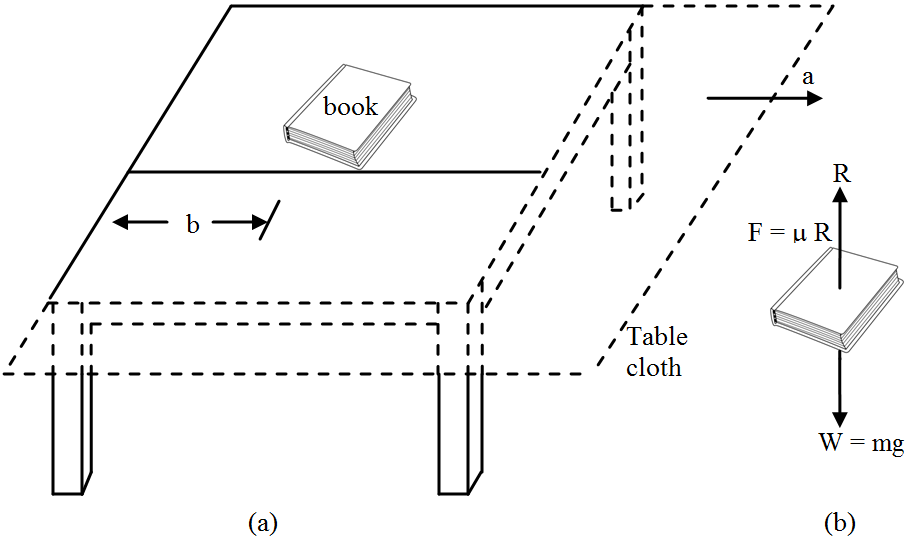
A book rests on a table cloth spread over a table as shown in Fig. The centre of the book is at a distance of b from the edge of the table at time t = 0; the table cloth is suddenly pulled at this instant with an acceleration a. Show that the cloth will slip from under the book if a > µ g, where u is the coefficient of sliding friction between the table cloth and the book. Assuming this condition to be satisfied. calculate:
  1. Time instant.
  2. The velocity.
  3. The distance of the centre of the book from the edge of the table when the edge of the table cloth passes over the centre of the book.
Prove that when the vector sum of all external forces acting on a system is zero, then the center of mass remains constant.