Question
A spring compressed by 0.1m develops a restoring force 10N. A body of mass 4kg placed on it. Deduce
  1. The force constant of the spring.
  2. The depression of the spring under the weight of the body(take g = 10 N/ kg).
  3. The period of oscillation, the body is distributed and.
  4. Frequency of oscillation.

Answer

Here,$\text{F}=10\text{N}$

$\Delta\text{l}=0.1\text{m}$

$\text{m}=4\text{kg}$

  1. $\text{k}=\frac{\text{F}}{\Delta\text{l}}$

$=\frac{10}{0.1}=100\text{Nm}^{-1}$

  1. $\text{y}=\frac{\text{mg}}{\text{k}}$

$=\frac{4\times10}{100}=0.4\text{m}$

  1. $\text{T}=2\pi\sqrt{\frac{\text{m}}{\text{k}}}$

$=2\times\frac{22}{7}\sqrt{\frac{4}{100}}$

$=1.26\text{s}$

  1. Frequency. $\text{v}=\frac{1}{\text{T}}$

$=\frac{1}{1.26}=0.8\text{Hz}$

Need a full question paper?

Generate a complete, print-ready paper with questions like this in minutes — across 16+ boards, with answer keys.

Start Generating Free

Similar questions

Compute the volume in m3 of a life preserver of SG 0.20, which, when worn by a boy weighing 60kg and having SG equal to 0.9, will just support him, if $\frac32$ of his body is submerged in freshwater of density 1000kg m-3. Assume that the life preserver is completely submerged.
Consider the situation of the previous problem. If $1.0\mu\text{C}$ is placed on the upper plate instead of the middle, what will be the potential difference between:
  1. The upper and the middle plates?
  2. The middle and the lower plates?
Consider that an ideal gas (n moles) is expanding in a process given by P = f( V ), which passes through a point (V0, P0 ). Show that the gas is absorbing heat at (P0, V0 ) if the slope of the curve P = f(V ) is larger than the slope of the adiabat passing through (P0, V0 ).
When a dielectric is placed in an electric field, it gets polarized. The electric field in a polarized material is less than the applied field. When a paramagnetic substance is kept in a magnetic field, the field in the substance is more than the applied field. Explain the reason of this opposite behaviour.
For the motion of a body due to external force, prove that its entire mass can be considered concentrated at the center of mass.
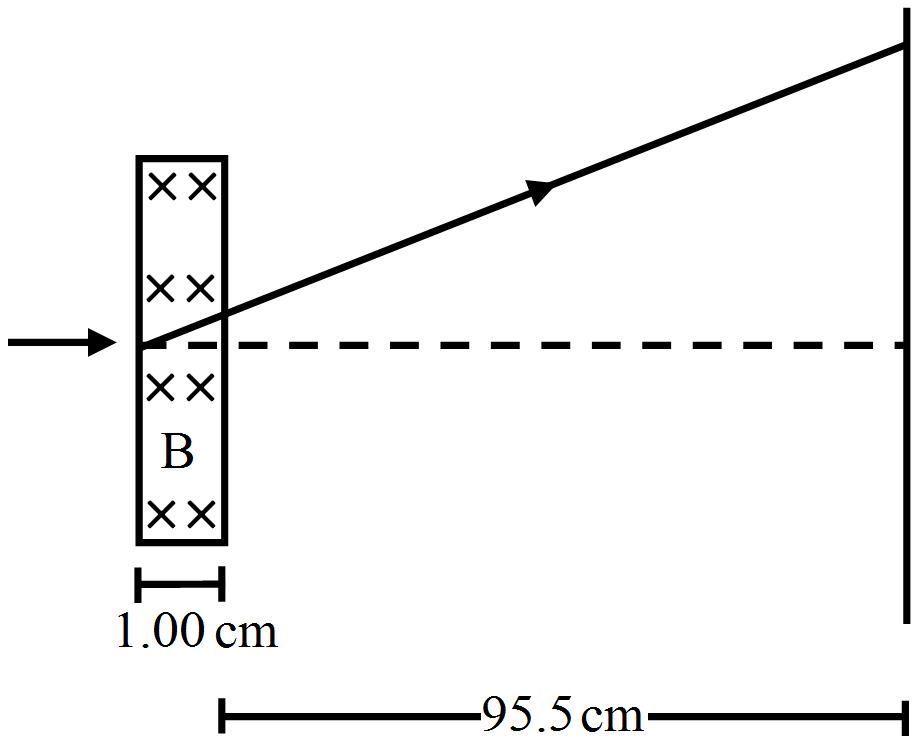
A narrow beam of singly charged potassium ions of kinetic energy 32keV is injected into a region of width 1.00cm with a magnetic field of strength 0.500T, as shown in the figure. The ions are collected at a screen 95.5cm away from the field region. If the beam contains isotopes of atomic weights 39 and 41, find the separation between the points where these isotopes strike the screen. Take the mass of a potassium ion = A (1.6 × 10⁻²⁷)kg, where A is the mass number.

Suppose a hole was drilled completely through the earth along a diameter. Show that the force on a mass m at a distance r from the centre of the earth is $ \text{F}= \frac{-\text{mgr}}{\text{R}}$ assuming that the density of the earth is uniform.
A magnetic field of $(4.0\times10^{-3}\vec{\text{k}})$ T exerts a force of $(4.0\vec{\text{i}}+3.0\vec{\text{j}})\times10^{-10}$ N on a particle with a charge of $1.0\times10^{-9}\text{C}$ and going in the x−y plane. Find the velocity of the particle.
Two objects of masses $m_1$ and $m_2$ are moving with velocities $u_1$ and $u_2$ respectively collide in an inelastic collision. If after the collision both the objects move together then calculate the change in the value of energy
A mass is dropped from a height h on to a floor with coefficient of restitution 'e'. Find
  1. The height to which, it will go after n collisions.
  2. The velocity after 'n' collisions with the floor.
  3. The time taken till the nth collision.