MCQ
A spring has a certain mass suspended from it and its period for vertical oscillation is $T$. The spring is now cut into two equal halves and the same mass is suspended from one of the halves. The period of vertical oscillation is now
  • A
    $\frac{T}{2}$
  • $\frac{T}{\sqrt{2}}$
  • C
    $\sqrt{2}T$
  • D
    $2T$

Answer

Correct option: B.
$\frac{T}{\sqrt{2}}$
b
(b) $T = 2\pi \sqrt {\frac{m}{k}} $. 

Also spring constant $(k) \propto \frac{1}{{{\rm{Length (}}L)}}$, when the spring is half in length, then $k$ becomes twice. 

$\therefore T' = 2\pi \sqrt {\frac{m}{{2k}}} $

$\Rightarrow \frac{{T'}}{T} = \frac{1}{{\sqrt 2 }} $

$\Rightarrow T' = \frac{T}{{\sqrt 2 }}$

Need a full question paper?

Generate a complete, print-ready paper with questions like this in minutes — across 16+ boards, with answer keys.

Start Generating Free

Similar questions

A wire can sustain the weight of 20kg before breaking. If the wire is cut into two equal parts, each part can sustain a weight of.
Two adjacent sides of a parallelogram are represented by the two vectors $\hat i + 2\hat j + 3\hat k$ and $3\hat i - 2\hat j + \hat k$. What is the area of parallelogram
The work done in blowing a soap bubble of $10\, cm$ radius is (Surface tension of the soap solution is $\frac{3}{{100}}N/m$)
A thin rod of length $L$ and mass $M$ is held vertically with one end on the floor and is allowed to fall. Find the velocity of the other end when it hits the floor, assuming that the end on the floor does not slip
Three particles of equal mass $m$ are situated at the vertices of an equilateral triangle of side $l$. They are moving in a circle in influence of their mutual gravitational interaction. Then their time period of revolution is directly proportional to
Acceleration of a particle changes when
Equation of motion of a body is $\frac{d v}{d t}=-4 v+8$, where $v$ is the velocity in $m / s$ and $t$ is the time in second. Initial velocity of the particle was zero. Then,
The waves in which the particles of the medium vibrate in a direction perpendicular to the direction of wave motion is known as
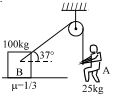
Block $B$ of mass $100 kg$ rests on a rough surface of friction coefficient $\mu = 1/3$. $A$ rope is tied to block $B$ as shown in figure. The maximum acceleration with which boy $A$ of $25 kg$ can climbs on rope without making block move is:
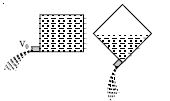
A cubical box of wine has a small spout located in one of the bottom corners. When the box is full and placed on a level surface, opening the spout results in a flow of wine with a initial speed of $v_0$ (see figure). When the box is half empty, someone tilts it at $45^o $ so that the spout is at the lowest point (see figure). When the spout is opened the wine will flow out with a speed of